
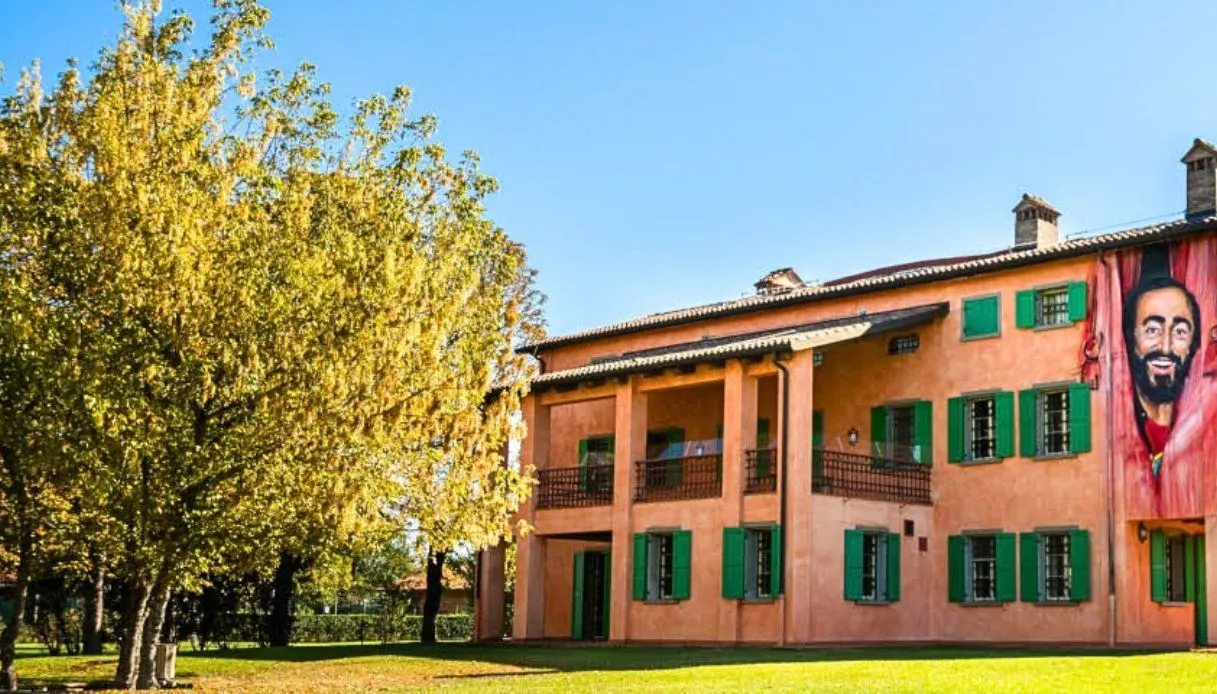
A Steinway piano, rooms bathed in vivid colors, photographs, memories, and objects that tell a life spent between stages around the world and the people who mattered most: in the Modenese countryside, the Luciano Pavarotti House Museum opens the doors to the home the renowned tenor chose to build within a large estate, a place to spend time with family, welcome friends, and transmit his passion to young singers.
Here the Maestro lived his last years with his wife Nicoletta and daughter Alice, in an environment that fully reflected his personality and his interests. Open to the public in 2015, the residence preserves the original furnishings and offers a close-up view not only of the artist acclaimed in the most prestigious theaters, but also of the man tied to his homeland, to the small everyday joys, and to conviviality.
What to see at the Pavarotti House Museum
The visit begins in the Main Salon, where Pavarotti spent much of his days sharing meals, playing cards, and meeting friends: the vibrant colors, natural wood, and exposed beams convey his cheerful and hospitable personality. What catches the eye is the Steinway piano, used also to listen to the young talents whom the Maestro gave free lessons. Nearby lie the concert tailcoat and the famous white handkerchief, evoking his performances, while letters, paintings, and small personal objects reveal the more intimate side of his life.
In the room called “The Joy of Living” another passion emerges: painting. Pavarotti produced vivid works, signed under the pseudonym “LUPA”; floral shirts, scarves, and items linked to leisure complete an intimate and surprising portrait.
The journey continues to the “Window to the World,” lit by a large skylight the tenor had installed to let in the sun’s rays: here are displayed some of the more than 500 awards and recognitions earned throughout his career, including Grammy and Emmy Awards, together with gold and platinum records.
The path then leads to the bedroom, perhaps the most moving space: Pavarotti spent his last days there and died on September 6, 2007. In the wardrobe, hats and scarves have become part of his image.
The three rooms dedicated to opera retrace an extraordinary career that began in 1961 with his debut as Rodolfo in Puccini’s La Bohème: the stage costumes recall some of the 29 roles he interpreted, while photographs and testimonies recall the great international theaters.
On the top floor, a bright open space gathers images and portraits of Pavarotti alongside other famous figures; a room reserved for small groups also allows visitors to watch unseen video recordings of rehearsals and behind-the-scenes moments.
In the Decca room one can listen to his most famous arias in remastered recordings, while the tributes from fans from every corner of the world testify to a love without borders.
The visit also recalls the famous charity concerts Pavarotti & Friends and ends in the bookshop, housed in the playhouse that the tenor had built for Alice: a final detail that speaks, besides artistic greatness, of the tenderness of family life.
Christmas 2026 at the Pavarotti House Museum: visit and Emilian flavors
The estate will also be the stage for a holiday event: Sunday, November 29, 2026, the Ristorante Europa 92 will host the traditional AIS Emilia Christmas Lunch, open to both members and non-members.
The day will begin at 11:00 with a guided tour of the House Museum, included in the participation fee, to retrace the Maestro’s life and passions through photographs, testimonies, and personal objects. At 13:00 lunch will be served, with wines selected by the sommeliers and Emilian specialties. The welcome includes two Franciacorta from the Muratori winery, the Dosaggio Zero Blanc de Blancs Numerozero and the Franciacorta Brut in Magnum, followed by a buffet on an imperial table with fried gnocchi and regional products.
The menu then features tortellini in capon broth, rosemary-seasoned beef with roasted potatoes, and zuppa inglese, with wine pairings arranged for each course.
Booking is open on the AIS Emilia website: by November 15 the price is 77 euros for members and 85 for non-members, then 85 and 95 euros respectively.
Where it is and how to reach it
The House Museum is located at Stradello Nava 6, in Modena, in the countryside to the south of the city.
From the A1 Modena Sud motorway exit, follow Strada Vignolese/SP623, Strada Gherbella, and via Bellaria/SS12 to Stradello Nava, for an approximate 13-minute drive.
From the A1 Modena Nord exit, take the Tangenziale Nord and the Sassuolo branch, exit 20, and continue on via Bellaria to the destination, about 12 minutes.
Those departing from central Modena or the train station can opt for a taxi: the fare is capped at 20 euros one-way and 30 euros for the return. In front of the museum there is also a large, non-covered parking area.
Hours, tickets, and useful information for the visit
The House Museum is open daily from 10:00 to 18:00, with the last entry at 17:00, and it is closed on January 1 and on December 24–25; the visit lasts on average 50–60 minutes.
A full-price ticket costs 12 euros, a reduced ticket 10 euros, while children under 12 enter for free. The reduced rate is available, among others, for seniors over 65, youths aged 12–18, university students, and eligible categories. The price includes an audio guide, available in eight languages, including Italian, English, French, and German. All four floors of the route are accessible by elevator.
Tickets can be purchased on-site at the facility or online via the official website of the Luciano Pavarotti House Museum.
