
There are people who simply cannot stop bathing. And when the summer ends and the beaches empty out, the choice remains to turn to one of the hidden treasures of the Italian territory, always rich in surprises and beauty: free outdoor thermal springs, namely sources of hot water that gush from deep within the earth and that, beyond being a pleasure, are also a remedy that nature offers us.
Autumn and winter are the best seasons to discover them: who would think of immersing in a pool at temperatures above 35°C on days when the fiercest heat of summer is raging; yet no one minds the idea of slipping into a hot bath while the cheeks tingle from the crisp outdoor air. Their free and thus accessible nature is another commendable aspect: a democratic natural resource, open to everyone, to enjoy the wonders of the territory even during the autumn months.
Leonardo’s Pool, Bormio
We begin in the Alps, at an altitude of more than a thousand meters, to experience the thrill of soaking as the cold reddens the cheeks outside.
A short stroll of about half a kilometer, just beyond Bormio in the forest near the Bagni Vecchi, leads to a small cove along the Braulio stream, where the thermal water arrives: this is the Pozza di Leonardo.
We are talking about that Leonardo: it is said that Leonardo da Vinci himself inscribed in his Atlantico Codex some references to this small, enchanting natural spot, although the connection to the pool is more traditional than documented.
The water sits at around 36 degrees and the pools, when observed carefully, are two: a larger one and a smaller one just beneath it. It’s ideal for recharging body and soul after a day in the mountains, perhaps when there’s already a light snowfall outside.
Mill Falls, Saturnia
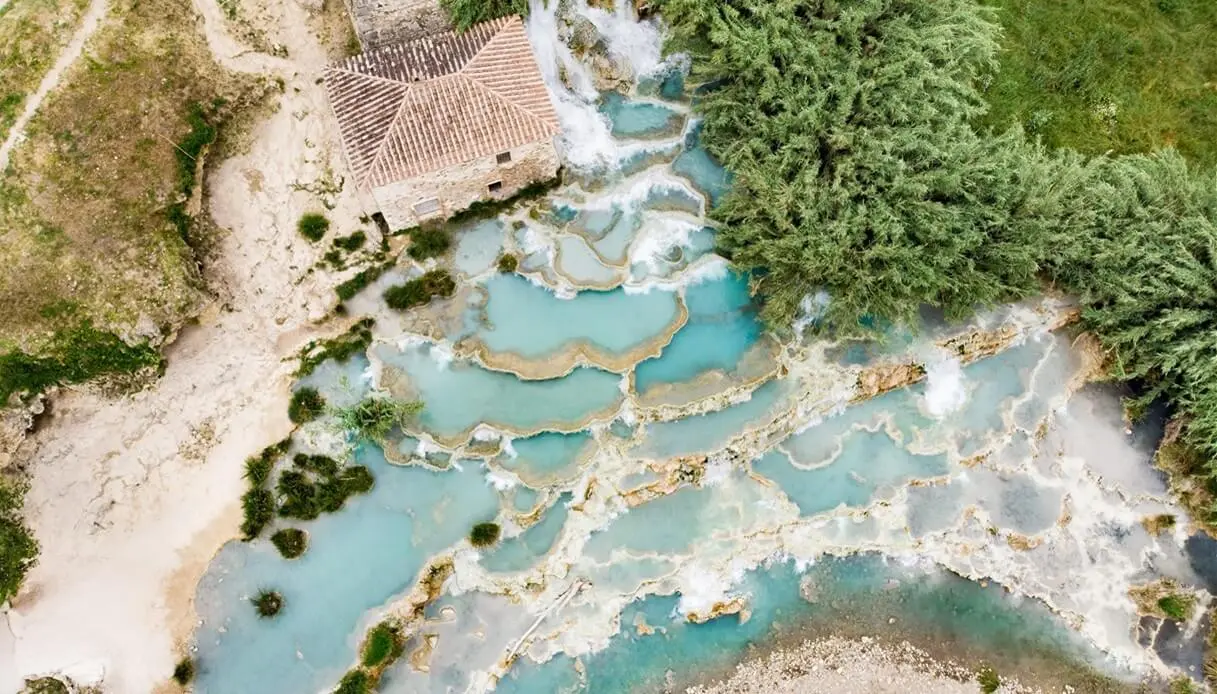
One of the Toscana’s classic destinations, one of the Italian regions richest in free outdoor baths: the famed Mill Falls in Saturnia, a tiny village in the municipality of Manciano, in Maremma.
The Gorello thermal stream winds here sinuously, along a series of stepped basins, creating a multitude of opaque pools of thermal water. They are called the Mill Falls precisely because of the ancient mill that stands right nearby.
The sulfurous water springs forth at a constant 37.5°C, pleasant in every season, and access is open to all.
The legend says the springs were born from a lightning bolt hurled by Jupiter, furious with his father Saturn. They are probably Italy’s most famous free hot springs, and thus very crowded in summer, but often also on autumn weekends.
Bagni di Bagni San Filippo
Bagni San Filippo is a small, charming hamlet of the municipality of Castiglione d’Orcia, nestled in the splendid and panoramic Val d’Orcia. The village lies at the edge of dense forests, at the foot of Monte Amiata, the most prominent peak in southern Tuscany.
Here a path starts just outside the village and winds through the forest’s canopy, descending along the banks of a stream with emerald-green waters, named Fosso Bianco, until it reaches the Balena Bianca: a large calcareous formation, imposing in shape and thus likened to a whale, created by the continual deposition of mineral sediments from the thermal waters around a waterfall along the river.
It is in this area that the hottest waters flow, reaching up to about 48°C, and mixing with the river’s cooler waters in the lower pools, where anyone can find their preferred temperature. Small waterfalls alternate with the successive pools, in a fairly wild environment, a white island among the surrounding larches.
Petriolo Hot Baths
Still in Tuscany: on the border between the provinces of Siena and Grosseto, in the Ombrone Valley, the Farma stream hosts a thermal spring near the locality of Petriolo. The baths are easily reachable via a short path hugging the paved road, but then the pools immerse you in a world of warmth and steam.
The thermal water, rich in hydrogen sulfide, bubbles up at 43°C and flows toward the river, forming calcareous basins, separated from the current by a low pebble wall.
The game is simple: you move from the hotter pools to the cooler ones, down to the cold waters of the Farma, in a sequence that evokes the calidarium, tepidarium, and frigidarium of Roman baths.
Carletti Pools, Viterbo
About two and a half kilometers from the center of Viterbo, in the thermal area at the city’s edge, the Carletti Pools are part of the wide hydrothermal basin of Tuscia, the same that feeds other famous springs like Bullicame, mentioned by Dante Alighieri in the Inferno of his Comedy, and Bagnaccio.
The pools are rich in minerals and trace elements, and it’s a pleasure to move from one to another, enjoying the different heat levels. The notable maximum temperature reached by one of the springs is 58°C.
The Carletti Pools lie in a flat area, where the view can stretch to the horizon. An autumn sunset, around mid-afternoon on a clear day, is an ideal moment to savor a beautiful spectacle while staying warm in the healthful thermal waters.
Caronte Pools, Lamezia Terme
Contrada Caronte, a locality in the Lamezia Terme area, at the foot of the Reventino massif, in the heart of Calabria: here some sulfurous pools have offered public use for over two thousand years.
The water bubbles up at 39°C from springs already known to Bruzi, Greci, and Romans—the populations that followed one another in antiquity in this territory. The main on-site spa is a paid facility, but about 300 meters away there is a small outdoor pool, surrounded by greenery. It uses the same waters and is freely accessible: these are the free Caronte baths. Beside it flows a stream with a small cold waterfall, perfect for alternating hot and cold.
Sant’Angelo Fumaroles, Ischia
The final selection in this short list is dedicated to a place that is special and unique, somewhat different from the others. Although not strictly outdoor baths, it deserves inclusion for its exceptional nature.
On the volcanic island of Ischia, between the village of Sant’Angelo and the Maronti beach, there is the Spiaggia delle Fumarole. There aren’t real pools here, but a stretch of shore where vapors and gases rise, warming the sand and making the sea water warmer. A true treasure to enjoy in autumn, when sea bathing is usually less appealing. Ancient Romans are said to have covered themselves in warm sand for therapeutic purposes as well.
The beach is reachable in about ten minutes on foot from the village, along the pedestrian path that leads to the Maronti beach.
