
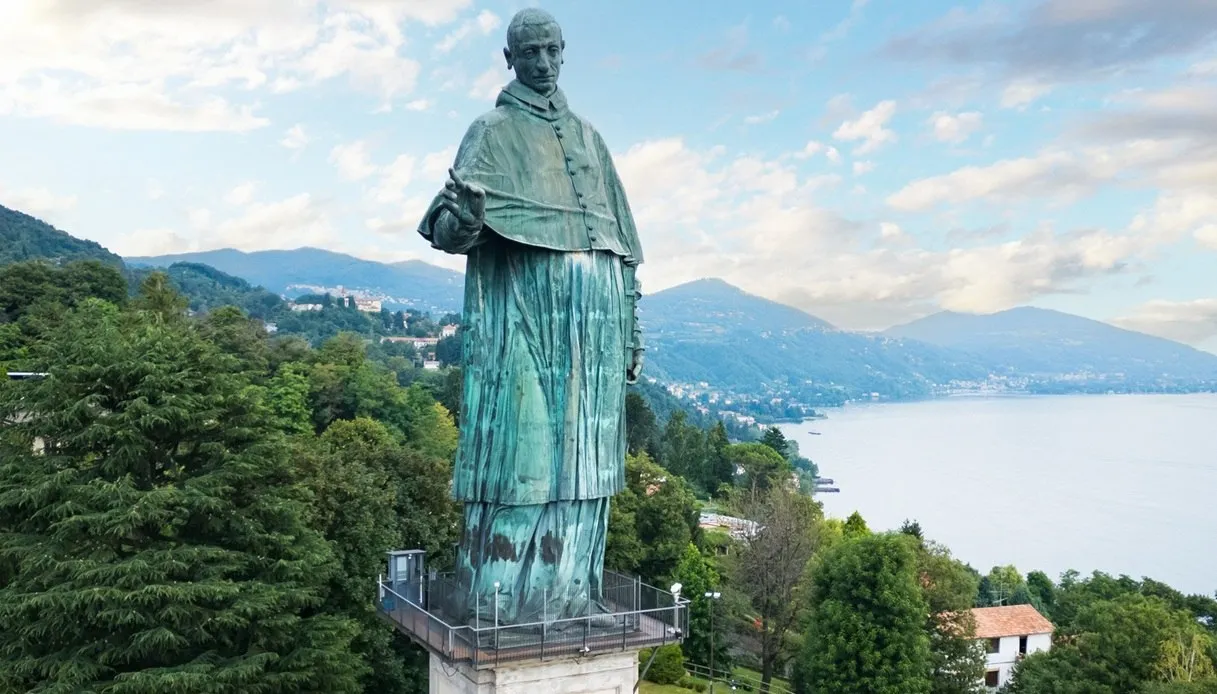
There is an Italian statue that you can incredibly visit from the inside and that has a special connection to one of the world’s most famous monuments: the Statue of Liberty in New York. It is the Colossus of San Carlo Borromeo in Arona, nicknamed San Carlone, the gigantic statue dedicated to Saint Charles Borromeo standing at 35.10 meters tall, which for about two centuries was the tallest in the world. But not everyone knows that the designer of the Statue of Liberty, Frédéric-Auguste Bartholdi, visited the statue to study its structure. Several years later he would design the famous statue that overlooks the port of New York and which, with a total height of 93 meters, would supplant San Carlone’s world record.
For centuries it has dominated Lake Maggiore and inside it hides a surprise: it’s possible to enter and climb up to the head, traversing 85 steps, between spiral staircases and hidden passages, to find yourself facing a spectacular view of the lake and the surrounding mountains.
The History of San Carlone
The San Carlone isn’t a contemporary installation, but a monument that carries more than three centuries of history and continues to watch over the territory of Arona with its arm raised in a blessing. The Sancarlone, as the locals lovingly call it, was completed at the end of the seventeenth century, but its story begins after the canonization of Carlo Borromeo, which occurred in 1610.
Born in Arona in 1538, the future saint was the Archbishop of Milan and one of the most influential religious figures of his time. To honor his memory, Cardinal Federico Borromeo, his cousin, supported the ambitious project of a Sacred Mountain, a complex that was to include a church, fifteen chapels dedicated to the saint’s life, and a monumental statue.
The project was never fully completed, but the colossal statue was realized from a design by Giovan Battista Crespi and completed in 1698 by the sculptors Siro Zanella and Bernardo Falconi.
A Record-Setting Structure
The Colossus of San Carlo Borromeo stands at 35.10 meters, including the marble pedestal: the figure of the saint itself measures about 23 meters, while the base exceeds 11. It is built with an internal framework of stone, bricks, and iron, clad on the exterior with hammered copper sheets. Even the raised right arm in blessing is supported by a complex metal framework, designed to withstand the winds that can strike the area.
It is precisely this distinctive construction technique that attracted the attention of Frédéric-Auguste Bartholdi, who stayed in Arona to study the monument before designing the Statue of Liberty, which was destined to surpass San Carlone and snatch its world record.
How to Visit the Statue
Visiting San Carlone is an extraordinary experience, and you can choose between two options: stay on the panoramic terrace at the base of the statue, from which you can admire Lake Maggiore and the Rocca di Angera (the better option if you suffer from vertigo or claustrophobia), or proceed inside the colossus.
To arrive inside the giant’s head you must tackle 85 steps, between a spiral staircase and a steep vertical stair, until reaching 24 meters in height. The reward is a very unusual perspective that leaves you breathless: the panorama of Lake Maggiore and the mountains unfolds precisely through the statue’s eyes, ears, and nostrils, as well as through openings at shoulder height. In practice, you view the landscape from the statue’s point of view, as if you were exactly in Saint Charles’s place.
However, the ascent is not suitable for everyone: the spaces are tight and the route can be challenging for those who suffer from vertigo, claustrophobia, or heart and respiratory problems. Access is allowed from age 6, with an adult accompanying until age 12. Slippers, flip-flops, backpacks, bulky bags, and umbrellas are not allowed.
The full-price ticket costs 10 euros and includes the terrace and the interior of the statue (but if you stay on the terrace, the price is 7 euros). The reduced rate is 5 euros for children and youngsters aged 6 to 16. Tickets are sold exclusively at the ticket office, not online.
Where It Is Located and How to Reach It
San Carlone is located at Piazzale San Carlo, in Arona, in the province of Novara, on the hill named after it to the north of the town, along the road that connects the town to Dagnente. By car you reach it from the Sempione/Autostrada, taking Via Verbano and following the signs to the statue. For those coming from Milan, the reference is the A8 highway toward the Lakes, then continuing toward Arona.
The elevated position makes the colossus recognizable also from the lake: once you arrive, in addition to visiting the statue, you can stroll through the surrounding park and stop to admire the romantic panorama that opens onto Lake Maggiore.
