
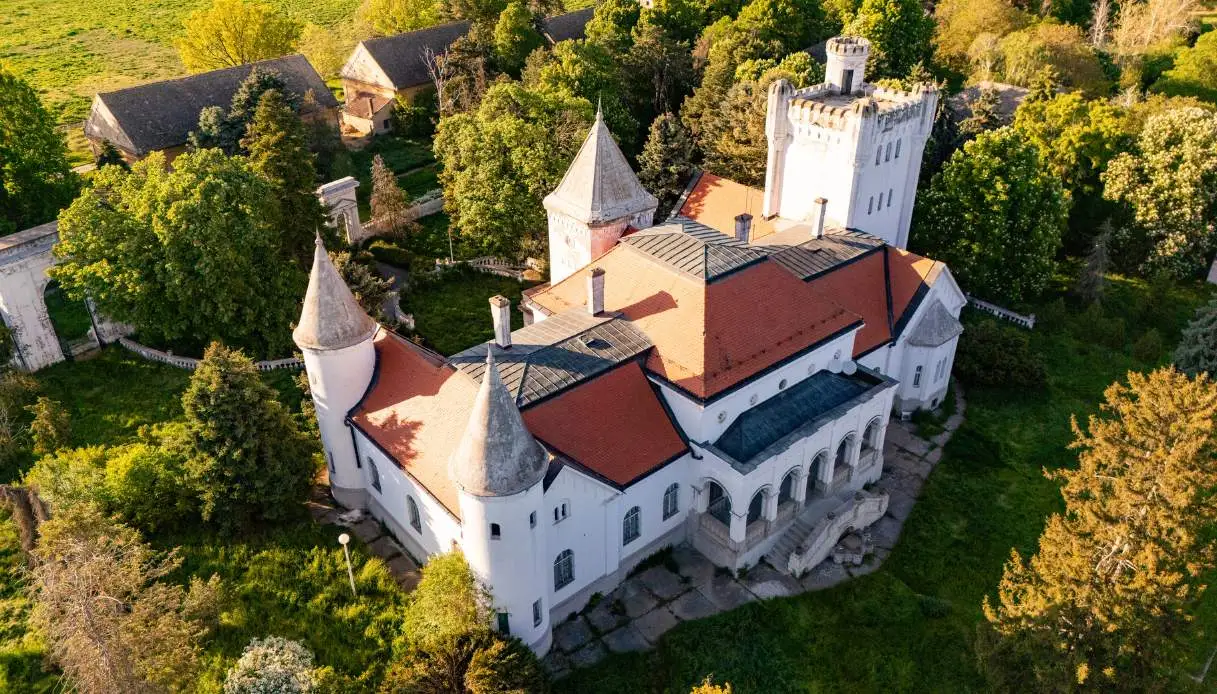
Hidden behind the foliage of a large park in Serbia lies a building that is almost entirely white, full of slender towers and with a romantic silhouette. It is the Fantast Castle, one of the most peculiar historical residences in the Vojvodina, an autonomous region characterized by a flat landscape and a long agricultural tradition.
Instead of mountains, dense woods and the elevations usually associated with European fortresses, Fantast sits in the heart of the plain. An unusual detail, but one that makes it even more special because its light walls rise among the fields, while a large square tower dominates the complex together with four corner turrets.
Behind this singular property lies the story of Bogdan Dunđerski, one of the wealthiest landowners in Vojvodina, belonging to a family that contributed deeply to the economic and cultural life of the region. Fantast represented his personal retreat, designed according to tastes and passions developed during numerous European journeys.
Brief history and legends of Fantast Castle
Born in 1862, Bogdan Dunđerski inherited vast agricultural estates, expanding them through careful economic management. He chose to realize his monumental residence when he had already surpassed fifty, and, according to a tale passed down in the region, the construction would have also arisen from pride.
Voices circulated indeed about his alleged financial distress to which he would have responded by erecting a sumptuous building. But that is not all, because the castle’s name itself tells a peculiar story: Fantast was a racing stallion, the protagonist in 1932 of a significant sporting achievement, when he won three races at the Belgrade racetrack.
Other stories concern the construction itself. It is said that Dunđerski hired artisans from Bohemia to keep certain details of the project confidential. Large quantities of oak from Slavonia would have been transported to the property and used to line secret passages between the palace and the stables. The actual existence of such connections, however, remains without documentary confirmation.
The mystery also reaches the chapel dedicated to Saint George, in which Bogdan himself rests, having died in 1943. According to local folklore, during the Transfiguration festival (August 19) his spirit would leave the tomb to once again traverse the estate’s lands. Some stories add the whinnying of Fantast, as if still ready to gallop beside his master.
After World War II, the complex was nationalized. Much of the furnishings and decorations were lost, while some spaces suffered serious damage. In the 1980s, instead, the residence was recovered and transformed into a hotel, returning for a couple of decades to host visitors.
However Bogdan had left different testamentary dispositions: he wished to allocate his assets to the Matica srpska, a prestigious Serbian cultural institution, so that the property would host an agricultural academy. That project remained unfinished and the question of patrimonial restitution continues to condition the future of this extraordinary building.
Visiting Fantast Castle and its most surprising features
There is an important preface to note: this jewel of Serbia is unfortunately closed to ordinary visits since 2021 and its opening remains conditioned by the complex legal matter surrounding ownership. Currently the restitution procedure seems to be stalled, so much so that local press (quite recently) reported the progressive deterioration of the building. Consequently, access to the interior halls and to the panoramic tower is not open to the public.
The chapel has undergone conservation interventions concluded in 2023, while the possibility of visiting the exterior spaces and the stables must be checked in advance. Even while bearing the recognition as a monument of great importance to Serbia, the castle still awaits a solution that would allow its full restoration and reopening.
That said, its most recognizable image remains the white façade, characterized by a compact central body and the towers that shape its profile. The building has a essentially square footprint, a monumental entrance and a composition designed to amaze.
The little towers evoke Neo-Gothic language, while the entrances and the spaces used for representation feature elements of the Neoclassical style. The main tower is particularly evocative, conceived as a vantage point as well, inside which there are reception halls, rooms furnished with antique furniture, and spaces dedicated to the memory of the family.
Also noteworthy is the Chapel of Saint George, a small neobyzantine religious building, whose artistic value is tied above all to Uroš Predić, the famous Serbian painter and personal friend of the owner. The artist created 12 icons for the iconostasis, the structure in Orthodox churches that separates the sanctuary from the space reserved for the faithful.
According to tradition, Predić would have attributed to the Virgin Mary the features of Mara, a woman linked sentimentally to Bogdan’s life. Another testament to their friendship is kept in the bas-reliefs made by sculptor Đorđe Jovanović, depicting the two men on the chapel walls.
Around the buildings extends, among other things, a park conceived through elements of the English and the French garden styles: tree-lined avenues, open spaces and ornamental paths accompany the main residence, a smaller auxiliary building and the equestrian structures. The complex also includes a large historic swimming pool, today unused.
The stables constitute another fundamental element of Fantast’s identity. In the past they housed highly prestigious racing horses, with a paddock, service buildings and a training track.
Where it is located and how to reach it
The Fantast Castle stands in central Vojvodina, about 14 kilometers from Bečej, along the road toward Bačka Topola. The area is roughly 60 kilometers from Novi Sad, the main urban center of Vojvodina, and about 130-140 kilometers from Belgrade, depending on the chosen route.
By car, the simplest route from Novi Sad crosses the plain to Bečej and continues toward Bačka Topola. Access to the estate is located along this road, while the palace itself remains partially hidden by the park’s greenery.
Starting from Belgrade, itineraries are possible via Novi Sad or Zrenjanin. Bečej can also be reached by regional buses from Novi Sad, but to continue to Fantast one would necessarily need to arrange a private transfer, or check the available trips on the Bačka Topola line (bearing in mind that the road stop is some distance from the building).
Before departure, therefore, it is essential to check the access conditions to the property, given the current closure of the residence and the absence of an official date for the resumption of visits.
