
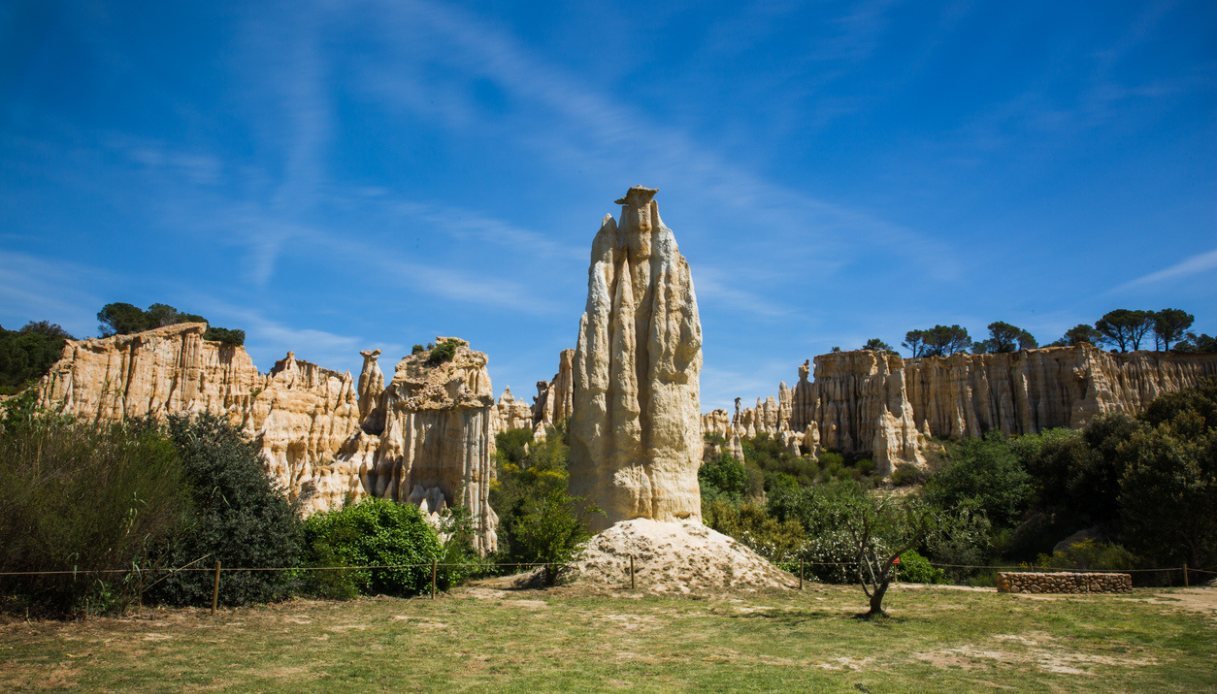
It’s not hard to mistake them for the picturesque ruins of an ancient city, with crenellated walls, pinnacles, and towers standing shoulder to shoulder. In fact, it happens more often than you might think (especially when viewed from afar). What you see among the hills of southern France are honey-colored structures, but entirely natural. They are called Orgues d’Ille-sur-Têt and they stand as one of the most peculiar geological landscapes in the Eastern Pyrenees.
Just before you reach them, you encounter trees, cultivated lands, and scrub-covered reliefs, and after a few steps, everything changes abruptly: vertical walls emerge in ivory, ochre, and pale yellow shades. Some formations evoke the pipes of a monumental organ (the origin of the French name Orgues), while others take on the appearance of medieval towers.
You have arrived at the so-called Cheminées de Fées, the Fairy Chimneys, also known as Demoiselles Coiffées or Ladies with the Hat. From a geological standpoint, however, they are columns of soft sedimentary material, sometimes taller than 10 meters, topped by a more resistant cap.
Formation and legends of the Orgues d’Ille-sur-Têt
To reach that period in history, one must take a long leap back about 5 million years to the epoch known as the Pliocene, a phase in which the Roussillon underwent important geological transformations. Previously, the dramatic drop in the Mediterranean sea level had favored the carving of deep river valleys. When the sea returned to occupy part of the region, the waters reached inland as far as present-day Ille-sur-Têt.
Rivers and streams from the Pyrenees carried vast quantities of sand, clay, and rock fragments, depositing them over time. Thus the accumulation formed several sedimentary layers, later shaped by erosion. Then there were the rains, which, with their force, carved deeper channels, separated portions of terrain, and left the current columns exposed.
But why do they have this curious shape? The secret lies in the different resistance of the materials: at the top there is a cover of pebbles cemented by compact clay that protects the more friable underlying sediments. When this protective layer gives way, rain quickly erodes the column. The Orgues, therefore, continue to transform even today and are never the same.
There is certainly a more imaginative dimension: fairies and sprites animate the narratives offered during some guided tours. For in these parts, more than a single legend handed down through the centuries, it is the unusual character of the formations that feeds the various folk interpretations.
The visit among columns, canyons, and panoramic terraces
The exploration of Orgues d’Ille-sur-Têt begins with a trail that winds through a quintessentially Mediterranean environment. There are holm oaks, lentisk shrubs, gorses (cisti) and aromatic bushes, which gradually are enhanced by sandy walls, leading to the opening of a small natural amphitheater.
The itinerary reaches three panoramic terraces, carved from ancient agricultural terraces, from which one can observe the different structures of the complex. Some towers seem welded to the back walls, while others stand out clearly, with slender profiles and irregular tops.
Particularly striking is the passage through the open canyon accessible to visitors. The walls draw closer, the ground takes on sandy hues, and the vertical incisions become even more evident. Looking upward, the crests appear as if cut out against the sky. The full route measures nearly 2 km, with a total elevation gain of 50 meters.
For a self-guided visit, typically 45–60 minutes are needed, while guided experiences can last up to 1 hour and 30 minutes (but they surely provide a broader awareness). At the entrance, informational material is distributed, and inside the complex there is also a tactile model of the territory. In summer, guided tours and narrative appointments dedicated to local stories are organized.
However, one must be absolutely aware that the fragility of these French formations imposes certain precautions and rules to be followed: climbing is forbidden, crossing delimitations is prohibited, and removing natural material is not allowed. The trail includes sandy stretches and slopes that can pose difficulties for wheelchair users.
In the warmer months, water, a hat, and footwear suitable for uneven terrain are advised. Access is paid, and visiting hours change throughout the year (the site closes during the Christmas holiday period).
Where they are and how to reach
The Orgues d’Ille-sur-Têt are located in the Pyrénées-Orientales department in southern France along the Mediterranean coast. The site occupies the left bank of the Têt River, north of the town of Ille-sur-Têt, a locality situated between Perpignan and Prades. The area belongs to the historic region of Roussillon, known for its strong Catalan identity (that is, part of the Barcelona region), still recognizable in language, traditions, and place names.
From Perpignan, one reaches Ille-sur-Têt by taking the N116 toward Prades. The drive takes roughly 25–30 minutes. From the town center, follow signs to the Site des Orgues along the Chemin de Régleilles, toward Bélesta. A free parking lot is also available right near the ticket office.
From there, a trail of about 800 meters leads to the area of the formations, passing through a landscape of Mediterranean scrub. The distance is part of the overall visiting route. For those using public transport, Ille-sur-Têt is reachable by train with regional connections from Perpignan; the final transfer to the site requires an additional trip.
An alternative, another interesting perspective can be found along the D2 road toward Montalba, at a viewpoint equipped with an orientation table. From this position one can deeply appreciate the ensemble of spires and their relationship with the Têt valley, the profile of the Pyrenees, and the expanse of the Roussillon.