
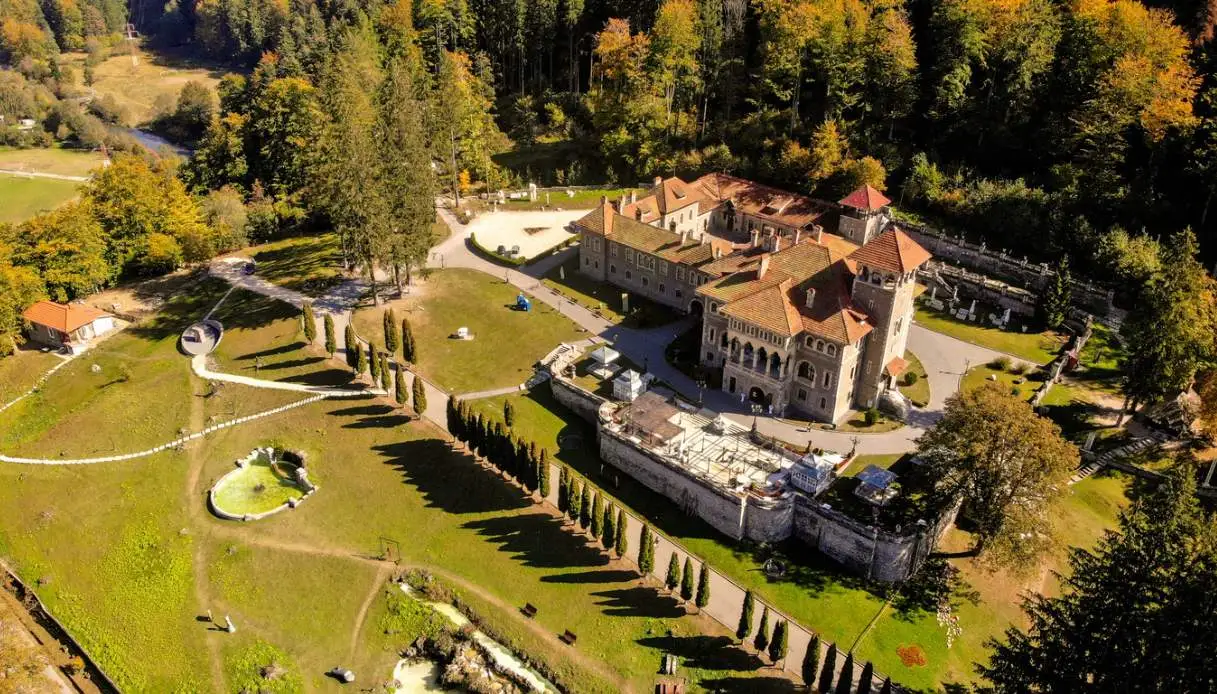
From the wide terrace of the Cantacuzino Castle, the mountains look incredibly close. Those who stand there see rocky walls, dense forests, and towering peaks that sketch the landscape of the Prahova Valley, one of the most evocative mountain regions in Romania. But there is also the Bucegi Massif, part of the Southern Carpathians, with the profile of Mount Caraiman and the famous monumental cross that dominates the valley. A spectacular setting for an aristocratic residence that, more than a century after its construction, still holds a particular charm.
We are in Bușteni, a town situated along the road that connects Bucharest to Transylvania. And right on the slope of Mount Zamora, surrounded by a 3.5-hectare park, there stands this mighty building with stone façades, arcaded terraces and roofs with elaborate shapes. Perhaps you haven’t been there yet, but to many of you it might already seem familiar (and perhaps quite well!).
How is this possible? The answer is really simple: it was the Netflix series Wednesday that made it famous, digitally transforming its exteriors into the mysterious Nevermore Academy.
A Brief History and Legends of Cantacuzino Castle
Behind the construction of this jewel lies one of Romania’s most influential figures: Gheorghe Grigore Cantacuzino, who held the office of Bucharest mayor on two occasions and who led the Romanian government in the periods 1899-1900 and 1904-1907. His fortune was enormous, so much so that he earned the nickname Nababul, the Nababo.
And it was precisely in Bușteni that the prince sought to realize a sumptuous summer residence. The project was entrusted to architect Grigore Cerchez, an important exponent of the Neo-Romanesque style. Construction ran from 1901 to 1911, the year of the inauguration. For the era, the property boasted particularly modern solutions, including electricity, running water and sewer systems.
Around the Nababu figure there arose several curious tales. According to a legend, Cantacuzino would have wished to cover the roof and pave the courtyard with gold coins, a project never documented but that nonetheless reflects the extent of his fame. Another tradition concerns the building’s alternate name, Castle Zamora. It is said to derive from a female dog used during hunting, recalled by the owners with the expression “Za’ Mura!”
The residence remained tied to the family’s summer stays until 1930. In 1948, with the advent of the communist regime, it was nationalized and transformed into a sanatorium. Furnishings and precious objects were dispersed, while several decorative elements were covered with layers of paint. After restitution to the heirs and the subsequent transfer to private ownership, important restoration works began. Since 2010 the complex has been open to the public.
Visiting Cantacuzino Castle
The castle covers a total area of about 3,148 square meters and features a square plan opened on the southern side, organized into several connected blocks. Even from the outside it makes an incredible impression, but once you cross the entrance something really happens, because the solidity of the stone yields to surfaces richly worked, plays of light and precious materials. It is a hive of coffered ceilings, Murano glass windows and Italian ceramic elements that testify to the care lavished on each of its spaces.
Particularly refined are the Albești stone fireplaces, embellished with polychrome mosaics and gold leaf. There are also balustrades in oak, stone and wrought iron, columns with ornaments in the Brâncovenesc tradition and bronze finishes made in Paris. The true heart of the residence, however, is the Ballroom: it houses an extraordinary heraldic collection with the coats of arms of noble families related to the Cantacuzino.
Even more remarkable is the frieze composed of 12 life-size portraits, painted on Cordovan leather, depicting illustrious representatives of the Wallachian branch of the dynasty. Leaving the salons behind, one reaches, via cobbled avenues, the park. It presents itself full of green spaces enriched by fountains, sculptures and even an artificial grotto.
Particularly dramatic is the terrace overlooking the Prahova Valley: on clear days, the mountains occupy almost the entire panorama, while the roofs of Bușteni appear much lower.
Among the reasons for Cantacuzino Castle’s recent popularity is its role in the first season of Wednesday, the Netflix series with Jenna Ortega and directed by Tim Burton for the first four episodes. The production chose this building to represent the exteriors of the Nevermore Academy, the boarding school attended by the protagonist. Through digital effects, the real structure was altered with more Gothic architectural elements, accenting its mysterious appearance.
The interiors of the castle are visited with the accompaniment of a guide, while the park has its own dedicated access. On the upper floor there is also an art gallery, inaugurated in 2015, which hosts temporary exhibitions.
Where It Is Located and How to Reach It
The beautiful Cantacuzino Castle rises at number 1 on Zamorei Street, in the Zamora neighborhood of Bușteni, in Prahova County. The location comes alive along the valley of the same name, at the foot of the Bucegi Mountains, about 100 kilometers from Bucharest and 40 kilometers from Brașov.
By car you travel along the national road DN1, an important link between the capital and Transylvania. From Bucharest the journey typically takes about 2 hours, although traffic heading toward the mountain towns can significantly lengthen the time (especially on weekends).
A valid alternative is the train: Bușteni is located along the Bucharest-Brașov railway line and is served by connections that cross the Prahova Valley. From the train station you reach the property by crossing part of the town center and tackling the climb toward the Zamora neighborhood. But if you want to avoid the uphill stretch, don’t worry: you can use a taxi.
