What does it mean to be a sustainable city in 2026? Urban mobility and sustainable architecture play a fundamental role in making them healthier and more livable, but they are not enough on their own. The quality of the air, how much waste is produced and recycled, the water lost along the pipes, or the clean energy produced all count as well.
To measure all this year after year is Ecosistema Urbano, the report by Legambiente and Ambiente Italia prepared with Il Sole 24 Ore and now in its thirty-third edition. The survey sifts through 106 provincial capitals, where almost one Italian in three lives, and assesses them on 20 indicators spanning air, water, waste, mobility, urban environment and energy. The picture that emerges is that of a country that is moving, but at a slow pace.
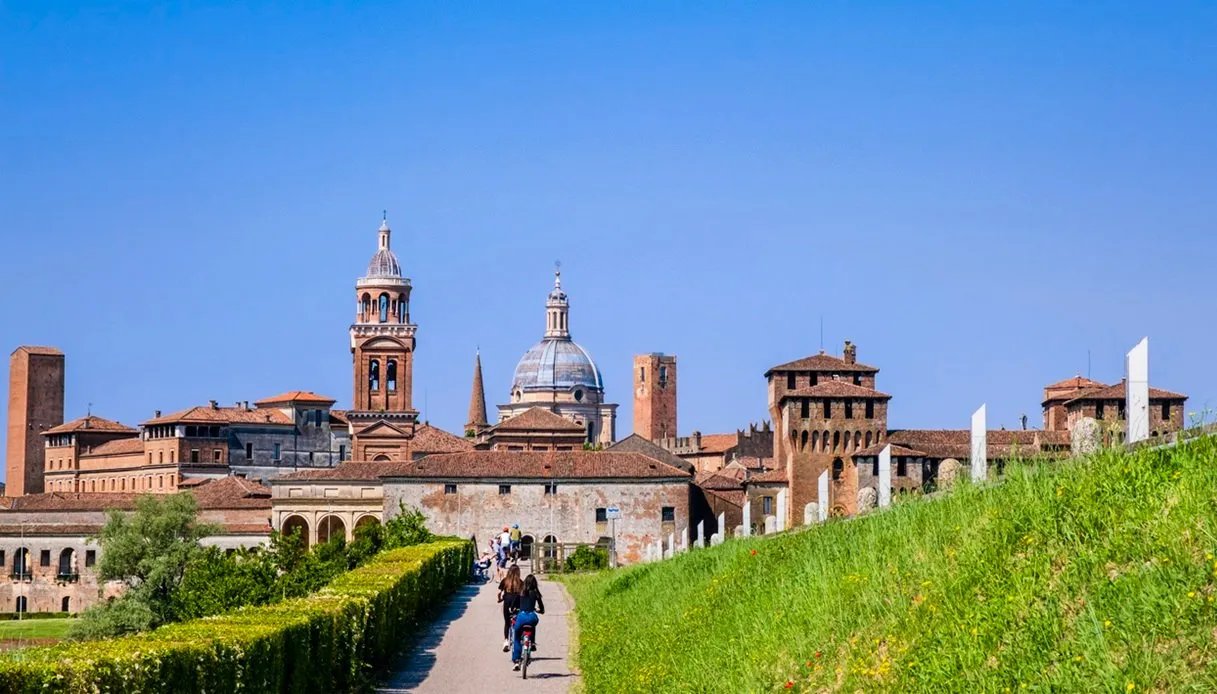
Mantua is the most sustainable city in Italy
At the top of the rankings is Mantua, which, with 81.29%, is the only city to exceed the 80-point mark and regains the primacy already won in 2017 and 2018, swapping places with Trento. The Gonzaga city impresses especially on the front of gentle mobility. It ranks third in Italy for cycling infrastructure, with 33.4 metres equivalent per 100 inhabitants, and first of all for the length of the bike lanes, with over 178 linear metres per 100 residents. In terms of the extent of low-traffic zones it is second only to Rimini and remains among the top ten for spaces reserved for pedestrians.
Green spaces also make a difference: with 93 trees per 100 inhabitants, Mantua ranks third after Trieste and Cremona. Good results on waste and water, with a recycling rate of 83% and network losses at 17%. The days of ozone exceedance have fallen, from 39 to 25, and per-capita land take has been halved.
The most sustainable Italian cities in 2026: the ranking
After Mantua, the second place goes to Trento (76.53%) and third to Bolzano (75.47%), the only ones to surpass 75 points.
Among the large cities, Bologna remains the most virtuous, even though it slips to twelfth place. What’s surprising is Venice, which rises from 47th to 31st: it is the best among the large cities for public transport passengers and second in Italy for the share of space dedicated to pedestrians.
Florence advances to 17th, where annual trips per inhabitant by public transport rise to 288 and Milano (50th), Padua (33rd) and Bari (71st) also make progress. Genoa, however, slides 14 places to 54th, slowed by smog, a recycling rate stuck at 52.3% and water losses approaching 35%.
These are the top ten in the Ecosistema Urbano 2026 ranking:
- Mantua, Lombardy;
- Trento, Trentino-South Tyrol;
- Bolzano, Trentino-South Tyrol;
- Cremona, Lombardy;
- Reggio Emilia, Emilia-Romagna;
- Bergamo, Lombardy;
- Parma, Emilia-Romagna;
- Pordenone, Friuli-Venezia Giulia;
- Cosenza, Calabria;
- Rimini, Emilia-Romagna
At the bottom of the ranking are the cities of the South, which occupy seven of the last ten positions. In last place we find Naples with 30.80%, penalized by air quality, a recycling rate below 50%, a scarcity of trees, and the new indicator on water purification.
These are the last five of the ranking:
- Caserta, Campania;
- Catania, Sicily;
- Palermo, Sicily;
- Reggio Calabria, Calabria;
- Naples, Campania.