
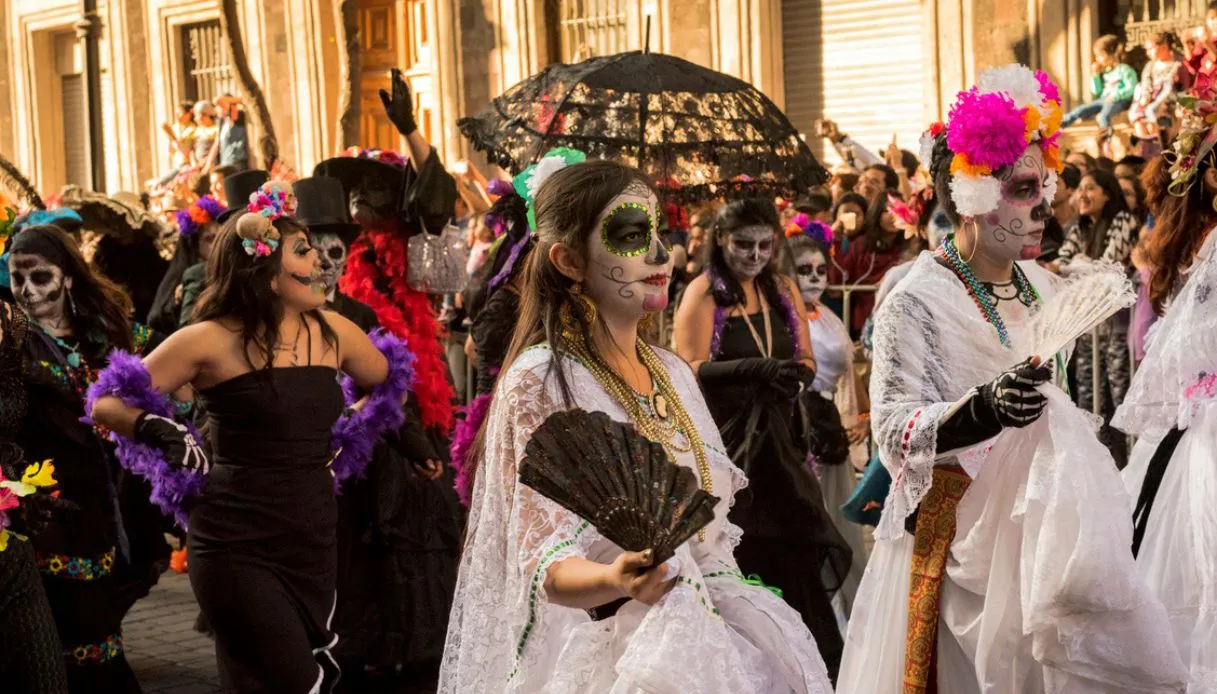
Día de los Muertos brings to Italy the colors, music, and rituals of one of the most evocative celebrations in Mexican culture: indeed, on the occasion of the festival dedicated to the memory of the departed, several cities organize events that blend spectacle, tradition, and cultural insight.
For 2026, Rome, Milan and Brescia offer distinct initiatives, ranging from family-friendly street fêtes to costume parades, up to museum programs devoted to the history and meaning of this captivating celebration.
Rome, mariachi, dances, and traditional cuisine
In Rome, Día de los Muertos is celebrated on Sunday, October 25, at Largo Venue, 2 Biordo Michelotti Street: the event runs from 12:00 to 21:00 and admission is free with a voluntary donation. The day is designed to immerse attendees in the Mexican atmosphere with live music, folk dancing, activities for children, and culinary offerings.
The musical program opens at 1:00 PM with Mariachi México, performing until 3:00 PM; in the afternoon, from 3:00 to 5:00 PM, traditional dances from the Mexican states of Veracruz and Jalisco take the stage, while at 6:00 PM the Mariachi Romatitlán concert is scheduled.
At 2:00 PM there will be a Mexican baby dance, and in the afternoon, at 3:00, 4:00 and 5:00 PM, piñatas are on the program, a traditional feature of Latin American celebrations. Workshops for children are also offered.
To complete the experience, there will be a craft market, Mexican food offerings, and an ofrenda, the altar dedicated to the memory of the departed.
Milan, the Día de Muertos parade winds through the center
Milan offers a calendar of events that culminates on Sunday, November 1 with the Día de Muertos Parade, scheduled for 6:30 PM. The procession will depart from Piazza San Babila and traverse some of the city center’s most famous spots, passing along Corso Vittorio Emanuele II, Piazza del Duomo, Piazza dei Mercanti and reaching Piazza Castello.
But that’s not all. From October 30 to November 6, the Cervantes Institute, at 2/A A. Mauri Street, will host the Altare dei Morti del Michoacán, dedicated to one of the Mexican regional traditions tied to commemorating the dead. The altar will be open Monday through Thursday from 10:00 to 13:00 and 15:00 to 17:00, while on Friday it will be open from 10:00 to 13:00.
Also at the Cervantes Institute, on Saturday, October 31, from 10:30 to 12:00, the workshop “Decorate your Catrina or Catrín mask” will take place, an activity devoted to the festival’s symbolic figures. On the same day, at the Antonio Maria Zaccaria Parish, located at 9 San Giacomo Street, the contest “Give Life to your Catrina” is planned.
The Milanese calendar actually begins the weekend beforehand. On Saturday 24 and Sunday 25 October, at Bicocca Village, there will be “Culture in Festa – Esperando el Día de Muertos,” featuring creative workshops for children, parades of Catrines and masks, music, cinema, and themed aperitifs. On Sunday at 10:00 a film screening of the animated movie The Book of Life, a chance to introduce even the youngest audiences to the imagery of Mexican culture.
Brescia, Día de los Muertos through lectures, visits, and workshops
In Brescia, Día de los Muertos becomes a cultural exploration path with the event “Que Viva el Día de los Muertos! 2026” running from October 23 to November 1 at the Museo del Risorgimento Leonessa d’Italia, inside Brescia Castle. At the heart of the initiative stands an ofrenda, around which a program of lectures, meetings, guided tours, and sessions dedicated to the history and flavors of Mexico unfolds.
On Friday, October 23, at 6:00 PM, the lecture “Día de Muertos: from the underworld to contemporary rituality,” with Massimo De Giuseppe, is scheduled to explore the origins and transformations of a celebration that preserves a strong link to memory and tradition.
Throughout the weekend there will be guided tours in Italian, Spanish, and English, in addition to explorations of Aztec deities. The program also includes a workshop dedicated to Aztec femininity, accompanied by an aperitif, and “Truccami!”, a makeup workshop that invites participants to approach the aesthetic elements characteristic of the festival.
The altar is set up at the Museum of the Risorgimento, where a concurrent exhibition by Mexican photographer Cristina Mittermeier is also on display, with free admission.
