
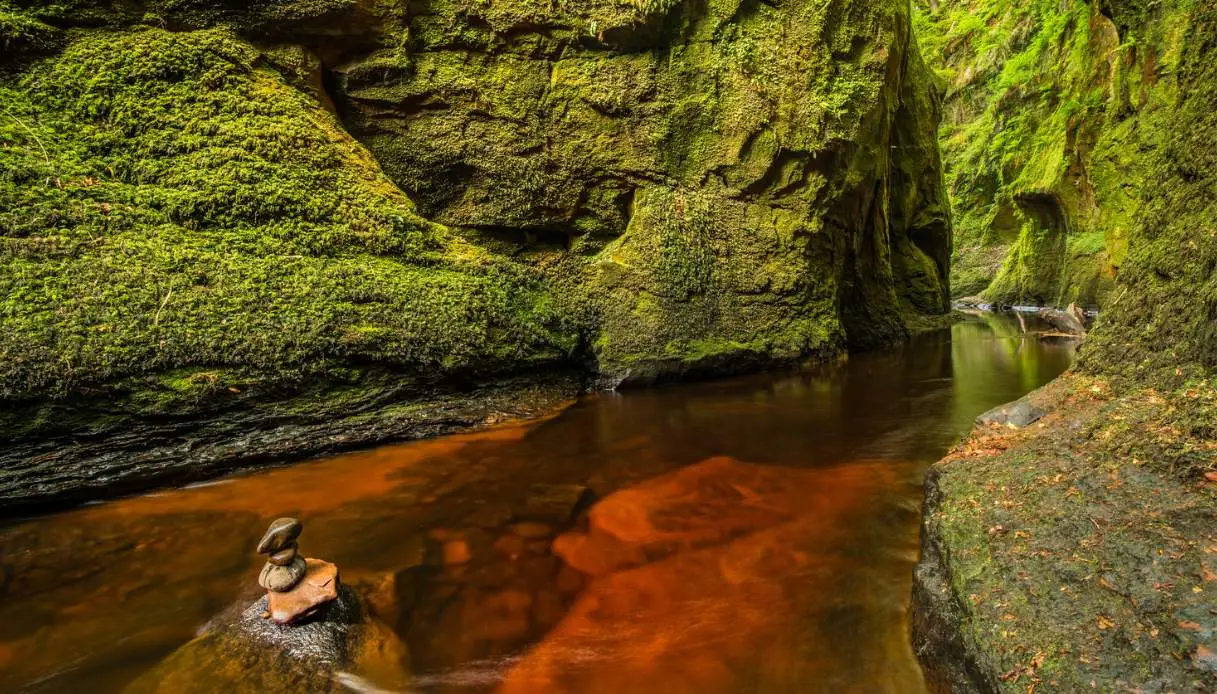
In the mysterious Scottish countryside, among dense woods, emerald meadows, and roads that wind through small villages, there lies a crack in the rock more than 20 meters deep where a stream flows through a narrow stone corridor with incredibly reddish hues. It is Finnich Glen, one of Scotland’s most evocative gorges, best known by the nickname Devil’s Pulpit, the Devil’s Pulpit.
A name that might sound unsettling, but in fact fits it perfectly: the walls seem to close in above the water, moss veils nearly all the rocky surfaces, and daylight reaches the bottom only through openings left by the vegetation.
Contributing to Finnich Glen’s singularity are stories of alleged druidic rituals, legends linked to the Devil, and a famous scene from the television series Outlander. But long before cameras arrived, this small natural marvel had already drawn the attention of travelers and scholars.
Origin, formation and legends of Finnich Glen
The mystical spectacle we can admire today is the result of the action of water on rock. For a very long period the Carnock Burn, a small stream, gradually eroded the terrain, cutting into the sandstone layers and forming a narrow, winding gorge. The current exploited the stone’s characteristics, slowly wearing it away and giving rise to a landscape with smooth surfaces, overhangs and small water cascades.
The sandstone belongs to the sedimentary formations characteristic of this part of Scotland. Its reddish color is tied to iron-containing minerals, while the current appearance of the gorge results from the erosion exerted by the stream. It is the stone itself that contributes to one of the most striking effects: the water that never ceases to flow seems to take on a blood-red hue, especially in the shallower stretches. In fact, it is “simply” an optical phenomenon related to the color of the underlying sandstone, which becomes particularly evident because of the contrast with the vegetation.
Constant humidity, in fact, fosters the growth of mosses and ferns that in turn cloak the vertical surfaces, while from above branches, roots and shrubs hang down. Finnich Glen and Devil’s Pulpit are often used to indicate the same place, but originally the names identified two different elements.
The first refers to the entire gorge, while the second belonged to a particular rock formation present in the stream. The stone, with its mushroom-like bulbous shape, closely resembles a small natural pulpit. According to a local legend, the Devil would have delivered his sermons before his followers from that very rock, surrounded by the eerie blood-red waters.
Other tales attribute to it a past tied to druids, the priests of the ancient Celtic peoples, who would have used the gorge for ceremonies and secret gatherings. Some versions of the folk tradition even evoke rituals practiced by witches.
Visit Finnich Glen, between Jacob’s Ladder and the Outlander locations
To the (brave?) visitors there is a dirt path that weaves through the woods and follows the upper edge of the fissure, from which the rock walls and the stream far below can be glimpsed. The most challenging passage is undoubtedly Jacob’s Ladder, also known as Devil’s Steps, the Devil’s Stairs.
It is an ancient staircase used to descend along one side of the gorge. The steps are irregular, partly worn and often coated with mud, demanding particular caution even when climbing back up. It is not impossible to catch sight of ropes along the route, but be aware that they are lacking any maintenance or safety guarantees.
At the bottom, when conditions permit, the landscape fills with imposing walls, light fades, and the stream occupies a large part of the available space. Small waterfalls interrupt the flow, while the rocks take on hues ranging from brick red to dark brown.
One of the reasons for Finnich Glen’s growing popularity is the television series Outlander. The gorge appears in the sixth episode of the first season, titled The Garrison Commander, and represents the mysterious St Ninian’s Spring, also known as Liar’s Spring, the Spring of the Liar.
In the story, Dougal MacKenzie leads Claire Randall to a spring to which supernatural powers are attributed. According to the belief recounted by the character, anyone who drinks that water and lies will suffer a terrible punishment. And, as one might imagine, Finnich Glen’s landscape provides a perfect setting for the scene.
Finnich Glen features distinctive characteristics throughout the year: in spring and summer the vegetation is particularly lush, while in autumn the leaves take on golden and copper tones that contrast with the rock. Weather conditions, however, have a huge influence on the possibility of visiting.
Even after several dry days, the gorge can still retain mud and slippery surfaces. Rainfall can also raise the Carnock Burn’s flow, making the bottom access risky. Trekking shoes with good grip and clothing suited to humidity are essential. It is advisable to avoid the route in rain, flood conditions, low visibility, or doubts about ground stability.
Where it is and how to get there
The charming Finnich Glen is located in central-west Scotland, in the Stirling administrative region, near the villages of Killearn and Croftamie. Essentially it lies not far from the southern edge of Loch Lomond & The Trossachs National Park, one of the country’s major natural areas.
The location makes it feasible to include Finnich Glen in a Loch Lomond itinerary, or during a journey between Glasgow and Stirling. To reach the area by car, take the A809 road, near the junction with the B834. The access point to the gorge is near Finnich Bridge, the bridge that crosses the Carnock Burn.
Parking deserves special attention: the area features very limited parking spaces and, along several stretches of road, restrictions have been introduced to prevent dangerous stops. If you want to opt for public transport it is possible, but it is quite complicated. Some area links allow you to approach the surrounding villages, but the last leg requires travel along rural roads, sometimes lacking sidewalks. Bus schedules and availability should be checked before departure.
In the last few years, proposals have been put forward to improve visitor reception, including a dedicated center, parking lots and safer routes. The presence of these projects, however, should be distinguished from the infrastructures actually available at the time of travel.