
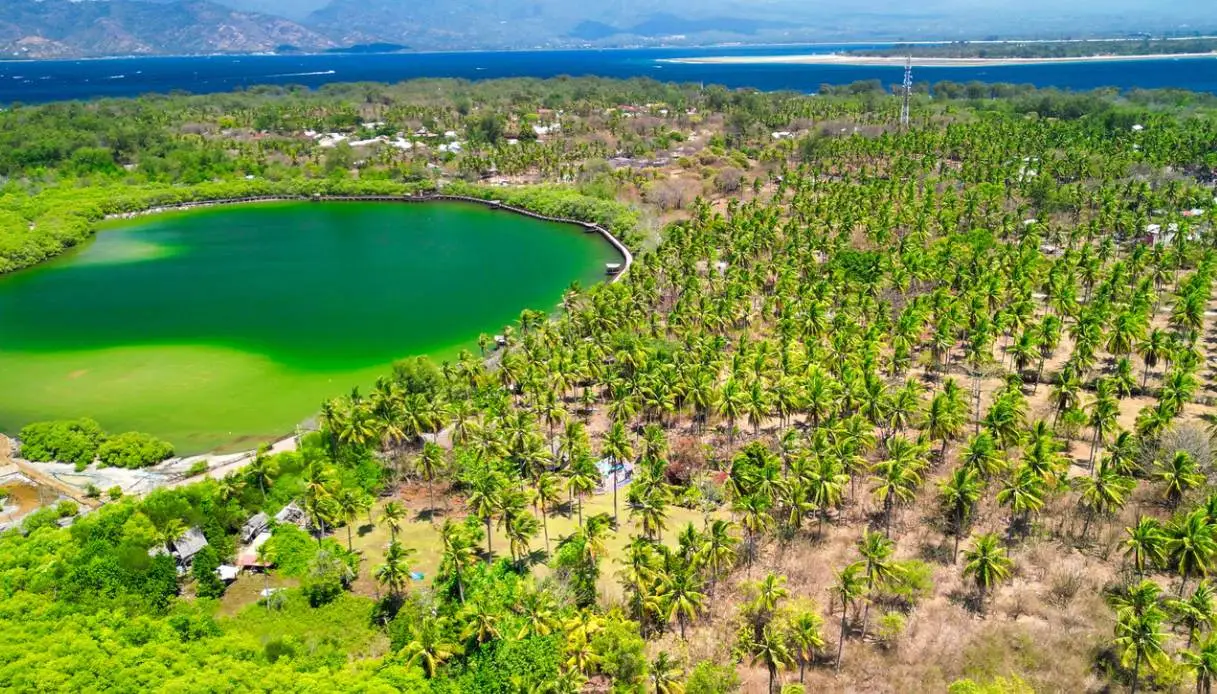
Its precious water bears a dark hue, yet it reflects the silhouettes of the trees that grow along its banks. Then there are the roots that rise from the muddy ground, the birds moving among the branches, and a little farther the sea, which, though quite near, seems almost unreachable (in reality a few minutes are enough to set your feet on a white-sand beach).
All this takes place at Gili Meno, a tiny island off the northwest coast of Lombok, in Indonesia, famed for its turquoise waters, sea turtles, and the serenity that sets it apart from the neighboring islands. A true tropical paradise, but it harbors a natural environment rather unusual for a territory of such small size: the Gili Meno Saltwater Lake.
Also known by its Indonesian name Danau Air Asin, it is a salt lake surrounded by mangroves that covers an area of about 7-8 hectares, and at the same time represents one of the island’s most intriguing geographical peculiarities and a testament to the relationship between the inhabitants and natural resources. For generations, in fact, these waters have been used to produce salt.
Origin, formation and legends of the Gili Meno Saltwater Lake
The Gili Islands are three in number and rise in an area previously affected by submarine volcanic activity, which over time gave rise to coral structures. The accumulation of materials from the coral reefs themselves together with the volcanic deposits contributed to the formation of the current landmasses.
And it is within Gili Meno that there lies a natural depression filled with saline waters, separated from the sea by a strip of land. The lake features shallow, muddy bottoms, surrounded by vegetation adapted to conditions that are particularly challenging.
Its salinity is one of the most surprising aspects: recent studies have shown a salt concentration of about 54 grams per liter, thus higher than the values typically detected in Indonesian marine waters. This means that only certain plant species can thrive here.
Before tourism became one of the island’s main economic activities, the lake was a valuable resource for the local population. During the dry season, residents gathered the salty water and used it to obtain salt crystals through evaporation. A process that required much labor and a deep understanding of the climatic rhythms.
But the lake also carried a spiritual significance. According to local tradition, before the salt harvesting began, the Sampang Sandro was celebrated, a ritual intended to seek the permission of the spirits believed to guard the marsh. The ceremony involved ritual offerings and the preparation of the pools destined for production.
Other tales attributed to the lake spoke of profound depths and dangerous currents. The gradual abandonment of artisanal production, encouraged by new economic opportunities related to visitors, has reduced the spread of these practices. A cultural memory remains, however, that adds a special meaning to the visit.
Visiting the Gili Meno Saltwater Lake
The lake lies in the northwestern part of Gili Meno and is reachable via paths that cut through the interior. Along its shores, boardwalks and wooden structures have been built to make exploration easier, but it’s worth knowing that some sections show signs of deterioration: it’s prudent to check their condition before using them.
Among the distinctive elements are also small shelters and raised constructions on stilts, evidence of an attempt to make the area accessible while respecting the natural landscape. One of the most interesting aspects for those arriving at this corner of the world concerns the vegetation. The mangroves are plants specialized to survive in brackish and saline environments, equipped with distinctive root systems that allow them to cope with oxygen-poor soils.
From these areas some grow roots that emerge vertically from the mud to facilitate gas exchange, while others possess support structures that resemble small arches or woven wooden frameworks. The visit becomes particularly captivating for those who enjoy birdwatching.
The lake indeed serves as an important resting and feeding area for several bird species, including herons, kingfishers and shorebirds. These latter frequent the muddy zones in search of small aquatic organisms, taking advantage of the shallows.
The early hours of the morning and the late afternoon are generally recommended for birdwatching and for enjoying milder temperatures. When the wind drops, the water’s surface mirrors the trees and the sky, creating a particularly picturesque landscape. In the middle of the day, the heat can be intense.
For a visit, plan about 30 minutes, with the possibility of staying longer to observe the fauna. It is advisable to wear shoes suitable for dirt paths, carry drinking water, and use mosquito repellent, especially in humid areas.
Where it is and how to reach
The beautiful island of Gili Meno administratively belongs to North Lombok, in the province of West Nusa Tenggara, and is part of the small Gili archipelago in the stretch of sea that separates Lombok from Bali. To reach it, you can depart from Bangsal harbor, on Lombok’s northwest coast, but there are also maritime links from the other islands of the archipelago and fast services from Bali.
Those landing at Lombok International Airport must first reach the northern coast of the main island and then continue by sea. Once landed on Gili Meno, getting around is mainly on foot or by bicycle, as motorized transport is strongly limited. Traditional horse-drawn carts, called cidomo, are also present.
From the western part of the island, about a 10-minute walk brings you to the lake area, following inland connections. The period roughly between May and October coincides with the generally drier season of this part of the country, hence favorable for excursions. The rainy season makes the landscape more humid and can worsen the condition of the trails (though not necessarily rendering them impossible).
It is worthwhile to include a visit in a day dedicated to the less-known side of Gili Meno. A few steps from the tropical beaches, the lake tells a different story of the island, made of salt, mangroves, ancient crafts and beliefs handed down through generations.
