
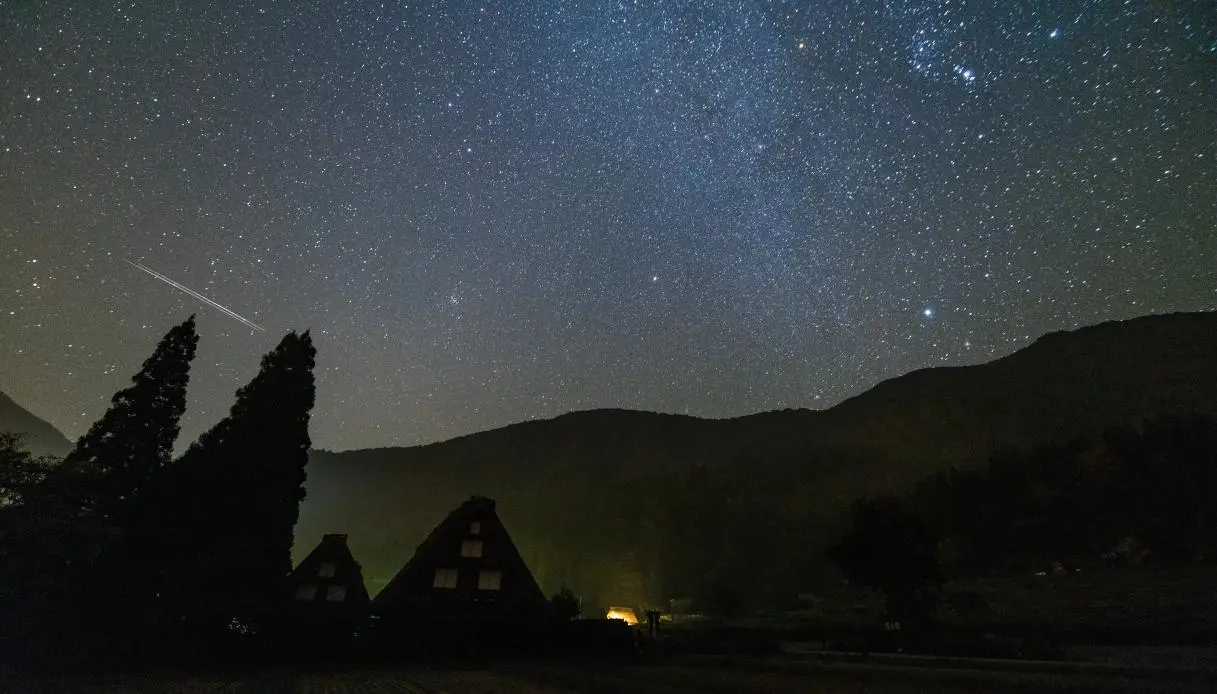
Autumn gifts one of the most captivating events for sky enthusiasts: the Orionids, the so‑called autumn shooting stars, are ready to illuminate the night sky with luminous trails and extremely fast meteors.
On the night between October 21 and 22, 2026 it will be possible to attempt observations also from Italy, weather permitting. The spectacle promises up to about twenty meteors per hour under ideal conditions, although the Moon’s glare and light pollution could make it harder to spot the fainter trails.
Orionids, when to see the autumn shooting stars
The Orionids are active from early October to the early part of November and traditionally reach their maximum in the latter half of the month. The peak in 2026 is expected between October 21 and 22.
The theoretical number expected is about 20 meteors per hour, a figure that presumes ideal conditions, with the radiant at the zenith and a sky free of obstacles and light pollution. In reality, sightings can be lower, especially in urban areas or when Moon light disrupts the view.
This year the Moon, approaching full phase, represents in fact one of the main obstacles. Its glow can wash out the fainter meteors, so it’s wise to concentrate attempts in the last hours of the night, when the satellite is lower or has set. Weather will also play an important role: clouds and precipitation, forecast for several parts of Italy, could compromise the visibility of the phenomenon.
The Orionids take their name from the Orion constellation, from which the meteors appear to originate. The radiant is located near Betelgeuse, the bright reddish star that marks one of the hunter’s shoulders. The constellation rises in the east late in the evening and gradually moves toward the southwest as the night progresses.
Halley’s Comet
At the origin of the Orionids lies the comet 1P/Halley, one of the most famous and recognizable bodies in the Solar System. Its orbital period is about 76 years: after its last close approach to Earth, which occurred in 1986, it will become visible again in 2061. During its journey, the comet releases dust and fragments that linger along its orbit. When Earth passes through this debris trail, the particles enter the atmosphere and disintegrate, producing the characteristic glowing trails.
The Orionids are particularly spectacular for their speed: they travel at about 66 kilometers per second, more than 237,500 kilometers per hour. This direct impact with the atmosphere can generate bright meteors and persistent trails.
Tips for admiring the spectacle
To enjoy the show in Italy, it is advisable to reach a location far from artificial lights, with an unobstructed horizon and a wide view of the sky.
Here is a selection of places we recommend:
For those seeking a guided experience, Italy hosts several astronomical observatories, including the one in the Valle d’Aosta at Saint-Barthélemy and the Gal Hassin in the Madonie, in Sicily. Before departing, it is wise to check the weather conditions and whether the facilities are open to the public.
