
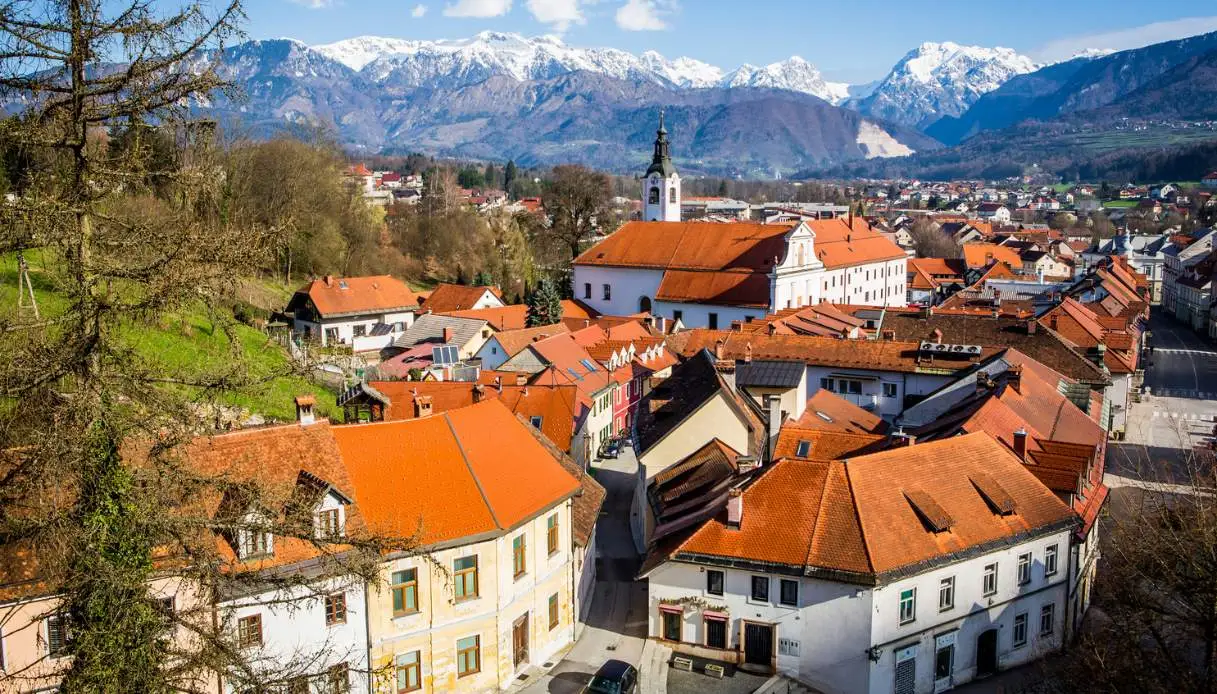
Less than 30 kilometers from Ljubljana, at the foot of imposing mountains, a city materializes where the medieval past seems never to have been surpassed. It is called Kamnik, and it presents itself with colorful façades, sloping roofs, and a small castle (in fact several) perched above the houses. In the background rise the Kamnik and Savinja Alps, a mountain range dominated by Grintovec (reaching an altitude of 2,558 meters).
The streets of the center guard stone portals, Baroque buildings, and ancient workshops, while from the squares one glimpses the Alpine peaks. During the Austrian domination it was known by the German name Stein im Oberkrain, tied to the word Stein, stone, an element echoed also by the Slovenian toponym. Even today, among the testimonies of old noble families and the stories handed down by the inhabitants, one senses the richness of a past that has left surprising traces.
What to See in Kamnik
The historic center of this Slovenian town unfolds around a long square and a street that for generations has hosted artisanal activities. In the past Kamnik was protected by walls up to 10 meters high, with a moat and four entry gates, which gradually gave way to the present locality (though it is not hard to recognize the importance of the ancient settlement).
Glavni trg, the main square
More like a refined street than a traditional square, Glavni trg is the true heart of city life. Here the façades of buildings reveal delicate colors, decorative moldings, and windows arranged according to the architectural transformations that occurred over the centuries.
Among the structures there are also interventions linked to Jože Plečnik, renowned local architect who left a fundamental mark on the architecture of Ljubljana and other places in the country.
Mali grad, the Countess Veronika’s Castle
A few steps are enough to reach one of the town’s most enchanting monuments: Mali grad, literally Small Castle. It sits on a rocky outcrop above Glavni trg, in a position that earned it the nickname of the balcony of the city. Of the ancient fortress complex, what remains is mainly an extraordinary Romanesque chapel on two levels, with a lower crypt.
From the hill the view crosses the town and reaches the mountains, but the site also guards one of the region’s most famous legends: it is said that the Countess Veronika, very rich and stingy, refused to contribute to the construction of a church, declaring that she would rather turn herself into a serpent.
The curse came true, to the point that she transformed into a being half woman and half reptile, until she vanished into the depths of the rock together with her treasure. Her figure has become so important that it even appears in the city coat of arms.
Stari grad, the ruins above the valley
On the hill that dominates Kamnik, on the opposite side of the river, rise the remains of the Stari grad, the Old Castle, which in the past formed one of the main defensive points of the territory.
What stands out is the contrast between the ruin of the structure and the natural panorama: on clear days the view embraces Kamnik, the Alpine slopes and part of the plain toward Ljubljana.
Via Šutna, between crafts and historic houses
Considered the most beautiful street in Kamnik, Šutna preserves the atmosphere of the old artisanal neighborhood. The houses overlook a narrow lane, with traditional signs, restored façades, and decorative details. Beautiful is the Immaculate Conception Church, recognizable by its Gothic bell tower separated from the main body.
Along the street you also find the birth house of Rudolf Maister, a Slovenian general, poet and painter born in 1874, who played a key role in the events following World War I. We also recommend visiting the Museum Sadnikar, tied to one of the town’s most interesting private collections of historical and artistic objects.
Franciscan Monastery and the Chapel of the Holy Sepulchre
Behind the quiet façades of the Franciscan complex lies a cultural heritage of considerable value. The nearby Church of St. James appears in documentary evidence as early as 1423, while the convent houses a library with about 10,000 volumes.
One of its most precious texts is the Slovenian Bible translated by Jurij Dalmatin and published in Wittenberg in 1584, a fundamental work for the history of the national language. Inside the complex is also the Chapel of the Holy Sepulchre, designed by Jože Plečnik in 1952.
Zaprice Castle and the Interregional Museum
Finally, on a hill not far from the old core stands the Zaprice Castle, another important testimony of aristocratic presence in Kamnik. Today it houses the Interregional Museum, which deals with the history, archaeology, and traditions of the territory.
What to Do in Kamnik
Kamnik is a privileged starting point for discovering the Central Slovenian alpine landscape. Within a few kilometers, pastoral plateaus, mountain springs, botanical gardens, and thermal resorts alternate.
- Visit the Velika Planina plateau: renowned for the pastoral village with characteristic wooden huts and very low-pitched roofs.
- Taste Trnič cheese: traditionally prepared from curd, cream, and salt, it is shaped into small forms decorated using carved wooden molds.
- Visit Arboretum Volčji Potok: a short distance from the center, it is one of Slovenia’s most important botanical parks, with thousands of plant species and varieties, meadows, lakes, and large floral collections.
- Explore the Kamniška Bistrica valley: woods, rock faces, and clear waters.
- Relax at the Snovik Thermal Baths: east of Kamnik lies this thermal spa complex set among hills and woods, known for its waters and environmental sustainability.
- Join traditional celebrations: September is the time for the festival Dnevi narodnih noš in oblačilne dediščine, dedicated to folk costumes and Slovenian cultural heritage. In August, Kamfest animates several city spaces with concerts, performances, and cultural initiatives.
Where It Is and How to Get There
Kamnik is located in central Slovenia, about 25-30 kilometers northeast of Ljubljana, thus a position that allows easy access to both the capital and the mountainous areas of the region. By car, starting from Ljubljana, the journey generally takes about 30-40 minutes, depending on traffic and the chosen route. Access is via the road network that traverses the Slovenian plain, heading north.
There are also rail and bus connections from Ljubljana, with travel times varying depending on the service. For those wishing to visit Velika Planina, the Arboretum, and other nearby attractions, having a car makes getting around easier.