
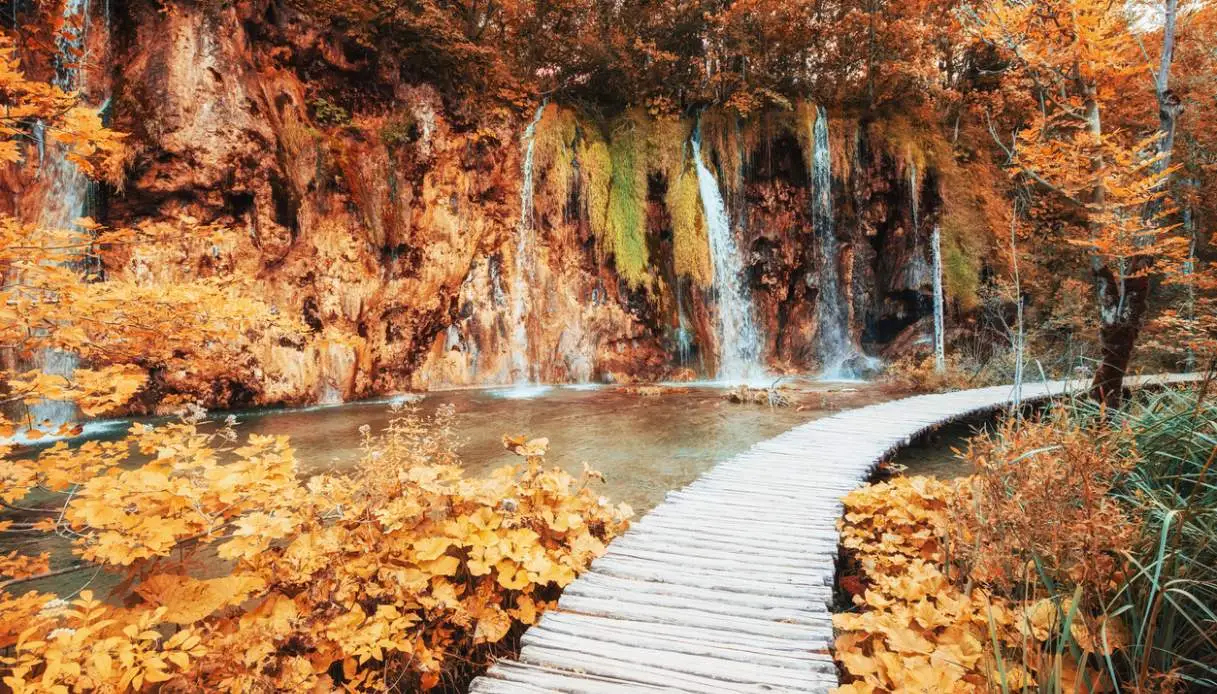
The water assumes an almost surreal color—sometimes emerald green, at other times a vivid blue—while the beech and maple leaves color the banks in yellow, copper, and red. There’s also that fresh, biting morning air, accompanied by the sound of waterfalls, sometimes barely audible among the trees, at other times so powerful that it drowns out every other noise. If all this happens, it means you have reached the Plitvice Lakes, which in autumn are one of Croatia’s most fascinating natural spectacles (perhaps even in all of Europe).
Located inland, away from the Adriatic coastal resort towns, the Plitvice Lakes National Park protects a system of 16 main lakes arranged in tiers, linked by cascades, streams, and natural rock barriers. Arriving here, one almost feels they have stepped into a fairy-tale dimension, yet in reality it is the result of ongoing geological processes that slowly reshape the course of water (Mother Nature at work).
Founded in 1949, it is the oldest and largest national park in the country. In 1979 it entered the UNESCO World Heritage List thanks to the extraordinary characteristics of its lacustrine system. Its beauty changes with the seasons, but between September and November it acquires a particular intensity, which we will now explore together.
Origin, Formation and Legends of the Plitvice Lakes
The lakes’ territory lies within the karst region of the Dinaric Alps, characterized by limestone and dolomite—rocks that react differently to the passage of water. At the base of the lake system lie the rivers Bijela rijeka, the White River, and Crna rijeka, the Black River, which converge to form the Matica, directing water toward the Prošćansko Lake. The waters contain dissolved calcium carbonate, a mineral fundamental to the creation of the so-called travertine barriers, also known as calcareous tufas.
Moss, algae and microorganisms foster the deposition of minerals, contributing to the growth of small natural barriers. Over millennia these structures have trapped water, giving rise to basins at different elevations and spectacular drops from one level to another. The peculiarity of the Plitvice Lakes lies precisely in this delicate balance, because the landscape remains subject to ongoing transformations.
Alongside the scientific explanations, there survives a legend linked to the Black Queen, a mysterious figure in local tradition. It is told that during a severe drought the inhabitants pleaded for her aid. Moved, the queen summoned rain, and from her tears were born the White River and the Black River. According to tradition, even the name of Prošćansko Lake is connected to the prayers addressed to the sovereign.
Visiting the Plitvice Lakes in Autumn
During autumn, the land of this enchanting corner of Croatia is carpeted with fallen leaves, while the air around smells of damp wood. Walking on the picturesque boardwalks, one realizes that between the branches there suddenly appear expanses of water in striking hues. What makes the visit especially special is the continual alternation of environments, from lakes with tree-lined shores to calcareous canyons crossed by roaring waterfalls.
The park covers about 296 square kilometers, but the lake basins account for less than 1% of the total area. The main basins are divided into two groups, with distinct geological and scenic features. The Upper Lakes, known as Gornja jezera, include twelve basins perched on dolomite rocks, surrounded by dense forests and irregularly shaped shores.
Prošćansko is situated in the highest part of the system and introduces a wide, tranquil landscape. A little further on, the succession of small water mirrors leads to Galovac, one of the most scenographic zones due to the presence of cascades and lush vegetation. Among the highlights are Veliki Prštavac and Mali Prštavac, waterfalls that plunge down moss-covered walls.
Then there is Kozjak Lake, the largest in the park: it can be crossed by electric boats, an experience that offers a completely different perspective on the forested shores. The atmosphere changes markedly in the Lower Lakes, or Donja jezera, formed by four basins framed by a canyon of calcareous rock.
Milanovac, Gavanovac, Kaluđerovac and Novakovića Brod follow one another along a route punctuated by bridges, steps and viewpoints. Seen from above, the lakes reveal color gradations that shift with depth, light, and the nature of the bottom. The most spectacular moment comes at the face of Veliki Slap, the Great Waterfall, with a drop of about 78 meters.
At its base the spray creates a fine mist, and the autumn foliage frames the imposing rocky wall. A short distance away, the Sastavci Cascades mark the final section of the lacustrine system, near the birth of the Korana River.
To explore Plitvice, there are marked itineraries labeled with letters, varying in length, duration and the zones they cross. The two main entrances let you begin from different sectors, while electric boats and panoramic vehicles help you move within the park.
The Route A is about 3.5 kilometers long and typically takes 2-3 hours. The Route C, nearly 8 kilometers, traverses both sections and takes 4-5 hours. Those who wish to spend more time exploring can opt for longer itineraries, up to 6-8 hours. In addition to the lakes, pay attention to the forests, home to numerous animal species, including deer, wolves and brown bears.
Where they are and how to get there
The Plitvice Lakes National Park lies in central Croatia, in the mountainous region of Lika, at an elevation roughly between 370 and 1,280 meters above sea level. Its inland location, between Zagreb and Zadar, makes it accessible from both the Croatian capital and the Dalmatian coast. From Zagreb the road distance is about 140 kilometers, while from Zadar it is nearly 130 kilometers.
By car, the main routes are the D429 road, which leads to the two main entrances, or the D52 for those arriving from the Otočac area. Both access points offer paid parking. There are also bus connections from Zagreb, Karlovac, Zadar and other Croatian cities, with frequencies varying by season.
To fully enjoy the magnificent autumn colors, it is best to arrive in the morning, when the light remains soft and mist may linger on the water. The park remains open year-round, although hours and the accessibility of trails depend on seasonal conditions.