
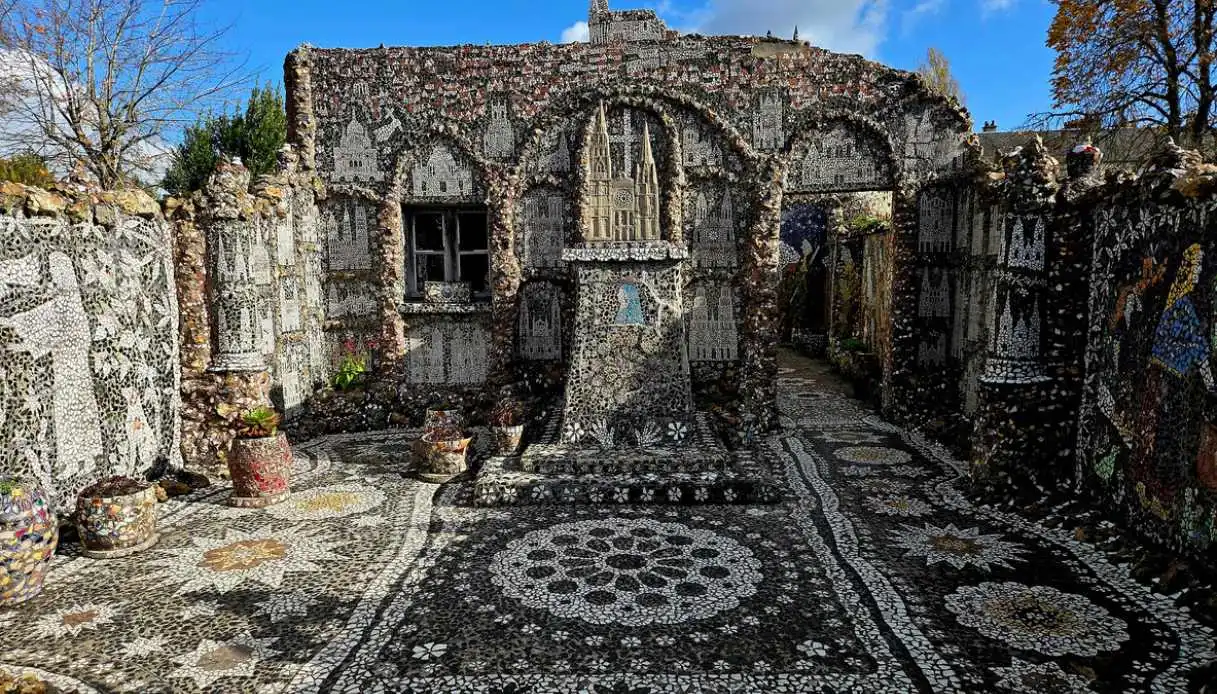
What we are about to tell you may feel uncanny: broken dishes transformed into flowers, porcelain fragments drawing cathedral silhouettes, and tiny glass tiles embedded even in the furniture. No, this isn’t a dream or the opening of a tale, because it is a real dwelling in Chartres, a French town famed for its monumental Gothic cathedral. In essence, tucked between streets lies a modest 20th-century home that guards one of the most astonishing creations of European outsider art. Its name is Maison Picassiette, but it is also known as the House of a Thousand Pieces.
Behind its walls hides the labor of Raymond Isidore, a municipal worker who spent more than three decades gathering abandoned crockery, colored glass, and ceramic fragments to transform his house into a work of art. Classifying it is difficult, because it sits somewhere between naïve architecture, mosaics, and Art Brut.
The sense many experience is like stepping into the imagination of a person who entrusted colors, shapes, and his own faith to tell the story of his life. And yes, it feels truly strange (but in a good way).
A Brief History of Maison Picassiette
Raymond Isidore, the creator of this jewel of France, was born in Chartres on September 8, 1900, the seventh of eight children in a family with modest means. In 1910, however, an event is said to have profoundly shaped his sensibility: during a visit to the Notre-Dame de Chartres cathedral with his mother, he would have suddenly regained the ability to see, discovering colors through the building’s famous medieval stained glass windows.
None of this has hard evidence, but what is certain is that during his life he held several jobs, eventually taking a position with the City of Chartres. He first worked in the waste depot and later in road maintenance, yet during his travels he remained captivated by the reflections of broken tableware and discarded glass (which he would promptly collect and keep in his garden).
It was in 1938 that the decisive insight came: those materials destined for the trash could become decorations for the home. He began with the interiors, using his spare time to paint, etch, and craft increasingly elaborate compositions. Gradually it all grew to astonishing dimensions, with walls, floors, ceilings, and furniture filling with color.
Neighbors took an interest in his activity, some bringing him broken dishes, others postcards to serve as models for the decorations. It was during this period that the nickname Picassiette was born, a play on words between Picasso and assiette, the French term for a plate, but also a nod to the expression pique-assiette, used to describe a freeloader.
Interest grew in the following years as photographer Robert Doisneau and several journalists visited the property, helping to spread knowledge of the artist’s work. In total, Isidore devoted about 29,000 hours to his creation, using an estimated 15 tons of dish fragments and glass, according to figures from the city of Chartres. In 1981 the town purchased the property, which was recognized as a French Historic Monument in 1983. Since 2017 it has also held the designation Architecture contemporaine remarquable, awarded by the French Ministry of Culture.
Visit to Maison Picassiette
Visiting the wonderfully quirky yet astonishing Maison Picassiette offers a chance to follow, in essence, the evolution of Raymond Isidore’s work—from domestic interiors to outdoor constructions. The route winds through a collection of decorated surfaces, narrow passages, and intimate spaces, where even the most common objects have shed their original appearance.
Within the walls, fragments of plates, porcelain, and ceramics form geometric and floral motifs, alongside figurative paintings. Among the subjects depicted are Chartres, its surroundings, and Mont-Saint-Michel, the famous monastery complex in Normandy. The imagery alternates with daisies, botanical intertwinings, and religious scenes.
The furniture is equally curious, with tables, chairs, and a variety of household objects incorporated into the decorative project. Even the floors were surfaced using marble scraps and salvaged materials. Beyond the living quarters, the compositions continue along the exterior walls and in the courtyards, where natural light inevitably highlights the differences between the materials.
Among the decorations, the replicas of Chartres Cathedral, the Porte Guillaume, and other French monuments stand out, including the Eiffel Tower, the Sacré-Cœur, and Notre-Dame in Paris. There is also the so-called black courtyard, one of the most distinctive spaces: pale tiles stand out against the dark backgrounds, forming miniature religious architectures, crosses, figures, and ornamental designs.
In 1956 Raymond expanded his concept by adding a chapel and a Maison d’été, a summer house designed to further widen his artistic universe. The chapel embodies the close link between his creative activity and spirituality and is adorned with Christian symbols, floral motifs, and a ceiling embellished with mirror fragments that evoke a starry sky.
Equally fascinating is the garden, which represents a true continuation of the house. Low walls, winding paths, beds, and architectural decorations give life to an environment where vegetation intertwines with the artistic compositions.
Some surfaces reproduce famous buildings, while others host animals, flowers, and human figures. The colors shift in intensity with the light, making surfaces covered with glossy fragments particularly evocative. The final creation was the Tombeau de l’Esprit, a symbolic construction dedicated to the spiritual dimension of existence.
Maison Picassiette is open to visitors with a paid admission, either on its own or through guided tours by appointment. For 2026, prices range from €9 to €12 for adults, with reduced rates for children and other categories. The site operates seasonally, with hours varying by season and an annual closure planned for November 29, 2026.
Where It Is and How to Reach It
The extraordinary Maison Picassiette sits at 22 rue du Repos, in Chartres, within the Eure-et-Loir department of the Centre-Val de Loire region, roughly 90 kilometers southwest of Paris. The property lies in the Saint-Chéron neighborhood, near the cemetery of the same name, which adds to its charm.
From Paris you can reach Chartres by train, leaving from the Montparnasse station. The trip generally lasts a little over an hour, depending on the chosen service. From the town’s railway station you can continue by public transport or by taxi. To reach Maison Picassiette by urban transport, line 4 of the Filibus network serves a stop named Picassiette.
Travelers driving from Paris can take the A10 motorway and then the A11, following signs toward Chartres.
