
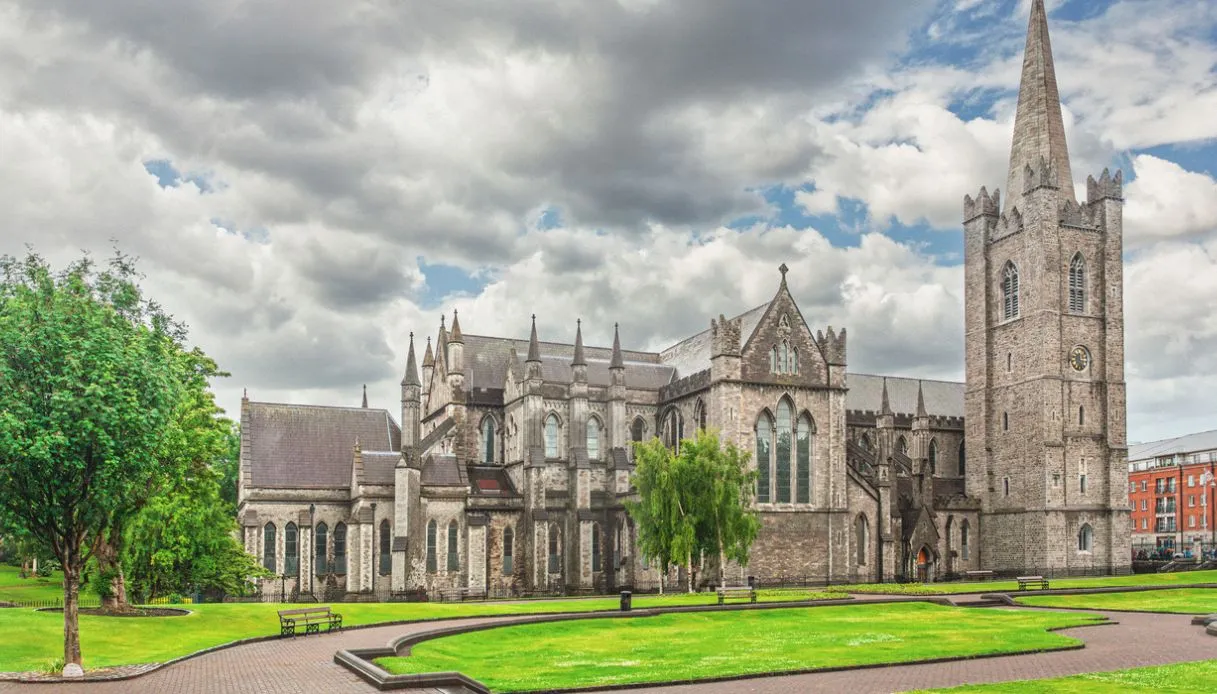
On October 28, 1726 Gulliver’s Travels landed on London bookshelves, the novel destined to become one of the most celebrated masterpieces of world literature: it was signed by Lemuel Gulliver, a fictitious ship’s surgeon, behind whom lay Jonathan Swift, a Dublin-born writer and dean of the Cathedral of St Patrick.
Three centuries later, his voyage through imaginary worlds becomes an opportunity to discover Ireland, following the traces of an author who managed to transform fantastical adventure into a tool for telling, with biting irony, the contradictions of society.
The Gulliver Tercentenary Breathes Life into Ireland’s Autumn
The celebrations come to life on October 28, the day the book was published, with a special evening at the St Patrick’s Cathedral in Dublin, dedicated to historical readings and music. The program continues with the Jonathan Swift Festival, scheduled from November 18 to 28, with an institutional opening on November 12.
Among the most curious events stands out the Craicademia: Gulliver Special, organized on November 18 at the Rascals Brewing Company: from 7:30 p.m. to 10:30 p.m., the brewery’s format becomes a gathering devoted to the world of Swift, with the so-called “Lillipian Lessons”: thirty-minute talks that blend literary insight with Irish conviviality. The speakers Brendan Twomey, Harry Burton and James Anderson will lead the audience through irony and reflections, before giving way to informal conversations, food, and beer.
The most spectacular moment will, however, be hosted by the Cathedral of St Patrick, which on Thursday, November 26, at 8 p.m., will frame the new musical And Then There Was Gulliver.
The calendar also includes theatrical and choral evenings, a candlelit gala dinner inspired by the four worlds traversed by the protagonist, and an event pairing Vivaldi’s Four Seasons, performed live, with the writer’s texts.
Even Northern Ireland takes part in the celebrations with the Armagh Georgian Festival, from November 26 to 29. Alongside costume re-enactments of the eighteenth century, light shows, and convivial moments, the program features academic sessions such as the Rokeby Lecture on November 26, dedicated to the critical and political heritage of the novel.
Dublin, Historic Libraries and Places Loved by the Writer
To reconstruct the relationship between Swift and the Irish capital, a natural stop is Trinity College, the university where he studied: in the Long Room of the Old Library, among the city’s most evocative spaces, is located the marble bust of the writer, crafted by Louis François Roubiliac. Until December 31, 2026, the library also hosts the exhibition Gulliver at 300, recounting the novel’s fortune through editions preserved in the university’s collections.
Nearby is Marsh’s Library, the oldest public library in Ireland: Swift frequented it diligently, also as a member of the library’s governing council. The eighteenth-century setting remains largely unchanged, with oak shelves, antique volumes, and the characteristic cages once used to protect readers from theft. The collection also includes works and first editions tied to the writer.
The itinerary then moves toward the northern coast of Dublin Bay to Howth Castle: the medieval stronghold, linked to the St Lawrence family, was a frequent dining venue for Swift. Reachable from the city centre by the DART, the suburban rail line running along the bay, it allows a literary discovery to be combined with a stroll through the marina village of Howth.
St Patrick’s Cathedral and the Memory of Laracor
The place that most vividly tells Swift’s life remains, above all, St Patrick’s Cathedral, where he served as dean from 1713 to 1745: here lie his tomb and funeral masks, along with various personal relics. The writer rests beside Esther Johnson, known as Stella and a central figure in his correspondence.
On the tombstone is engraved an epitaph composed by Swift himself, mentioning his “scoffing indignation,” now unable to trouble his heart. Among the objects preserved in the cathedral is also an ancient wooden table that Swift carried with him to Dublin: previously used to celebrate the Eucharist in his rural parish of Laracor, in County Meath, before he moved permanently to the capital.
Armagh, where the Annotated Copy of Gulliver Survives
The journey tracing the writer’s footsteps then leads to Armagh, a city in Northern Ireland Swift visited several times for ecclesiastical duties: here lies the Armagh Robinson Library, founded in 1771 and still characterized by its original interiors and architectural features.
The library houses a personal copy of the first edition of I viaggi di Gulliver, enriched by Swift’s autograph corrections: when he learned that the London publisher Motte had censored some of the book’s most incisive political passages to avoid legal trouble, the author personally annotated the margins with the changes needed to restore the original text.
Visiting Armagh can continue between the two Cathedrals of Saint Patrick, the Anglican Church of Ireland church and the Catholic one, which face each other on opposite hills. The area is also known for mead and for the production of cider: historical outfits, such as Long Meadow Cider, open their doors for autumn tastings.
Belfast and Cave Hill, on the Trail of the Giant Gulliver
The final stop of the itinerary is Belfast: local tradition and some critical readings associate the colossal figure of Gulliver with Cave Hill, the hill overlooking the city whose silhouette resembles a sleeping giant set against the rock.
From Armagh to Belfast, the route thus moves from historical documents to places where geography seems to converse with literary fantasy. For traveling between Dublin and Belfast one can also use the rail network connecting the two cities, with hourly departures.
