
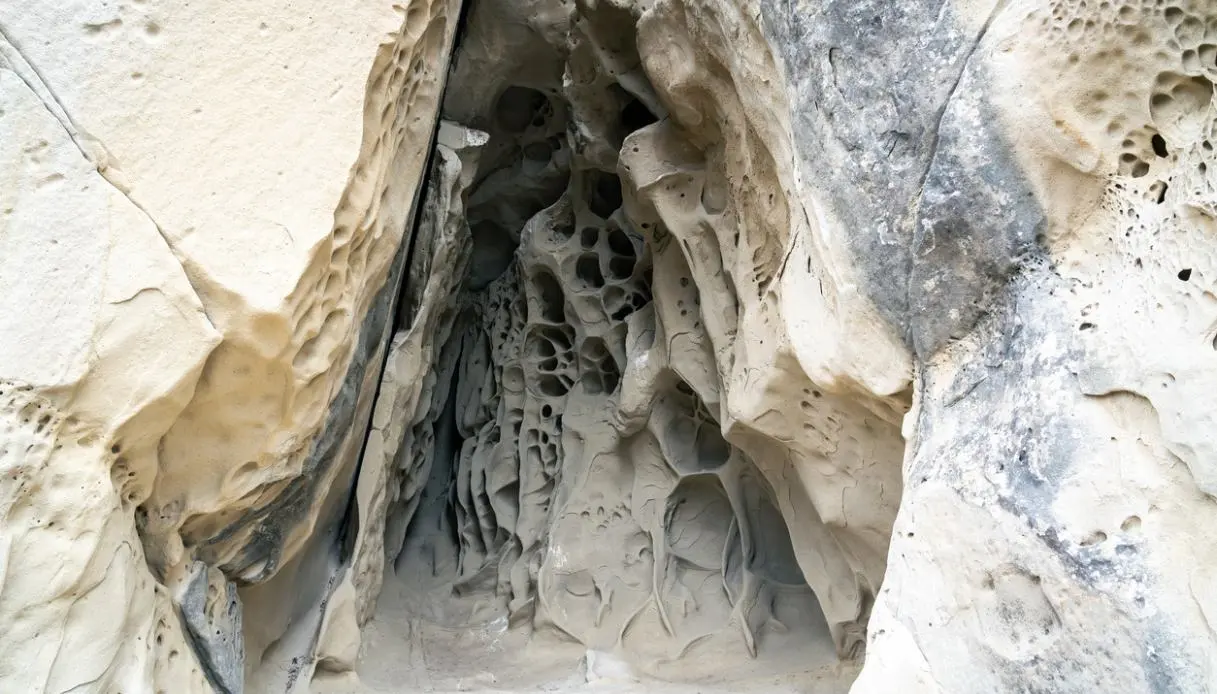
It almost seems as if someone took pleasure in digging hundreds of tiny craters into the rock, choosing with great care the depth and shape of each one. Some of these “holes” are perfectly circular, while others extend, meet, and overlap, turning entire rocky walls into a gigantic honeycomb (or even a colossal cheese). Yes, this spectacle is so whimsical that it might appear to be the product of human folly, when in fact it is the result of a geological history spanning millions of years.
The Soprasasso Caves, in the Bologna Apennines, are one of Emilia-Romagna’s most astonishing natural curiosities. They lie in the territory of Vergato, among forests, ancient rural settlements and ridges, about 50 kilometers from Bologna. In total there are three natural cavities carved in sandstone, with surfaces so elaborately textured that they evoke a lunar landscape, a petrified sponge, or the bed of a vanished sea (you can choose your metaphor).
Origin and Formation of the Soprasasso Caves
These wonders of Emilia-Romagna trace their origins to a very distant past: around 27 million years ago, during the Oligocene. In that era, sediments carried by currents accumulated at depth, gradually forming layers that would become the sandstones visible today.
The rocks belong to the Membro di Anconella della Formazione di Antognola, a geological sequence that in this sector comprises thick sandstone beds rich in quartz and feldspar grains. With the movements of the Earth’s crust and the uplift of the Apennine chain, those ancient marine deposits were raised, deformed and exposed to the elements.
What makes the scene even more thrilling is primarily the phenomenon of tafoni, a geological term used to denote particular hollows produced by the alteration and disintegration of rock surfaces. Water, humidity and weathering agents act on the granular structure of sandstone, promoting the gradual detachment of small fragments.
Some surfaces appear to be covered with bubbles, others display concentric niches, rounded edges and slender rock separations. The grazing light heightens the shadows inside the holes, making the relief look even more intricate. Tafoni are commonly associated with coastal and desert landscapes and arid environments. Finding them among the Bologna mountains makes Soprasasso particularly intriguing.
Some surfaces seem to be covered with bubbles, others show concentric niches, rounded edges and slender rock separations. Grazing light highlights the shadows inside the hollows, making the relief appear even more intricate. Tafoni are often associated with coastal, desert and arid environments. Finding them among the Bologna mountains makes Soprasasso particularly interesting.
The Emilia-Romagna region has recognized this area as a geosite of local significance, and the territory also falls within the Natura 2000 site named Soprasasso, Montecavalloro, extending over about 279 hectares (also significant for the biodiversity of plants and animals).
Visiting the Soprasasso Caves
Clearly, reaching them requires comfortable footwear and an excursion that lets you witness a gradual transformation of the landscape. The route runs through an Apennine environment still tied to its rural history, with old stone buildings, traces of farming, and paths once used to connect scattered settlements along the slopes.
The three formations are the stars of the visit, each with its own character. The first is aptly named the Soprasasso Cave, a wide recess that forms a natural shelter. It stands out for the size of the wall and for a peculiar rock shape at its base: erosion has carved out a kind of seat, often likened to a throne.
Looking upward, one can discern stacked layers, protrusions and small hollows, while the different tilt of the light brings out the sandstone’s hues, from beige to ochre yellow. Then comes the Grotta dei Piatti which is perhaps the most curious. Its name derives from the circular cavities that characterize the walls, with relatively flat bottoms and rounded profiles, resembling stone plates.
With a roughly triangular shape and limited internal development, it allows close inspection of the extraordinary concentration of tafoni. The rock is dotted with dozens of tiny shadows. The third marvel is the Grotta Buia, which the name alone hints at a different atmosphere: compared with the other caverns, it presents a more tunnel-like progression, with a deeper interior and less light.
The entrance leads to a zone where natural light fades and the walls take on darker tones. The contrast with the outer opening creates a particularly dramatic effect, especially on bright days. To appreciate the finer details, bringing a flashlight can be helpful, keeping in mind that the short approach includes a steep stretch, with sandy terrain and potential slipperiness.
The caves undoubtedly anchor the day’s highlight, but the surrounding landscape is not to be overlooked. From the sandstone escarpments, the view follows the Reno valley, discerns the ridges of the Bologna Apennines, and on clear days reaches the Corno alle Scale massif, one of the region’s principal peaks.
Along certain routes you also encounter the old Church of San Giorgio di Montecavalloro, a religious landmark tied to the historic settlements of this area.
Where They Are Located and How to Get There
The Soprasasso Caves lie in the municipality of , in the province of Bologna, on the heights overlooking the settlement of and the Reno valley. From Bologna you reach Riola by following the Strada Statale 64 Porrettana, while those who prefer train travel can take the Bologna-Porretta Terme line, alighting at Riola station.
For the hike you can start from the locality of , following the marked scenic loop that crosses the cave area. The tourist office of the Bologna Appennines suggests a circuit that can be completed in about 2 hours, plus time for stops. The longer itineraries vary in distance, generally between 6 and 8 kilometers.
The difficulty is hiking, with steep stretches, rock-carved steps and exposed passages that demand sure footing. Trekking shoes with good grip, water and a flashlight are strongly advised as part of the equipment. Before setting out it’s wise to verify the condition of the trails and select the route that best matches your fitness level.
For those who wish to extend their day, nearby you’ll also find the Grotte di Labante, famed for their distinctive calcareous formations shaped by water, and Rocchetta Mattei, a curious 19th-century building featuring medieval-inspired and Moorish architectural elements.
