
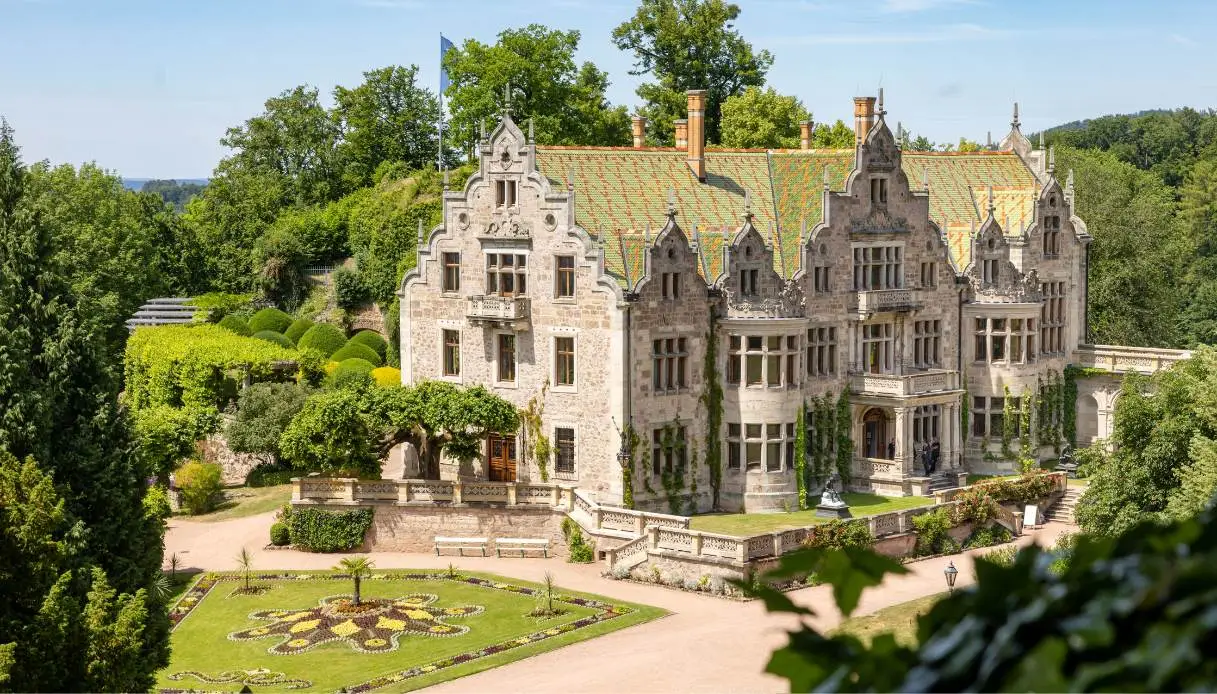
When one stands before the majestic Altenstein Castle, it is nearly impossible to remain indifferent, and the credit largely belongs to a duke. Its façade presents light-colored stone, a wealth of elaborate windows, sinuous pediments, and small decorative elements, so much so that for a moment one feels as if facing the home of an English aristocrat rather than a German residence.
Yes, we are in Germany and precisely in Thuringia, as unlikely as it may seem: even the landscape seems to join this particular display, with rocks jutting abruptly from the vegetation, romantically styled little bridges, and tiny structures hidden among the trees.
The castle, also known by its German name Schloss Altenstein, occupies a panoramic position overlooking the Werra valley, with views that on clear days reach the Rhön uplands. The estate, among other things, includes 160 hectares of landscaped parkland, one of the region’s most significant, designed to transform the mountainous terrain into a succession of romantic scenes.
Brief history of Altenstein Castle
The construction of this German castle began in 1736 by the ducal family of Saxe-Meiningen. It originally was a country residence, intended to become a retreat particularly beloved by the court. A decisive transformation occurred around 1800 at the initiative of Duke Georg I of Saxe-Meiningen, who chose Altenstein as his summer residence.
The sovereign desired an environment that would evoke emotions through the landscape, so he added rocks, caves, and vegetation, themselves enriched by pavilions, bridges, and small commemorative monuments. The wonder we can admire today owes much to the second half of the nineteenth century, when Duke Georg II promoted an important reconstruction in Neo-Renaissance style, thus inspired by the great English gentleman residences.
< /ask-ai-widget>
Georg II was known by the nickname Theatre Duke, the Duke of Theatre, thanks to his direct involvement in theatrical productions. He designed costumes, planned stage sets, and contributed to the fame of the Meiningen court troupe, profoundly influencing European theater. No wonder, Altenstein also mirrored this artistic sensibility.
The nobleman indeed issued precise instructions to his architect, yielding a building characterized by curved pediments, semicircular bay windows, numerous chimneys and decorative pinnacles resembling small obelisks. During the summer stays, the residence hosted several representatives of the intellectual and musical world, including Johannes Brahms, who spent several periods there in 1894 and 1895.
As with most of the most fascinating stories, however, this captivating Thuringian castle also endured a painful chapter in 1982, when a fire destroyed much of the historic interiors. The subsequent restoration efforts restored value to the complex, which in 1995 became part of the Foundation of the Castles and Gardens of Thuringia.
Visiting Altenstein Castle and what to see in its park
You are greeted by a sumptuous Neo-Renaissance façade that features windows divided by slender stone elements and projecting towers, as if built to be observed from multiple angles. Then come the terraces that host geometric flowerbeds, ornamental trees, and refined floral compositions. One of the most enchanting is certainly Teppichbeet, a carpet bed created annually with about 4,600 plants arranged according to historical designs.
The effect is that of a vast botanical embroidery, with color motifs that stand out on the lawn. Equally characteristic is the Knotenbeet, a knot garden inspired by traditional ornamental compositions. Moving away from the building, the ground becomes irregular, the trees thicken and the rocky walls take the place of orderly flowerbeds.
The landscape project leverages precisely these differences, with trails, viewpoints, and architectures purposefully placed in scenic positions. Among the most singular elements is the Blumenkorbfelsen, the Flower Basket Rock: conceived at the behest of Georg I, it uses an 18-meter-high rocky spire on whose summit a large basket of flowers carved into the sandstone was placed.
At its base lies the Greifenbank, a semicircular bench decorated with griffins and a commemorative bust. The design echoes the seats of ancient Pompeii, especially admired by European aristocracy during the Grand Tour. Not far away is the Chinesisches Häuschen, the Chinese Pavilion, a testament to the taste for Oriental-inspired architectures that spread through European gardens in the 18th and 19th centuries. Nearby, the Ritterkapelle, or Knight’s Chapel, references medieval romanticism.
The route also includes the Teufelsbrücke, the Devil’s Bridge, along with the evocative Luisenthaler Wasserfall, a waterfall set in a rocky, almost Alpine landscape. Of notable interest is also the Altensteiner Höhle, a cave identified in 1799 during roadworks, later transformed into an unusual underground garden.
Today, the interiors of the castle are closed for restoration, with reopening planned by the Foundation in the summer of 2027. Within its walls lies the memorial dedicated to Brahms which includes autographed letters, first editions and testimonies of his visits to the ducal court. The residence certainly houses magnificent rooms such as the historic Dining Hall, rebuilt on the basis of photographs and period documents, the Hall of Celebrations, and the Concert Hall. Finally (but not least in importance or beauty) the Chinesisches Kabinett (Chinese Cabinet), dedicated to the aristocratic passion for East Asian art between the 18th and 19th centuries.
Where it is and how to reach
Altenstein Castle sits near Bad Liebenstein, in the Wartburgkreis district, in western Thuringia. To reach the estate by car you may use the address Altenstein 8, 36448 Bad Liebenstein. The main parking area is at Waldhaus, about 250 meters from the building that houses the visitor center, the Hofmarschallamt.
Those opting for public transport can use bus line 41, with a stop at Altenstein, or line 196 to Steinbach, Glasbachstraße. The limited availability of parking spaces makes public transport advisable, especially on days of higher attendance.
The visit can be combined with the spa town of Bad Liebenstein and the nature itineraries of the Thuringian Forest. For Altenstein, however, it is worth reserving several hours: behind the façade of an aristocratic residence lies an entire landscape designed to surprise.
