
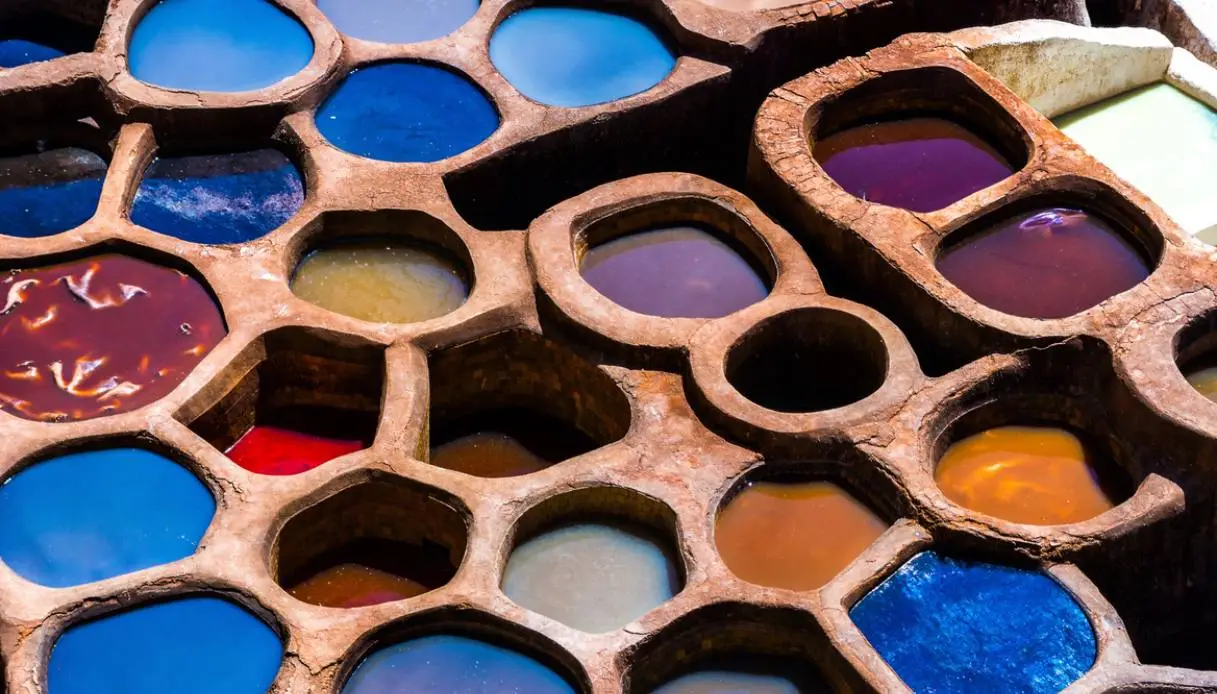
Hold onto the sprig of fresh mint they’ll give you shortly after entering, because the sharp steam that rises upward, loaded with ammonia, lime, and quicklime, is initially very bothersome. Those who overcome the first olfactory barrier, however, discover a giant chessboard carved into the earth, filled with hundreds of stone basins brimming with colored liquids. Dozens of circular basins crowd together, forming a mosaic of tones ranging from white to orange, while in the middle men with their legs immersed to the knees lift heavy wet skins. All of this unfolds under the sun and among walls that are decidedly very old.
We have arrived at the Fez tanneries in Morocco, one of the most peculiar places in North Africa, and what is observed is a craft handed down for about 1,000 years. What makes it even more surprising is the contrast with the rest of the city: not far away, in the alleys of the medina, merchants display embroidered babouches, bags and jackets in soft leather, while in the tanneries one witnesses the hardest part of their production, also because tanning is carried out exactly with the same methods used during the Middle Ages (yes, no modern machinery is used).
A Brief History of Fez’s Tanneries, Between Traditions and Ancient Tales
Fez is a remarkable city in Morocco that was founded toward the end of the 8th century and the beginning of the 9th by the Idrisid dynasty. Its development was rapid, quickly turning it into an important religious, commercial, and cultural hub frequented by merchants arriving from the Mediterranean, sub-Saharan Africa, and the East.
Leatherworking already represented, in the medieval period, one of the most lucrative activities: artisans and master craftsmen contributed to the diffusion of technical knowledge that allowed tannery production to reach markets even quite distant. The goods produced in Fez, moreover, were valued for the quality of the materials and for the refinement of their finishes.
During the Almohad period, between the 12th and 13th centuries, the craft became even more consolidated. Under the Merinids, commercial prosperity favored the development of artisan guilds, with trades organized in specialized districts. Around these workshops, stories about the skill of the tanners and the value of their craft were inevitably handed down.
Rather than to fantastical legends, their fame belongs to the collective memory of Fez, built through generations of families who safeguarded recipes, gestures, and professional know-how. In the 21st century restoration interventions were carried out, particularly important for Chouara (the city’s most famous tannery), aimed at preserving the historic structures and improving hygienic and working conditions.
What to See and How a Visit to Fez’s Tanneries Works
The most famous sight (and perhaps the most incredible) belongs to the Chouara Tannery, which is, among other things, the largest traditional tannery still active in the medina. From above, the vats seem to form an irregular mosaic, wedged between ochre-colored buildings, weathered walls, and terraces loaded with skins laid out to dry.
The courtyards are open to ensure light and ventilation, while the stone and masonry vats (often circular or polygonal) are arranged in close contact to make the most of the available space. Around them there are warehouses, workshops, and rooms dedicated to the various stages of production.
Once you cross the entrance, it’s almost inevitable not to stand still and watch the harsh working process that unfolds practically every day (or almost). Before becoming a bag or a pair of babouches, indeed, the skins of goats, sheep, cattle, and dromedaries must undergo a long and physically demanding processing. It begins with cleaning the raw hides, immersed in vats containing water, lime, and other substances traditionally used to help remove hair and organic residues. Follow-up treatments include the use of pigeon droppings, particularly renowned in Fez’s tanning tradition for their softening function.
It is precisely this last cycle that produces part of the acrid smell that characterizes the place. The artisans work in direct contact with the liquids, using their hands, feet, and simple tools to treat the surfaces and prepare them for the next operations. The tanning itself serves to stabilize the fibers of the leather, making it sturdy and durable.
Then comes the most spectacular moment, namely dyeing: the vats take on different hues thanks to the pigments used. Among the traditional dyes are indigo for blue, henna for orange tones, poppy for red, and saffron for yellow. The skins are infused with color, worked repeatedly, and then left to dry in the sun.
Besides Chouara, other historic laboratories still endure around this tireless city:
- Sidi Moussa: in the Guerniz district, preserves a more compact layout, with vats distributed irregularly. Its antiquity is evidenced by medieval chronicles.
- Ain Azliten: smaller in size and generally less frequented by tourists. Also here, tanning activity continues to be a fundamental part of the city’s artisanal identity.
Visiting the tanneries typically takes place from the terraces of leather shops that surround the courtyards. At first, you pass through rooms filled with bags, poufs, belts, and jackets, then climb stairs (yes, some are steep) to the viewpoints.
And it is during this final ascent that shopkeepers often hand you a sprig of fresh mint to hold near your nose, a small trick to lessen the perception of the odors coming from the vats. Access to the terraces is usually free, but a small tip is requested or appreciated, while purchasing items displayed in the shops remains optional (one small tip: clarify this in advance with the person greeting you at the entrance).
Where They Are Located and How to Get There
The tanneries are located within the Fez el-Bali medina, in the historical part of the city. Chouara sits in the Blida district, more precisely near the course of the Oued Fès and not far from Place Seffarine. The final stretch must be walked, as the narrow streets of the old town are largely inaccessible to cars. Starting from the main entrances of the medina, you can follow the signs to Chouara or rely on an authorized local guide.
Regarding the time of the visit, spring and autumn generally offer more pleasant temperatures than summer, when the heat can make the odors even more intense. The artisans’ activity and the shops’ hours can vary, especially during Ramadan and on holidays.