
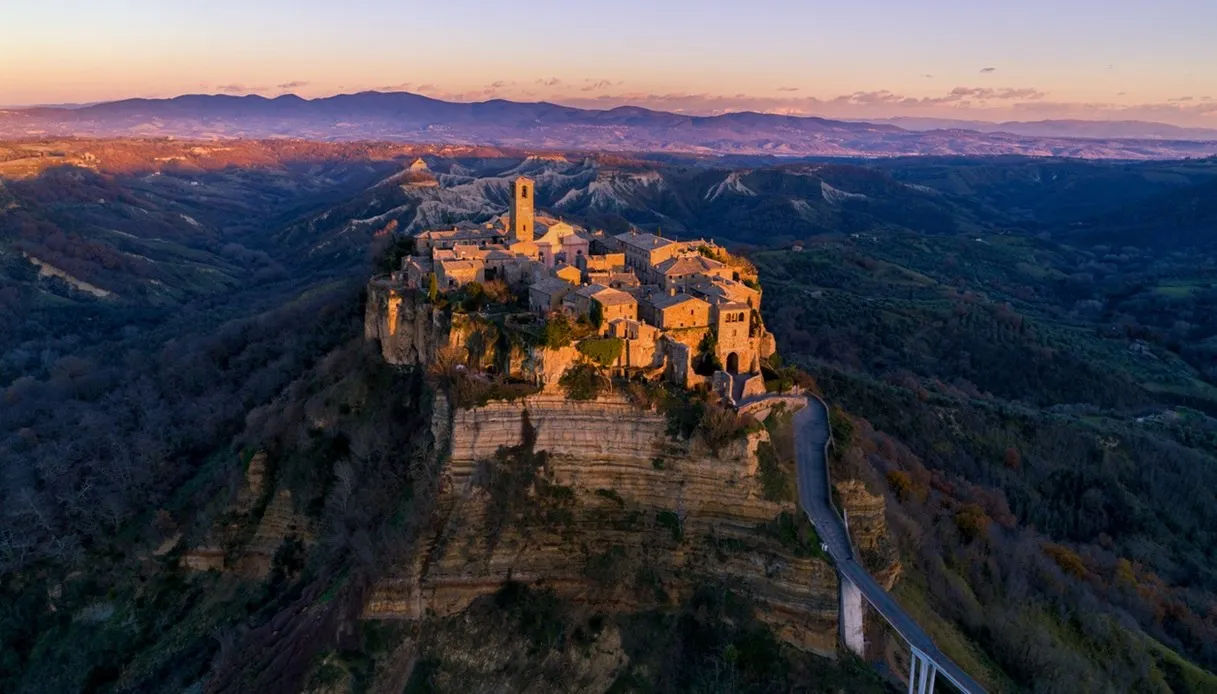
A hillside village perched above the Valley of the Calanchi and a town overlooking the lake win the title of the Italian Capital of Contemporary Art 2028: Civita di Bagnoregio and Bolsena. The Tuscia region thus earns another important recognition, thanks to a project that places historical heritage in dialogue with creativity and the new generations.
The announcement came from the Minister of Culture Alessandro Giuli. The jury was won by the dossier “Art that Comes, Art that Goes,” which proposes transforming the territory into a dispersed laboratory of artistic production, education and participation.
Civita di Bagnoregio and Bolsena win the title for 2028
The two towns in the province of Viterbo will jointly become the new Italian Capital of Contemporary Art for 2028. This year, the current holder of the recognition is Gibellina, while in 2027 the baton will be handed to the Piedmontese city of Alba.
For 2028, the Tuscia candidacy prevailed over the other three finalists: Capri, with “The Sirens of the New”; Padova, with “Still Learning. Exercises of Dissidence”; and Pozzuoli, with “The City of Creative Fragilities.”
To the winning proposal will be allocated one million euros to realize its cultural program. The title will be formally conferred by a resolution of the Council of Ministers, on the proposal of the Minister of Culture, following the guidance of the jury chaired by Lorenza Baroncelli.
The choice was unanimous. Among the reasons for its nomination are the relationship with the identity of the places, the attention to training and the ability to imagine a lasting heritage. The project aims to make contemporary art a permanent presence in the life of this fascinating territory, with a programming capable of continuing beyond 2028.
“Art that Comes, Art that Goes”: the project dedicated to young people
The dossier, presented by Civita di Bagnoregio together with Bolsena, stems from months of dialogue among artists, institutions, schools and associations. At its core are the young people, the opportunity to engage with art and the desire to build new opportunities in the territory.
For Luca Profili, mayor of Bagnoregio, the result represents a recognition that involves the entire Tuscia. The collaboration with Bolsena, led by mayor Andrea Di Sorte, has given shape to a proposal in which schooling and artistic training occupy an essential role.
Their ambition is to create a diffused cultural laboratory, where production, learning and participation reinforce one another. The dialogue between the ancient and the contemporary was also highlighted by Alessandro Giuli during the proclamation: “The contemporary has meaning if it looks forward, if in the flow of history it addresses the younger generations – said the Minister of Culture. – The activities of the Ministry of Culture find an ideal recipient among the younger generations, and to them we dedicate the opening of this envelope.”
The project, according to the jury’s reasoning, “distinguishes itself for the full and documented adherence to the vision of the call,” interpreting contemporary art “not as an event to be consumed, but as a permanent infrastructure.” In particular, “the artistic program is of high caliber and dialogues with the identity of the places without overlapping it,” and the project “is built from the outset on the heritage it intends to leave: continuity is safeguarded by a multi-year programming, the financial framework is sized prudently, not dependent on a single funder, at the heart of the proposal is the training of the youngest, for a result that matures over time.”