
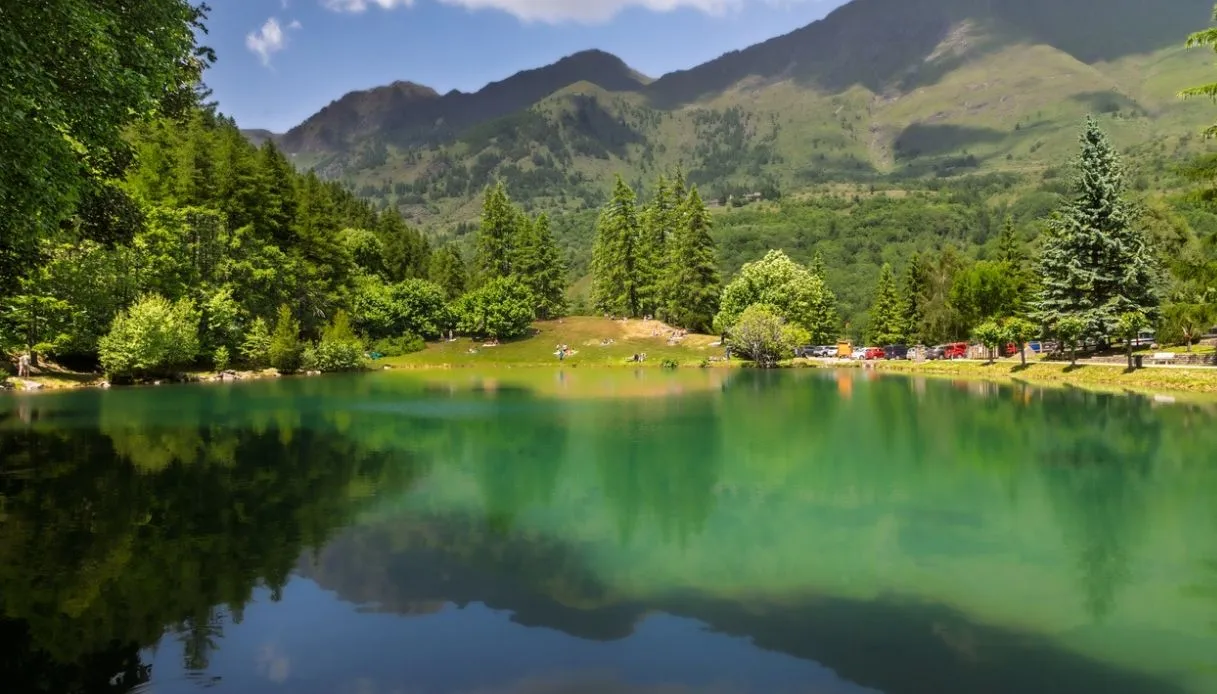
Trekking and outdoor enthusiasts love the Piedmont Alps as an Italian high-mountain destination with ever-changing vistas, but today we can look at them with new eyes: a valuable archaeological and natural history discovery is rewriting the story. Right in Val Chisone, two rocks with a history dating back about 530 million years have been identified.
The discovery of ancient rocks in Val Chisone
Two rock samples collected in Val Chisone, on the western slopes of Turin, could alter our understanding of the western Alps’ geological origins. They are approximately 530 million years old, far older than previously thought for this part of the region. The finding comes from a team of geologists from the University of Turin, led by Rodolfo Carosi, during a survey to update the national geological map.
Noticing the two rocks, one dark in magmatic origin and the other lighter with a granitic composition, was a team that also included doctoral student Francesco De Cesari. The samples underwent detailed analyses. The crystallization ages were determined through zircon crystal analysis, conducted in Bern with the contribution of researcher Daniela Rubatto. The results indicate crystallization ages of 532 and 530 million years, with an uncertainty of 11 million years.
Until now, for this portion of the Alpine basement, rocks of around 300 million years were referenced. The discovery thus pushes back by more than 200 million years a portion of the local geological history. The rocks lie in the Pinerolo-Sanfront Unit, within the Dora-Maira massif. They date to the Cambrian, a time when the Alps did not yet exist and life was largely confined to the oceans. A very remote past, kept hidden for millions of years among the Piedmontese mountains.
Why the discovery is so important
We are used to thinking of the Alps as ancient mountains, and indeed their formation began tens of millions of years ago. But the rocks that make them up can be much older. The Val Chisone finding reminds us of this: the mountains we see today are the product of a history that is much longer and more complex, involving shifting continents, ancient uplifts that disappear, and materials that are transformed and brought back to the surface over time.
So far, for this area of the western Alps, researchers had mainly reconstructed traces of the Variscan cycle, associated with the formation of a previous mountain belt during the Paleozoic. The new dating adds an even more remote piece, linked to the Cadomian cycle, which occurred more than half a billion years ago.
These fragments take us back to a time when the ancient continent Gondwana existed, long before the emergence of Pangea. The rocks underwent enormous transformations, eventually becoming part of the mountains that today characterize Piedmont. According to the researchers’ hypotheses, the Cadomian-era mountain system could have been vast, extending across thousands of kilometers. There has even been talk of some ranges surpassing 5,000 meters in height, but these remain unverified scenarios, not confirmed features of the landscapes from which the samples came.