
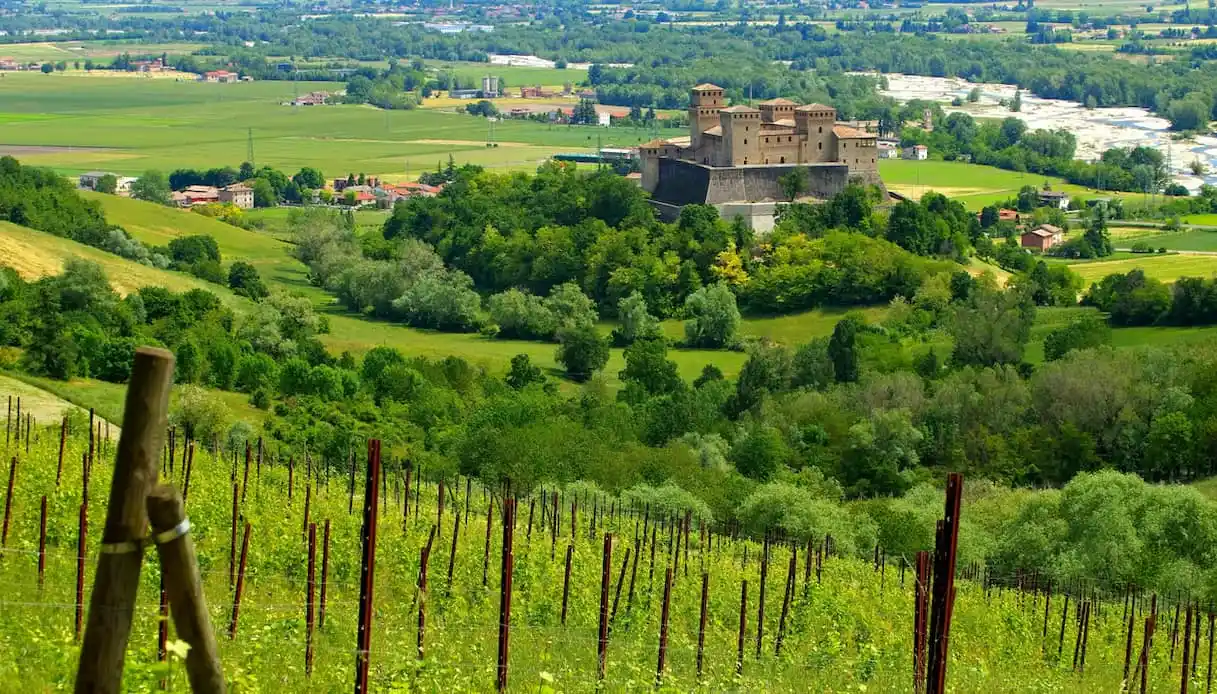
How often do we only realize, after someone tells us or after we see them in the media, all those places we are used to having nearby and that, precisely for this reason, we almost take for granted? It seems that sometimes the gaze of someone arriving from abroad is needed to remind us how extraordinary they can be. This is what happened to the castles of Emilia-Romagna, which found themselves in the spotlight of Forbes in an article dedicated to slow travel.
The Forbes journalist invited international readers to step away for a few days from the crowded Italian cities and to discover a landscape made of hills, small villages and ancient fortresses. According to the publication, it is precisely by traveling slowly through the Emilian countryside that one encounters one of the region’s most fascinating heritages: medieval and Renaissance castles that tell centuries of battles, dynasties, loves and intrigues.
An accolade that once again confirms how some of Italy’s most evocative treasures lie far from the most trodden tourist routes.
The Castles of Emilia-Romagna That Captivated Forbes
The journey recounted by Forbes begins with the network of Castles of the Duchy, which brings together 38 castles, fortresses and historic residences open to the public, along with about fifty other cultural sites ranging from villas and museums to abbeys, palaces and residences. Some structures even allow visitors to spend the night inside the ancient walls.
Among the places chosen by the American outlet is the Castello di Scipione dei Marchesi Pallavicino, near Salsomaggiore Terme. It has around a thousand years of history and was built in a strategic position to control the area’s valuable salt wells. Even today it is inhabited by descendants of the Pallavicino family and preserves seventeenth-century furnishings, coffered ceilings, frescoes and even a small secret door that leads to a spiral staircase.
Forbes then highlights the Rocca Sanvitale di Fontanellato, surrounded by a wide moat filled with water. Inside lies one of the most important works of Italian Mannerism: the hall frescoed in 1524 by Parmigianino with the myth of Diana and Actaeon. Also notable is the 19th-century Optical Room, a system of mirrors and prisms capable of projecting onto a table what happens in the square outside.
A Slow Journey in the Food Valley
Yet the charm of the itinerary isn’t tied only to the fortresses. Forbes describes Emilia-Romagna as a destination to traverse without hurry, taking back roads through fields, vineyards and small towns rather than sprinting from one major city to another.
Iconic is the presence, still in Fontanellato, of the Labirinto della Masone, created by designer and publisher Franco Maria Ricci. Opened in 2015, it comprises about 300,000 bamboo plants and is listed by ENIT as the world’s largest bamboo labyrinth. Inside the estate there is also a museum with hundreds of works of art and spaces dedicated to gastronomy.
And it is precisely food that is the other major protagonist of the journey. Forbes suggests stopping at trattorias and osterias, visiting a dairy where Parmigiano Reggiano is produced, or discovering the production of Parma Prosciutto. It’s no accident that this part of Italy is known as the Food Valley, where castles, landscapes and gastronomic products end up becoming part of the same experience.
