
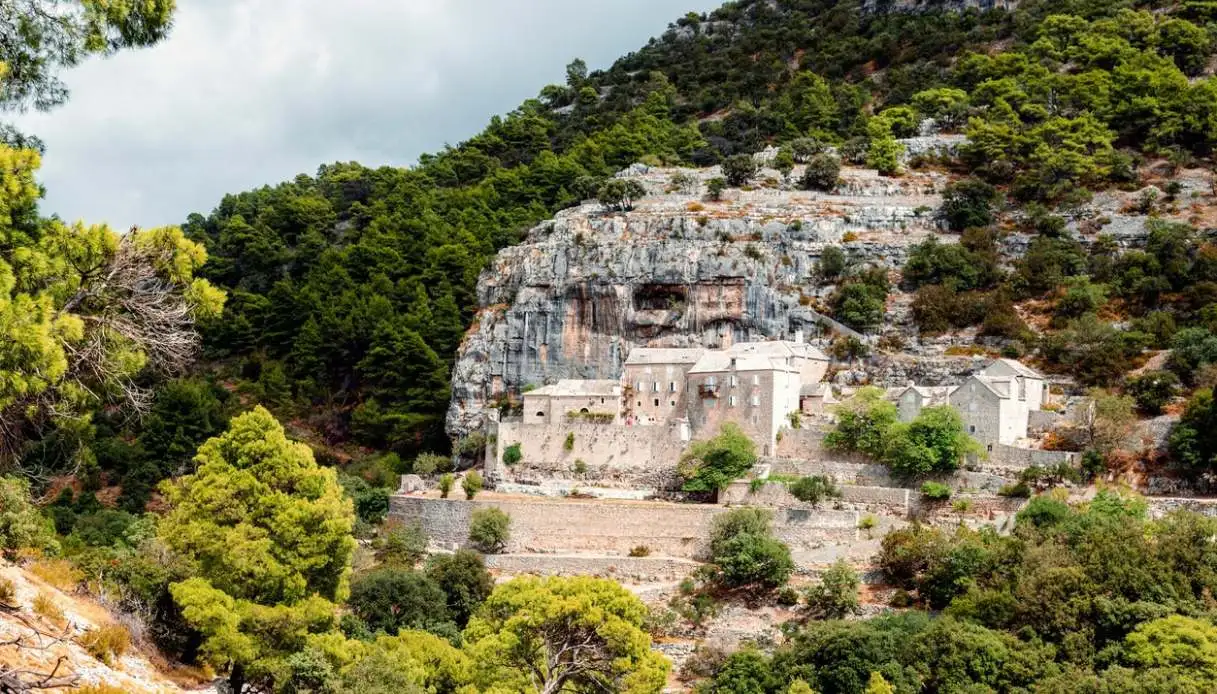
On the southern slope of Brač, a large Dalmatian island facing the Adriatic Sea off the coast near Split, a rocky gorge descends from the slopes of Vidova Gora toward the sea. The light limestone emerges among pines, holm oaks, olives and the Mediterranean scrub, while the valley walls seem to close in around a cluster of buildings the same color as the mountain. Right there appears the Blaca Hermitage, and it seems almost born from the rock.
Its Croatian name, Pustinja Blaca, evokes above all a secluded place destined for hermitic life. The image captures well the character of this complex founded in the sixteenth century, distant from inhabited centers and still reachable today only by a walk along a stretch. Behind that stone facade, however, hides far more than a monastery: Blaca was a farm, a school, a library, an economic hub, a printing house and even an astronomical observatory.
This very combination makes it one of Brač’s most singular places. Its history begins with a cave chosen as a refuge and ends, more than 400 years later, before a telescope pointed to the sky.
A Brief History Between Monks, Fires, and Stars
The origins date back to 1551, a period when Ottoman expansion in the Balkans drove religious figures and populations along the Dalmatian coast to seek refuge on the Adriatic islands. Two Glagolitic priests from the nearby Poljica region reached Brač and found shelter in the Ljubitovica cave, tucked into the hillside along the side of the valley.
The Glagolitic clergy belonged to a distinctive Croatian religious tradition tied to the liturgical use of the Slavic language and the Glagolitic alphabet, one of the oldest writing systems in the Slavic world. From that initial refuge formed a community destined to endure for centuries.
The original natural cavity became the core of the settlement, while around it residential buildings, workspaces, cellars, storerooms and religious spaces gradually arose. Between the 18th and 19th centuries Blaca achieved remarkable prosperity: the religious inhabitants expanded the properties, cleared lands, planted vineyards and olive groves, and organized an agricultural production that was surprising given the ruggedness of the terrain.
Towards the end of the 19th century a new phase of transformation arrived. The complex was enlarged with multi-storey stone buildings, cellars and spaces for the community. A mighty surrounding wall helped give it the appearance of a small citadel gathered at the foot of the cliff.
The final chapter belongs to Father Niko Miličević, a resident priest and perhaps the most remarkable figure in Blaca’s history. An avid astronomer, he transformed part of the hermitage into an observatory and acquired scientific instruments of considerable caliber for the era. His studies were published in European journals, and the large telescope preserved at the complex still recounts that unlikely season devoted to observing the sky.
A Visit Through Rooms, Books, and Astronomical Instruments
Those who arrive discover roofs, walls and façades that seem to follow the irregular course of the terrain rather than oppose it. Blaca indeed grew through successive additions, adapting the buildings to the gorge and linking religious spaces, dwellings, storerooms and production facilities. The effect changes when you enter the interiors: after the austerity of the valley, elegant furniture, paintings, books, clocks, tools and personal objects appear.
The rooms retain much of the furnishings present at the death of the last priest and convey the sense of a house left suddenly. One of the most precious centers is the library, consisting of about 11,000 volumes. A substantial portion predates 1800 and is filled with religious books, scientific works and texts of various kinds.
Also striking is the collection of clocks, tied to the care for precise timekeeping. Alongside stand scientific and astronomical instruments, up to the famous telescope used by Niko Miličević. The progression from ancient cells to the instrumentation for studying the stars perhaps sums up the hermitage’s identity better than any tale.
Among the objects kept are also historical weapons, paintings, period furnishings and a piano weighing about 400 kilograms. Imagining the transport of such an instrument across a landscape lacking a standard modern road helps to understand the organizational capacity achieved by the community.
The visit also reveals the hermitage’s economic structure: cellars, agricultural spaces and service buildings show that the priests lived off the work of the surrounding lands. Vineyards and olive groves occupied the terraces of the valley, while the products reached other ports by boats tied to the monastic estates.
Blaca has appeared since 2007 on Croatia’s Tentative List for a future UNESCO World Heritage nomination. The recognized value lies precisely in the exceptional fusion of Karst landscape, architecture, agriculture, spirituality, and scientific activity.
A visit requires footwear suitable for uneven ground and a good supply of water, especially during the hot months. The final approach is on foot, and the route is an integral part of the experience. It is advisable to check in advance the museum’s opening days and hours, as they can vary during the season.
Those who choose the sea itinerary can pair the excursion with a stop in Blaca Bay. After the stretch of rock and vegetation, the crystal-clear water of Brač’s southern coast offers a charming change of scenery.
Where It Is and How to Reach It
The Blaca Hermitage sits in a karst valley on the southern side of Brač, beneath Vidova Gora, the island’s highest peak at 780 meters. The area lies in the interior roughly between Bol and Milna, distant from the island’s more frequented seaside spots and from the main roads.
Two traditional access points are used: from the interior you reach the Dragovoda area by passing through the Nerežišća territory. The vehicle should be left before the final stretch, and from Vrh Blaca one proceeds along the path that descends into the gorge. The hike takes about 40 minutes, with variations depending on the exact starting point and personal pace.
The second option is arrival by sea at the Blaca Bay. From the coast, a roughly 2-kilometer uphill path leads to the monastery, crossing the rocky landscape of the valley. In this case, allow about an hour.
The very absence of direct road access has helped preserve its atmosphere: for centuries people, goods, tools, books and construction materials had to face the same geographic isolation. And even today, the hermitage appears only after traversing a stretch of rocks and vegetation, almost hidden until the last minutes.