
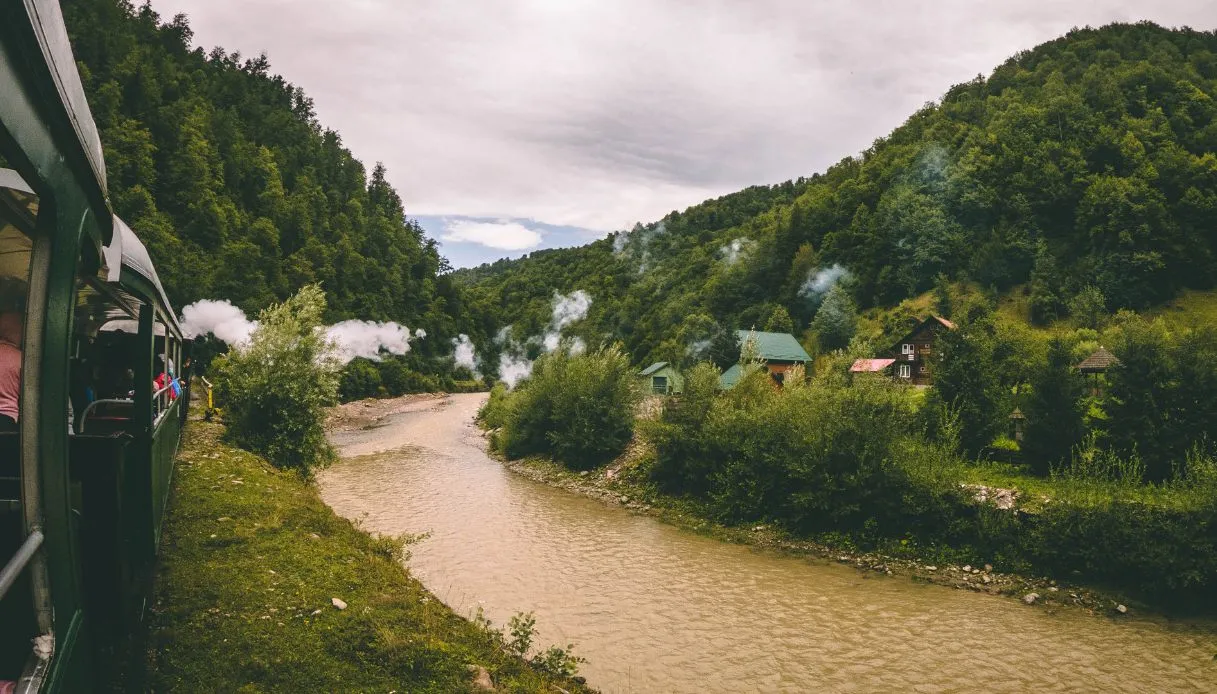
The locomotive’s whistle arrives before the movement begins. Immediately afterward, the train gradually gains speed, leaving behind the Vișeu de Sus CFF station amid puffs of steam, the metallic clatter of the wheels, and that iron odor typical of old railways. A few minutes later the urban landscape thins out and along the sides of the tracks slopes covered with trees, waterways, rocky walls, and small structures tied to the long forest history of the Maramureș.
The Mocănița of the Vaser Valley is certainly an era-steeped tourist train, but also a forest railway still linked to timber transport. The experience therefore preserves an authentic roughness, made of historic rolling stock, narrow-gauge tracks, essential stops and rhythms also dictated by the line’s operational needs.
The tourist route follows for 21.6 km the Vaser Valley, inside the Maramureșului Mountains Natural Park, in Romania. The Vaser River accompanies much of the journey with swift waters, bends and small tributaries, while the elevations progressively close in around the rails. In many languages it is also called Trenul Amintirilor, the “Train of Memories,” a term particularly apt for a vehicle that continues to carry locomotives, workshops, stations and habits born around the timber economy.
A Brief History of the Vișeu de Sus Mocănița
The forest railway of Vișeu de Sus took shape more or less around 1930, a period when timber from the Maramureș Mountains represented a fundamental economic resource. Carrying logs out of the mountain valleys required infrastructures suited to narrow territories, rich in waterways and difficult to reach by ordinary roads.
The CFF station was established within the Valea Râului sawmill area, which started operating in 1930. The railway buildings housed the offices of staff tasked with managing the forest network and supervising timber transport. In 1931, a first section was also put into service to connect the sawmill to the CFR station of Vișeu de Sus.
From that nucleus arose a railway system deeply intertwined with the valley’s productive life. The locomotives hauled wagons loaded with logs from the mountain zones toward Vișeu de Sus, following a natural corridor marked by the course of the Vaser, so that even today tracks, service points, rolling stock and old stops tell of a railway built primarily for work.
The locomotive fleet also preserves pieces from different eras and origins, such as locomotives produced in Reșița in the 1950s, including Bavaria of 1954, Ioana of 1955 and Elveția of 1954. There is also Măriuța, built by the German O&K in 1910. Some machines are operational, others form part of the historic heritage kept in Vișeu de Sus.
The journey thus offers a small sample of industrial archaeology still embedded in its original environment. The most interesting aspect is precisely this continuity: the CFF maintains a function tied to the forest and, at the same time, allows passengers to read directly a portion of the economic history of this area of Romania.
The Visit, the Journey, and the Most Beautiful Stops
The departure takes place from the Vișeu de Sus CFF Yard, distinct from the town’s normal CFR railway station. It is worth bearing this difference in mind during planning, since the two facilities have separate roles. The tourist journey lasts about 6 hours including outbound, stops and return, with a terminus at Paltin, 21.6 km from the starting station.
After departure the train meets Fabrica Trei at km 5.2 and Valea Scradei at km 6.8. The latter presents the appearance of a small mountain settlement cut by swift waters and also houses the monastery dedicated to the Nativity of the Mother of God, linked to local religious celebrations.
At km 12.4 you reach Novăț, a point historically connected to the timber processing. The brook flows into the Vaser, forming a small river delta of sorts and the presence of the old railway node recalls the logistical role the area assumed throughout the 20th century. From this part of the route the landscape becomes progressively more closed and mountainous.
Next is Glimboaca, at km 16, a stop that also marks one of the moments planned for those who purchase specific packages with gastronomic services. At the station a covered area has been arranged where a pastry product is served with a hot drink. A little further on lies Piatra Șoimului, one of the most recognizable natural features in this stretch of the valley.
The train continues toward Cozia, at km 18.5, then Novicior, at km 20.6. The proximity of the river, the forest pressing toward the rails in some places and the slow movement of the train make this section particularly scenic. Paltin, at km 21.6, marks the end of the regular tourist ride. The stop lasts roughly 1 hour and 30 minutes in an area that offers facilities for lunch, rest spaces and a small museum dedicated to the history of the Vaser Valley.
For 2026 the official schedule lists departures at 9:00 or 10:00, with possible adjustments tied to the season. One detail to keep in mind: during periods of high demand (or in particular operating circumstances) the steam locomotive may be replaced by a historic diesel vehicle.
Where It Is and How to Get There
Vișeu de Sus is located in northern Romania, in Maramureș County, within a historic region renowned for wooden villages, rural traditions, extensive forests, and uplands near the Ukrainian border. The town acts as the gateway to the Vaser Valley and is the main reference point for the Mocănița journey.
The starting station is the CFF Vișeu de Sus Station, at Strada Cerbului 5. This is the forest railway station and should be distinguished from the CFR station used by the national railway network. Those traveling by car can reach Vișeu de Sus via the Maramureș road network and use the parking included in the operator’s indicated services. It is advisable to arrive ahead of the time printed on the ticket, especially during peak periods.
Once you leave the station, the itinerary follows the Vaser and progressively penetrates into the Maramureșului Mountains. In just a few dozen kilometers the perception of space changes completely: houses, roads and traffic give way to the rhythmic clatter of the wheels, the curves of the valley and the green masses that close the horizon.