
On Saturday, October 10 and Sunday, October 11, The Autumn FAI Days 2026 return, one of the most awaited events to discover an Italy that is often hidden from the public. The fifteenth edition will involve more than 700 locations in 350 cities, opening the doors of historic palaces, churches, gardens, private residences, natural areas, and sites that are little known or normally inaccessible.
A broad, countrywide journey through Italy’s cultural and landscape heritage, made possible by the FAIs Delegations and Groups, by volunteers, and by the Apprentice Guides. Among the regions taking center stage is Puglia, with numerous openings and itineraries spread across the territory. Among these, we have chosen to recount two especially evocative ones: the debut in Polignano a Mare with the exceptional opening of Palazzo Miani and the water-and-stone itinerary in Castellana Grotte, two experiences very different that illustrate how rich and varied the Autumn 2026 FAIDays program is.
The Autumn 2026 FAIDays Across Italy’s Regions
The Autumn 2026 FAIDays will engage the entire country, with a schedule ranging from monumental buildings and historic palaces to theatres, churches, castles, art collections, natural areas, contemporary architectures, and unusual sites usually little known or not accessible to the public.
Among the events highlighted by the FAI are, for example, the Polo delle Arti Caselli-Palizzi in Naples, also devoted to the Capodimonte porcelain tradition, the Atelier Ricci in Lucca, where art and high fashion meet in a seventeenth-century palace, and the MAE Museum in Fiorenzuola d’Arda, dedicated to the history of acrylic fiber and carbon fiber. In Soveria Mannelli, Calabria, you will be able to discover Lanificio Leo and the Museum of Enterprise and Rubbettino Art Park, while in Collegno, in Piedmont, the Fabrica della Felicità-Leone 1857 opens to the public.
In Rome, among the expected openings is also the headquarters of the Ministry of Enterprises and Made in Italy at Palazzo Piacentini and, by reservation, Attrezzeria Rancati, a historic outfit specialized in creating stage objects for cinema, theater, and television. The 2026 edition indeed places particular emphasis on Made in Italy and exceptional craftsmanship, with over 75 openings and special visits linked to crafts, manufactories, and Italian production traditions.
Autumn FAIDays in Polignano a Mare, Palazzo Miani Opens
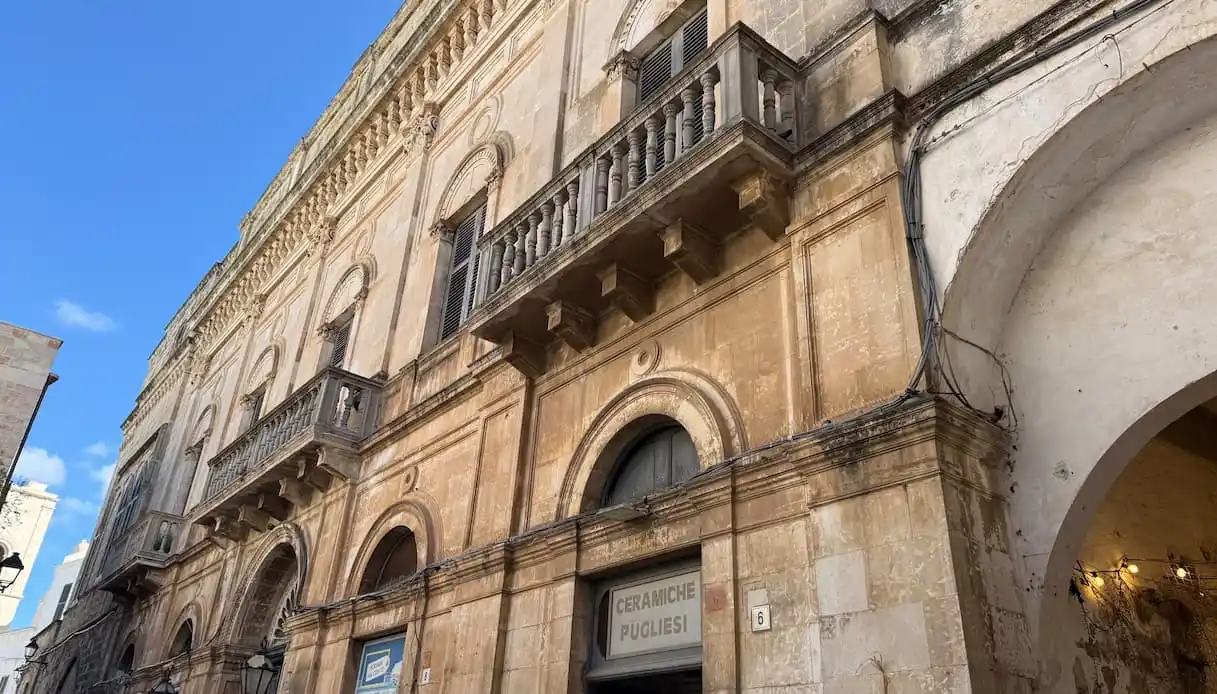
For Polignano a Mare, 2026 will mark an absolute debut. The town participates for the first time in the Autumn FAIDays and will do so by exceptionally opening Palazzo Miani, also known as Palazzo Marchesale.
The historic private residence sits in the heart of the old town, just after the Arch Marchesale, and preserves about five centuries of history. The oldest core dates back to the 15th century and was tied to the town residence of the feudal lords, while later enlargements and transformations gave the building the monumental appearance it still retains today.
During the weekend it will be possible to walk through its courtyard and loggia, climb the eighteenth-century staircase, and enter the drawing rooms of the noble floor, with decorated ceilings, furnishings, and testimonies of the families who lived in these spaces. The visits will take place on Saturday and Sunday from 9:00 to 13:30 and from 15:00 to 19:00, with 20-minute slots and a duration of about 40 minutes. Booking will not be required, and access will be granted with a contribution in support of the FAI.
Autumn FAIDays 2026 in Castellana Grotte, an itinerary between water and stone
Not far away, Castellana Grotte offers a true dispersed itinerary, built around two elements that have shaped this territory for centuries, water and stone. On Saturday, October 10 and Sunday, October 11, the route will touch the Church of the Madonna della Grotta, the Gravinelle, the Neviera, and the Church of San Nicola di Genna.
The visit will be a journey between surface and subsoil: to the Madonna della Grotta, a natural cavity documented as a place of worship as early as 1091, where history and devotion intertwine with local legends. In the church spaces, a photographic exhibition dedicated to the floods that struck Castellana Grotte in 1896 and 1968 will also be set up.
At the Gravinelle, two natural sinkholes reaching depths of up to about 37 meters, the landscape will be told through geology and speleology, showing how rainwater is absorbed by the karst ground and disappears underground. The route will then proceed toward the Neviera di Genna, built in the eighteenth century and formerly used to preserve snow and produce ice, and toward the nearby Church of San Nicola, a testimony to religious and community life in the countryside. Next to the Neviera there is also a vineyard planted with historic varieties, where tastings will be offered to FAI members. Visitors can also choose a single stop or undertake the full itinerary, reaching the different sites independently.