
Panama, to the whole world, is synonymous with the Canal: the small Central American republic, home to about four million people, truly safeguards the fastest transit route for commercial ships between the Atlantic and Pacific Oceans, thanks to the 82 kilometers of channels, locks, and dams that make up the passage. Yet there is much more to discover and visit in this corner of Caribbean than merely exploring this remarkable feat of human ingenuity.
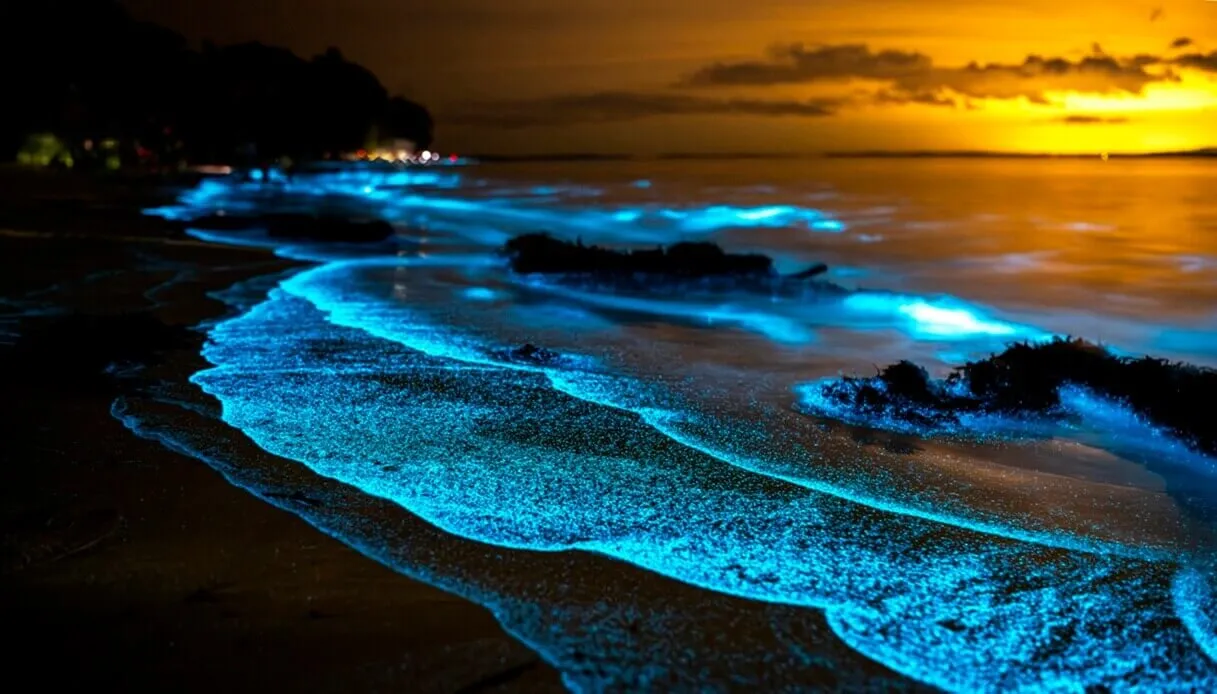
One of the destinations not to be missed, for example, is the Bocas del Toro archipelago, not far from the border with Costa Rica: more than 250 islands, islets, islets, and various cayos dotting the northwest of the country, attracting a varied but never overwhelming flow of tourists who come mainly to enjoy the extraordinary nature hidden between the beaches and the mangrove forests. One of the main attractions is bioluminescence, a rare experience to enjoy after sunset aboard a boat: the dinoflagellates, tiny single-celled organisms, emit a blue glow when they sense motion in the water and produce this natural spectacle, to be enjoyed on moonless nights.
Panama as a tourist destination
For a long time Panama was considered largely a land of transit. A narrow strip of land that joins the two Americas and separates the Atlantic from the Pacific, it is renowned worldwide for its Canal, as noted.
Things, however, seem to be rapidly changing, and a growing influx of visitors—interested not only in crossing from one side of the American continent to the other—begins to arrive in the country. The appeal for foreign tourists lies in the variety of experiences available, even while visiting a relatively small nation. In Ciudad de Panama, the country’s modern capital, a contemporary spirit blends with skyscrapers facing the Pacific and the historic Casco Viejo district, recognized as a UNESCO World Heritage site.
Inland to the west lie the fresh, cool mountains of Boquete and the Chiriquí province. To the northeast are the beaches of Guna Yala, land inhabited by the Guna indigenous people. Two coasts, two oceans, an interior rich in waterways and forests, and a multitude of islands and islets complete the picture, with the Bocas del Toro archipelago as the crown jewel.
Where the Bocas del Toro archipelago is and how to get there
The Bocas del Toro archipelago lies in the northwest of Panama, along the Caribbean coast, near the border with Costa Rica. The main islands that compose it are Isla Colón, where the capital Bocas Town is located, Carenero, Solarte, Bastimentos, San Cristóbal, Isla Popa, and Cayo Agua. Additionally, hundreds of little islets and other small islands dot this area of the Atlantic Ocean. It was to these shores that Christopher Columbus arrived in 1502 during his fourth and final voyage to the New World, and on Bastimentos he gave a name meaning “provisions” in Spanish, because the island served to resupply his fleet.
The quickest way to reach Bocas del Toro is by plane. Isla Colón, the largest and most tourist-oriented island of the archipelago, has a small airport about an hour’s flight from Ciudad de Panama. Isla Colón is also connected to Almirante, a small town on the coast opposite the archipelago, via the so-called water taxi, a maritime link of about half an hour with frequent departures throughout the day.
Once the islands are reached, getting around from one to another is done exclusively by boat.
Although the tropical climate keeps it warm year-round, the best months to visit the islands are September and October. This is the relatively driest period with generally calmer seas, though it is unlikely that rain stays far from Panama’s skies for long.
What to do and what to see in Bocas del Toro
The heart of the Bocas del Toro experience is a nighttime boat excursion to witness the incredible phenomenon of bioluminescence. To have a real chance of seeing it, you need to take advantage of moonless nights in the sky, and thus plan your trip according to the lunar cycle.
Through guided tours, you set out by boat in small groups to reach sheltered coves, where every movement of the water acts as a switch to light up numerous tiny blue and azure lights, like a swarm of fireflies flashing in unison, or like a shower of blue stars dissolving among the waves. The experience includes snorkeling with mask and snorkel in these areas, while the water lights up with each movement. It is truly a magical experience, with a scientific explanation that is less romantic than the stunning exterior display: the luminescence is produced by a particular type of phytoplankton, the dinoflagellates; these are single-celled organisms that, when given a mechanical impulse or water movement, trigger an enzyme called luciferase, which acts on luciferin, a small molecule capable of turning chemical energy into visible light. This natural glow is believed to serve as a defense mechanism to scare or confuse predators, but on dark nights in the heart of the Caribbean, among wild islands covered by mangroves and the calm inner sea of the archipelago, it offers moments of otherworldly beauty.
Among the other attractions of the archipelago is the Bastimentos National Marine Park, established in 1988 and identified as the country’s first marine park. It protects about 13,000 hectares of forest, mangroves, and coral reef, with nearly eighty species of corals. It includes the Zapatilla Cayos, two uninhabited islets of white sand and palm trees, among the area’s most visited destinations and ideal for snorkeling.
On the Caribbean side of Bastimentos, instead, lie beaches stereotypically Caribbean like Wizard Beach and Red Frog Beach, the latter named after the tiny red poisonous frogs that live in the nearby forest. Among the mangroves of Salt Creek, at the easternmost tip of the island, you can spot sloths and monkeys.
Sloths are particularly numerous in some areas of the archipelago. They are found in many on Bastimentos, but also on Isla Popa, though the highest chances of spotting this shy and tree-clinging creature are on Isla de los Perezosos, literally “Sloth Island,” a small islet near Isla Colón that is the destination of several guided tours.
On the big Isla Colón, there are also several noteworthy beaches: Starfish Beach, on the northwest coast, characterized by the starfish resting on the shallow, transparent seabed; Dolphin Bay is also a name that says it all, being a bay framed by mangroves where numerous dolphins live for a large part of the year.
All the day trips organized by local operators to reach other islands of the archipelago, such as Isla Solarte and Coral Cay, are absolutely worth it, offering memorable snorkeling among schools of vividly colored fish and corals with daring shapes.
Finally, between one excursion and another, a visit to the town of Bocas del Toro, commonly called Bocas Town or simply Bocas, the reference town of the archipelago, at the southern edge of Isla Colón, should not be missed. Here you encounter Caribbean heritage and traces of the indigenous communities of the islands, as well as being essentially the only real inhabited settlement on the islands, with accommodations, restaurants, bars, and a true urban life.