
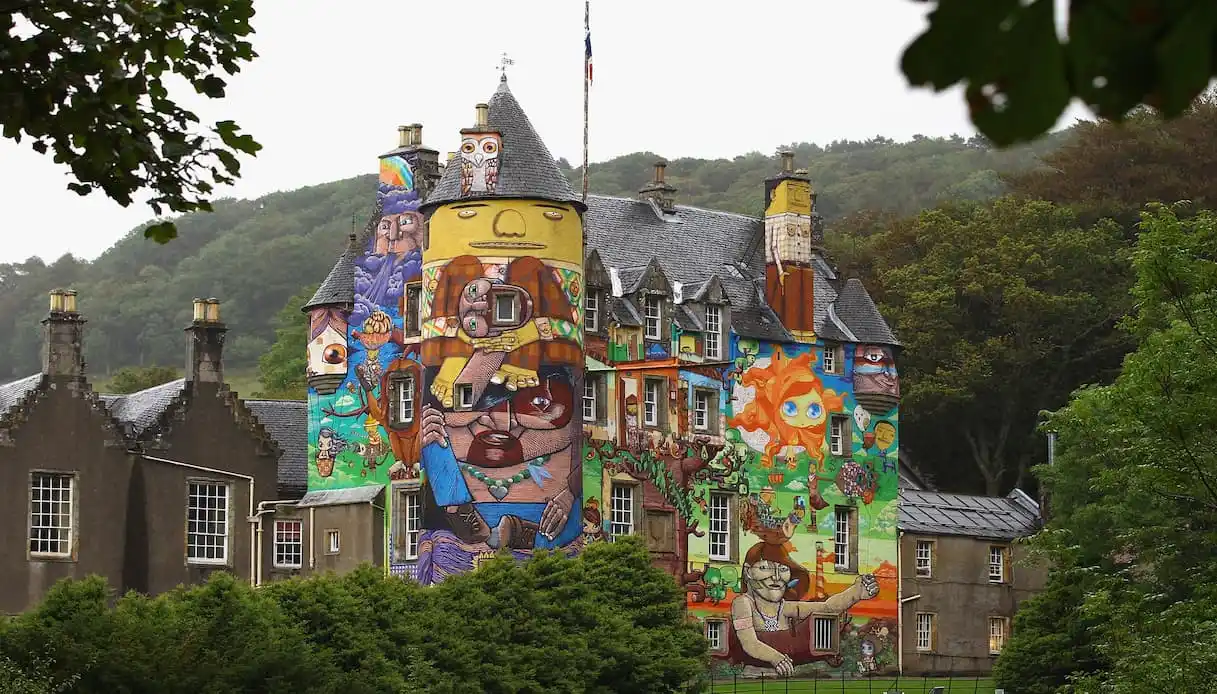
What happens when contemporary street art meets the Middle Ages? Ancient towers, woods, and a façade that seems to have stepped out of a colorful dream. Kelburn Castle has everything you would expect from a Scottish castle, but you only have to look at it from the right side to find something decidedly unusual: fantastical figures and graffiti wrapping walls and turrets, turning the architecture into a gigantic canvas.
Here Brazilian street art interweaves with the history of an aristocratic residence, creating a contrast that makes Kelburn instantly recognizable.
Kelburn Castle, the castle’s history and why it’s covered in graffiti
The history of Kelburn Castle predates the murals by many centuries. According to the estate’s reconstruction, the origins date back to around 1143, when a wooden tower is said to have stood on the site, replaced in the 13th century by a stone construction. In 1581 the castle incorporated the previous tower, while new enlargements further altered its appearance in the following centuries. Even today it remains the private residence of the Earl of Glasgow and his family, which is why interiors are not freely accessible year-round.
The artistic turning point arrived in 2007, with the Graffiti Project. Promoted by Alice and David Boyle, children of the owner, together with friend Camilla Wegener. The idea was to bring a language born mainly in urban spaces onto the walls of a castle immersed in the Scottish countryside. A deliberately provocative project, capable of putting in dialogue environments and traditions that seem far apart.
Four Brazilian artists were invited to carry it out: the twins Otávio and Gustavo Pandolfo, known as OSGEMEOS, Nina Pandolfo, and Nunca. For about a month the artists and organizers lived together in the castle, while the southern façade of the two oldest towers gradually took on a new look. The images also emerged from collaboration: a figure started by one artist could be completed by another, making the intervention a collective work.
But why paint a historic building? The occasion was tied to the works planned on the castle: the cementitious cladding of the walls would have to be removed to prevent further damage to the masonry. The graffiti were therefore created on that surface, with the initial idea of a temporary intervention, destined to disappear with the refurbishment of the cladding.
The result, however, earned a notoriety far beyond that of a passing experiment. Bright colors and surreal figures trace the towers’ contours, transforming the façade into a composition worth observing even in the finest details. The work, however, has not remained entirely unchanged: the estate notes that some portions have already disappeared as restoration continues.
Where Kelburn Castle is located and how to reach it
Kelburn Castle is located in Fairlie, near Largs, in North Ayrshire, on Scotland’s west coast. The address to use for organizing a visit is Kelburn Country Centre, Fairlie, Ayrshire, KA29 0BE. Glasgow is a convenient starting point for reaching the estate.
By car, the official site indicates a journey of about 40 minutes from Glasgow, varying with traffic and starting point. The suggested route follows the M8 toward the airport, then the A737 toward Irvine and the A760, passing Lochwinnoch and Kilbirnie to Largs. From here you take the A78 south: the entrance to Kelburn is on the left after about two miles, a little over three kilometers.
By train, you can depart from Glasgow Central and alight at Fairlie: ScotRail indicates an average journey time of 59 minutes. From the station, festival information organized at the estate indicates a walk of about 30 minutes, 2.3 kilometers, with a final uphill stretch. Alternatively, you can reach Largs and continue by taxi. By bus, the estate site notes a stop on the A78, next to the main entrance, and cites Stagecoach service 585.
To admire the graffiti you visit the castle from the outside, entering the estate grounds. According to the officially published information, access to the gardens and valley is free, while parking costs £7 per car; some attractions, such as Secret Forest and Playbarn, require a separate payment. Interior tours are arranged on select dates, generally in summer.