
Were you aware that, in the past, Salsomaggiore Terme was the gathering place for high society? In the early twentieth century, when roulette was played in the gilded halls of the Kursaal, the town was regarded as such a worldly destination that, as Forbes recalls, it was linked to Monte Carlo.
Then came years of hardship, with hotels closed and a slow losing of its shine. Today the town in the province of Parma is back in the spotlight precisely thanks to the pages of the American magazine, which devoted to it an extensive feature on its rebirth as a wellness destination.
The story of the baths that made Salsomaggiore famous
Even the name tells where Salsomaggiore’s fortune comes from: “salso,” meaning salty, as the waters that spring from underground. It all began in 1839, when the local physician Lorenzo Berzieri treated a girl afflicted with scrofula, a form of tuberculosis, with daily baths in the salso-bromoiodic waters of the area. From that moment, Salsomaggiore became one of Italy’s most appreciated spa towns, a reference point for those seeking relief from joint, respiratory, skin, and circulatory ailments. With the opening of the Kursaal Casino, in full Liberty style, the town added to its thermal vocation a worldly, cosmopolitan soul.
The golden era arrived in the postwar period. Between the 1950s and 1970s, the State covered the thermal treatments prescribed to workers, often including lodging in hotels, and hotels multiplied. In the same period, the Grand Hotel hosted the Miss Italia finals for more than forty years. Among the contestants of the 1950 edition was a very young Sophia Loren, competing as Miss Lazio. When in the 1980s and 1990s public subsidies were reduced, spa tourism faltered and many facilities closed their doors.
The Grand Hotel and the new baths in Palazzo Berzieri
According to Forbes, the heart of this revival beats at the Grand Hotel SalsomaggioTerme & Spa, the city’s only five-star property. Built in 1902, it has regained its glow after five years of restoration. Crossing the entrance, one walks on marble floors, while on the walls vintage photographs recall the illustrious guests of old times.
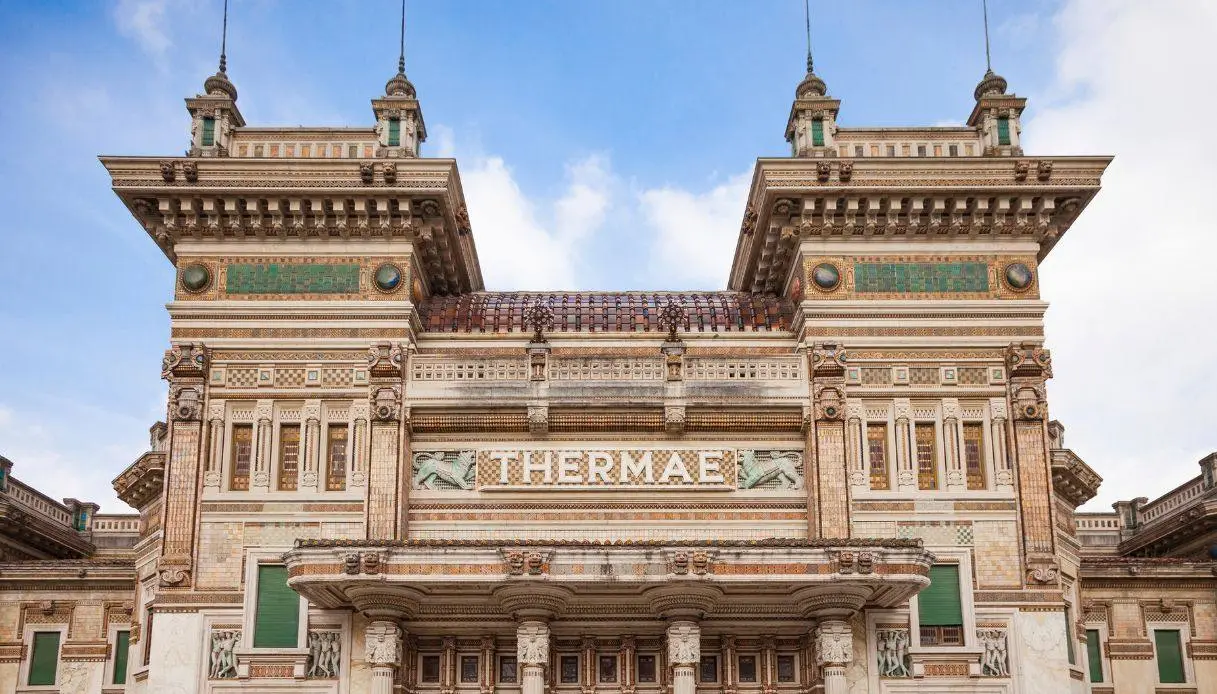
The other major novelty is QC Terme Salsomaggiore, the wellness center housed in Palazzo Berzieri, a masterpiece of marble, mosaics, and gilded decorations built precisely where the ancient salt wells once stood. The rest of the historic center has also been carefully restored and the tourist office has created walking itineraries to discover its emblematic buildings.
Salsomaggiore is also a good base for exploring the surroundings. A few kilometers away lies the Castello di Scipione, still inhabited by descendants of the Pallavicino, where the visit crosses frescoed salons and furnished rooms, up to the 17th‑century loggia overlooking the hills. In Fontanellato, the Rocca Sanvitale houses the Saletta di Diana e Atteone, frescoed by Parmigianino, and an intriguing 19th‑century Camera Ottica: thanks to a system of mirrors, the image of the external square is reflected onto a screen inside. Also in Fontanellato’s territory, the Labirinto della Masone, the largest bamboo labyrinth in the world, invites visitors to lose themselves among green corridors, forks, and dead ends. Designed by Franco Maria Ricci, it also hosts his art collection, with works spanning from the 16th to the 20th century.