
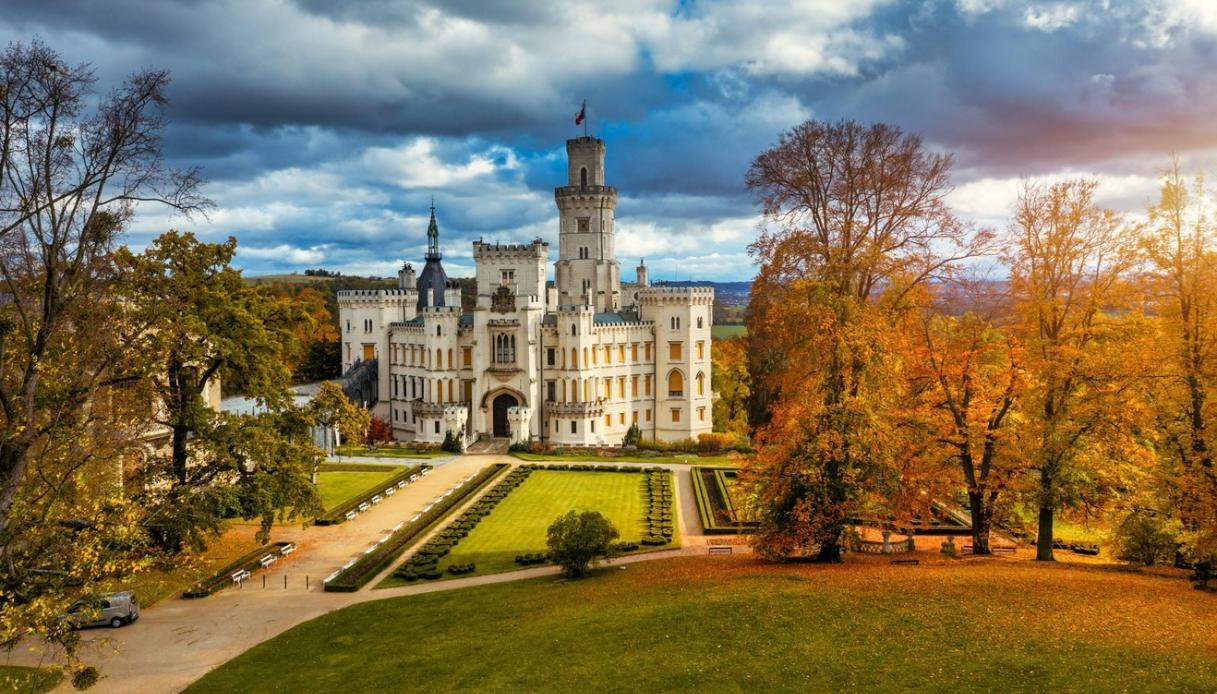
White, slender, densely adorned with spires, battlements and decorated windows: the Hluboká nad Vltavou Castle rises on a hill with the air of a princely residence built for a fairy tale, especially since the surrounding landscaped park and the territory crossed by the Moldau—the Vltava River to Czech speakers—stretch around it. First-time visitors might wonder: “am I in the Czech Republic or in England?”, and the exact answer does not come easily.
The current appearance of the castle is the result of a major neogothic reconstruction commissioned by the Schwarzenbergs between 1841 and 1871, inspired by Windsor Castle. An ancient Bohemian fortress, therefore, was transformed into a romantic residence with an unexpectedly English look, so much so that Hluboká has been described as a small fragment of Windsor England in the heart of southern Bohemia.
The surrounding park further enhances this impression: the Schwarzenbergs designed it in line with the 19th-century landscape taste, accompanying the architectural transformation with a redesign of the surrounding environment.
A Brief History of Hluboká Castle
The history of Hluboká begins in the mid-13th century, when Bohemian kings built on the rock a castle serving as a fortress. The position therefore had a strategic character quite different from the elegant image the complex presents today.
For a long time the estate passed through several aristocratic families. Among the protagonists of its history are the Pernštejn, who also founded the nearby Bezdrev pond in 1490, the second largest in Bohemia. In 1561 the estate passed to the lords of Hradec, who two years later converted it into a Renaissance residence.
Towards the end of the 16th century arrived the Malovec of Malovice. Their Protestant affiliation led to the loss of the estate in 1619, amid the religious and political tensions that swept Bohemia. In 1623 Hluboká was assigned to the Spanish General Don Balthazar de Marradas as compensation for the Emperor Ferdinand II’s war debts.
Then, in 1661, Jan Adolf I Schwarzenberg purchased the estate from his grandson and began a long period linked to the family that would give the castle its most famous appearance. The 19th-century project also grew out of the firsthand experience of Prince Jan Adolf II Schwarzenberg and his wife Eleonore, a Liechtenstein-born princess, during their travels in England.
The Windsor Castle became the principal model for Hluboká’s transformation. Work began according to the designs of the Viennese architect Franz Beer and continued, after his death, under the Schwarzenberg architect Damasius Deworetzky. The family remained the owners until the end of 1939. The last owner, Dr. Adolf Schwarzenberg, left the country and moved overseas to escape the Nazis. In 1947 a special law, known as Lex Schwarzenberg, ultimately led to the loss of the property.
The Visit Through Aristocratic Rooms, Towers and Historic Kitchens
For visitors who choose to discover this jewel of the Czech Republic, there is a guided tour that allows you to explore the private rooms of the family and the grand salons intended for representation, with a route that recreates the refined taste of the Schwarzenbergs.
The rooms stand out especially for the abundance of details: the walls feature panels and hand-carved wood decorations, while coffered ceilings contribute to the richness of the spaces. Crystal chandeliers, elegant furniture, paintings, silverware, porcelains and tapestries complete a setting designed to impress guests.
Among the most interesting spaces is the library, characterized by Renaissance panels, together with the armory and the private apartments of Princess Eleonore. The state apartments form the main route of the visit and allow entry into the most sumptuous part of the residence, between reception rooms, dining areas and the princess’s private rooms.
A different perspective comes from the panoramic tower: from above the complex is read differently and the relationship between the building, the park and the southern Bohemian landscape becomes more evident. The historic kitchens also deserve attention, as the equipment dates mainly from the late 19th to early 20th century, revealing a much more concrete side of aristocratic life.
After traversing rooms rich in crystal, carved woods and artworks, encountering stoves, utensils and instruments intended for meal preparation restores a daily dimension to the grand residence. The complex also includes the riding grounds, home to an exhibition dedicated to the Gothic of Southern Bohemia and to Dutch masters belonging to the collections of the Aleš Gallery of Southern Bohemia.
The castle also offers year-round activities, including a winter route through heated interiors. Availability of the routes varies by season, so it is advisable to check the current season’s arrangements before departure. Outside the rooms, the park deserves time: its extent allows viewing Hluboká from different angles, better capturing the scenographic effect designed by the Schwarzenbergs during the great 19th-century transformation. The white façade changes character with distance, shifting from the almost embroidered richness of the details to the tower silhouettes against the landscape.
Where It Is and How to Get to Hluboká nad Vltavou
The Hluboká Castle is located in Hluboká nad Vltavou, in southern Bohemia, about 12 km north of České Budějovice. The town sits on both banks of the Vltava and serves as a useful reference point for reaching this marvel. By car from Prague, the distance is about 145 km, a journey of nearly two hours. The quickest route passes the D1, heads toward Mirošovice and then along the E55 toward Tábor and Veselí nad Lužnicí. Near Bork you take road 146 toward Hluboká nad Vltavou.
From České Budějovice, the journey is much shorter, roughly 15 minutes by car. The area is also served by regional buses, and the nearest stop to the castle is Hluboká nad Vltavou pod kostelem, about 800 meters from the entrance. The train is also a viable option: Hluboká nad Vltavou has two stations, Hluboká nad Vltavou – U Sudárny, on the České Budějovice–Plzeň line, and Hluboká nad Vltavou – Zámostí, on the České Budějovice–Prague line. If departing from Prague, a change at České Budějovice is required.
For those who prefer cycling, the area is connected to the South Bohemian cycling network. A particularly popular route runs along the left bank of the Vltava between České Budějovice and Hluboká nad Vltavou, continuing toward Purkarec.
There is finally a decidedly more scenic way to reach the castle. Since 2011 the Moldau has been navigable along the stretch between České Budějovice and Hluboká nad Vltavou, with boat connections continuing to Purkarec.