
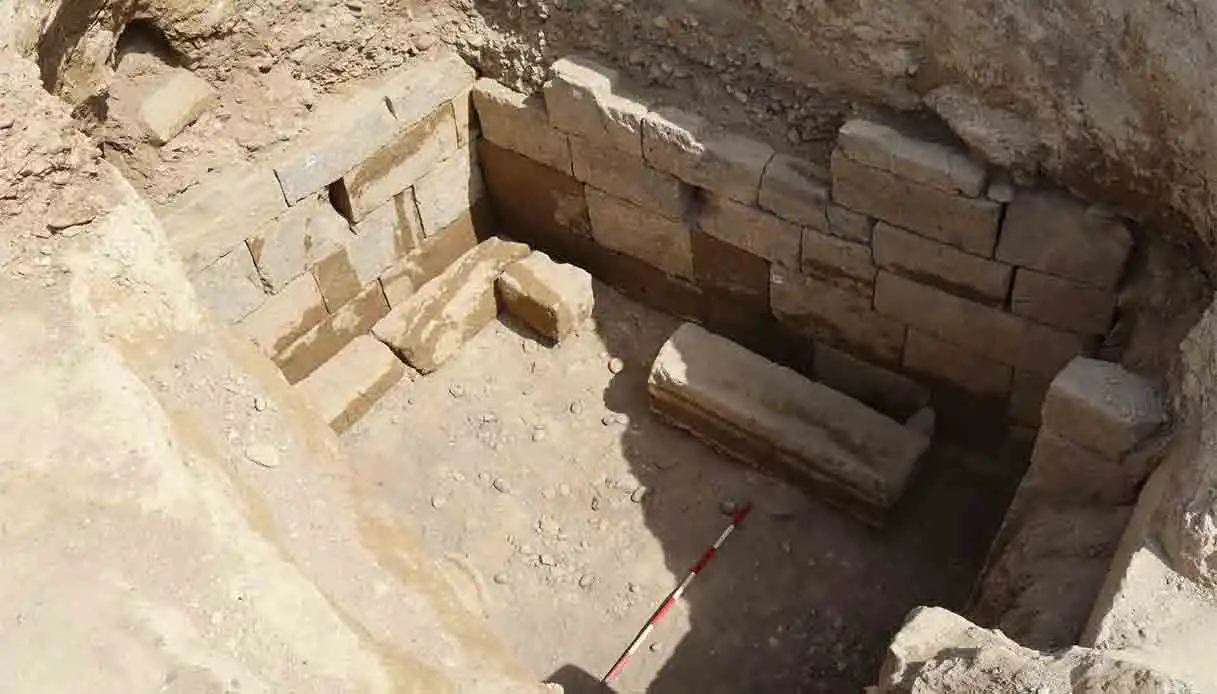
“The Tomb of the Stone Chamber represents a new important milestone in rebuilding Vulci’s archaeological history,” says Carlo Casi, director of the Vulci Natural Archaeological Park in the province of Viterbo.
The monumental Etruscan tomb, freshly revealed from the ongoing digging campaign at the archaeological site, which coincides with the former metropolis of Maritime Etruria, tells the story of the elite from 2600 years ago. Inside the Tomb of the Stone Chamber, in the Polledrara necropolis, refined treasures and artifacts still intact have been found. Among them, a banquet service, a rare female shoe, some weapons, Greek ceramics, and gold.
The new discovery at Vulci
“The preservation of part of the in-situ deposits, the variety and quality of the materials, and the possibility of comparing the complex with Vulcan contexts already known, but often lacking the original archaeological documentation, offer new perspectives for the study of the society, funerary rituals, and Vulci’s Mediterranean relations at the end of the VII century BCE,” Casi explained.
The grand funerary environment, called the Tomb of the Stone Chamber, reveals the habits of the Vulci aristocracy at the end of the VII century BCE, one of the city’s moments of greatest prosperity and of the most intense openness toward the Mediterranean.
Archaeologists were able to explore the tomb’s three burial chambers in their entirety. Despite the disturbances suffered over the centuries, numerous materials remained protected thanks to the collapse of the coverings and walls, built from large blocks of nenfro inserted into natural deposits of sand, gravel, and clay tied to the ancient course of the Fiora River, allowing the recovery of material of exceptional interest.
The recovered material includes Attic and Corinthian Greek ceramics, refined locally made decorated wares and bucchero, weapons, elements belonging to a chariot, coins, gold and bronze sheets, worked bone and ivory elements, and numerous ornamental and personal clothing objects, including a rare female shoe.
Of particular importance are some elements that remained intact in the side chambers. “Among these is a bronze tripod paired with a gypsum alabastrine lamp, probably from the Naucratis or Rhodes area,” reads Viterbo Today “and an exceptional banquet service in the rare local class of Polledrara Ware, consisting of phialai, olpai, hydriai and dinoi with polychrome decorations, some still preserved in their original positions, together with bucchero vases, a wine-grinding tool, and a rare large polychrome cup of the so-called Wild Goat Style (“style of the wild goats,” so named for the animal most commonly represented) Ionic.”
The research, carried out within the international project “Return to Vulci,” launched in 2023 and bringing together the École française de Rome, Sapienza University of Rome, and the British Museum, in collaboration with the Soprintendenza Archeologia, Belle Arti e Paesaggio for the province of Viterbo and for the southern Etruria, the Lazio Directorate of National Museums, and the Vulci Foundation, has allowed the circular enclosure of the so-called Gsell Tumulus to be identified, already discovered by the École française de Rome in 1889 but never fully excavated, and to bring to light the great monumental tomb inside the burial complex.
“The new discovery thus confirms the importance of archaeological research as a tool not only for bringing to light new artifacts, but also for reconstructing fragments of a dispersed history, restoring to Vulci and its heritage an international dimension and a new possibility for scientific interpretation,” commented Casi.