
There are some who happily await winter after a particularly hot summer, and others who, as soon as the first frost appears on the windshield, begin counting the days until spring. Yet the cold months are also the time when certain destinations shine brightest: it is the dry season in the Caribbean, the climate becomes ideal in desert cities, and prices, away from the holiday weeks, become more affordable.
The secret is to know where to go. For the winter 2026/2027 we have chosen seven destinations, among new direct flights from Italy, capitals that are changing their look, and islands far from the most-traveled circuits.
Dominican Republic
For those who dream of the Caribbean, this winter there is one more reason to go. From November 30, 2026, ITA Airways will link Rome Fiumicino to Santo Domingo with a new direct flight, operating on Mondays and, from December 14 until the end of March, also on Sundays.
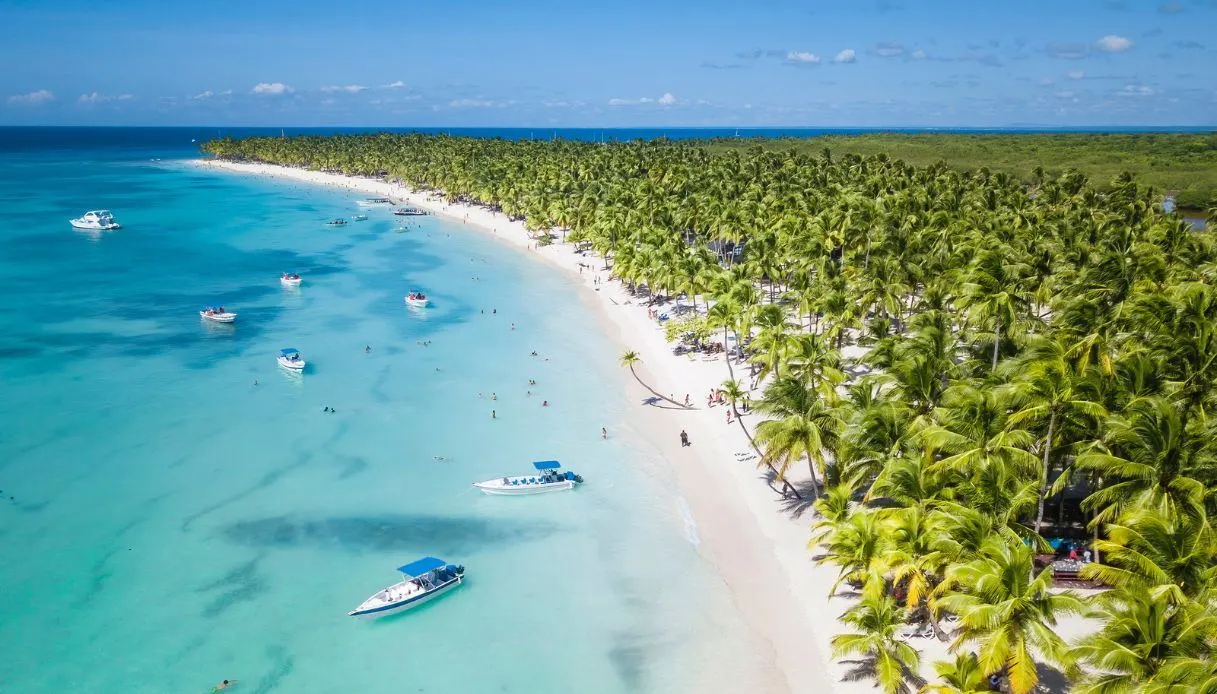
You thus arrive in the capital non-stop and can use it as a starting point to discover the country beyond the resorts. The Ciudad Colonial, with its squares and historic palaces, is perfect for the first days. Then you move toward the beaches of Punta Cana or Bayahibe, from where excursions depart to reach the island of Saona. Those who prefer wilder landscapes can aim for the peninsula of Samaná, while the inland areas of Jarabacoa and Constanza offer mountains, waterfalls and cooler temperatures.
Mexico City
In winter, Città del Messico offers skies that are almost always clear and mild days, even if the evening, at over 2,000 meters above sea level, calls for a jacket. This is the ideal moment to explore a colossal capital where the ruins of the ancient Tenochtitlán live alongside colonial palaces and world-class museums.
One ideal itinerary could begin at the Zócalo, home to the Catedral Metropolitana and the Templo Mayor, then devote nearly a day to the Bosque de Chapultepec and its Museo Nacional de Antropología. The picture would be completed with Coyoacán and Frida Kahlo’s Casa Azul, plus a trajinera ride along the canals of Xochimilco.
Those traveling between late February and early March 2027 will also encounter the Feria Internacional del Libro at the Palacio de Minería. The city can be reached non-stop from Rome Fiumicino with Aeroméxico, which from March 28, 2027 will operate a new direct flight also from Milano Malpensa.
Riyadh, Saudi Arabia
If in summer the heat in Riyadh is prohibitive, from November to March temperatures become pleasant and the Saudi capital comes alive with the Riyadh Season, the calendar of events, shows and sports that animates the city throughout the winter.
Between one stop and another it is worth taking the metro: the Prix Versailles 2026 has included two of the city’s stations among the most beautiful in the world. The National Museum Station, in the Al-Batha district, is the gateway to the National Museum; the Western Station, designed by Omrania, draws inspiration from the desert dunes with sand-colored structures, gardens and a square that becomes a market. If you’re curious to see them in person, from December 16, 2026 Riyadh Air will connect Milan and Riyadh with four direct flights per week.
Yaeyama Islands, Japan
Whereas in much of Japan winter means snow and hot springs, the Yaeyama Islands stay around 20 degrees Celsius even in January: they lie at the southern edge of the country, beyond Okinawa and close to Taiwan, and in this season they boast the mildest climate in Japan.
The gateway is Ishigaki, reachable by plane from Tokyo, Osaka or Naha. Here there is Kabira Bay, with turquoise waters dotted by islets, and days spent snorkeling, exploring markets, and enjoying local cuisine. In about 40 minutes by ferry you reach Iriomote, largely covered by jungle and mangroves and a UNESCO World Heritage Site since 2021, where you paddle upriver to waterfalls. In the evening it’s worth lifting your eyes: the Iriomote-Ishigaki National Park was the first in Japan to earn the Dark Sky Park certification.
Grenada
Less known than the major Caribbean destinations, Grenada is a small island nation at the southern tip of the Lesser Antilles, where winter coincides with the driest months of the year. Here, travel is as much about the palate as the scenery. It is widely known as the Spice Island: nutmeg, nicknamed black gold, is among its chief exports and ends up everywhere, grated over rum punch or transformed into jams and syrups for breakfast. In general, the dining scene blends African, French, British and Indian influences, such as the baiganee, eggplants fried in a batter of split peas.
But Grenada is also nature, and in the heart of the island you’ll find the Grand Etang National Park, a volcanic crater lake surrounded by rainforest, with trails leading to waterfalls. On the coast, there are two kilometers of white sand at Grand Anse, and nearby, the Molinere Bay underwater sculptures, to be explored with mask and snorkel.
Sri Lanka
From December to March, the monsoon rains concentrate on the northeast of Sri Lanka, while the route we propose, from the island’s centre to the southern coast, enjoys its dry season: this, therefore, is the ideal period for a journey that blends history, nature and sea. It begins at dawn, with the first light on Sigiriya, the ancient fortress perched atop a rock monolith. Then you reach Kandy and the Temple of the Tooth, one of the most sacred Buddhist sites.
From here you rise to the highlands, among plantations where you can taste freshly picked tea and trekking trails around Ella and Nuwara Eliya. The finale is on the southern coast, in the horseshoe bay of Hiriketiya where you can surf, with waves suitable for beginners. In Galle, finally, you wander among art galleries and shops inside the walls of the Dutch Fort, a UNESCO World Heritage site.
Abisko, Sweden
Finally, for those who prefer the cold and dream of seeing the aurora borealis in the winter of 2026/2027, we recommend heading to Abisko, in Swedish Lapland, one of the best places to await it. The secret is a microclimate of its own, the so-called Blue Hole. The westerly winds shed humidity and clouds over the mountains, so above the village and the lake Torneträsk there is often a clear patch of sky, even when nearby areas are overcast. In addition, long nights mean the aurora can be seen from September to early April, and virtually no light pollution, since the village counts around a hundred inhabitants.
