
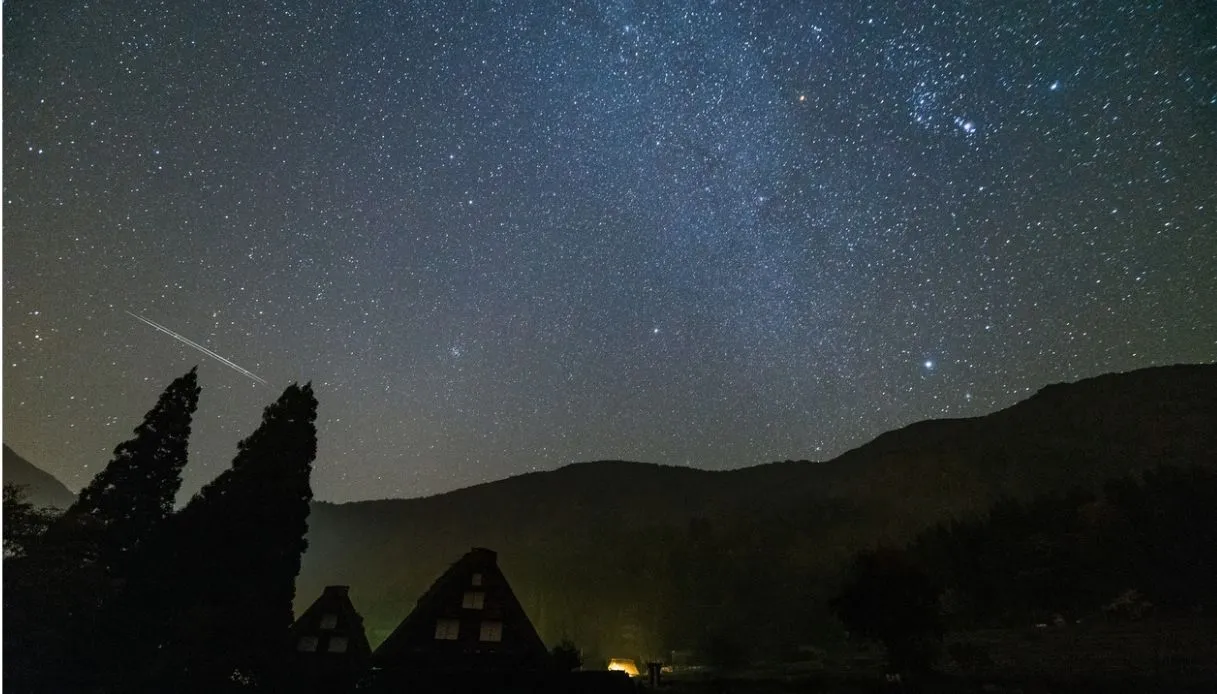
All eyes to the sky, there are still shooting stars and astronomical spectacles to observe even in October. Put the phone away and keep your eyes fixed on the heavens; there are several precious dates to put on your calendar, and you’ll be able to witness as many as 2 meteor showers that are very different from one another, and, toward the end, even a full moon with a distinctly autumnal name.
The first to reveal themselves will be the Draconids, slow and a bit unpredictable. Then it will be the turn of the Orionids, tied to the famous Halley’s Comet. To close the loop will come the Hunter’s Moon, on October 26. A telescope isn’t strictly necessary. For shooting stars, in fact, it’s better to leave it at home: you mainly need darkness, patience, and a broad patch of sky in front of you.
The Draconids Show
The Draconids will be active roughly between October 6 and 10, with the most interesting phase concentrated around the evenings of October 8 and 9. Their radiant, i.e., the point from which the meteors seem to originate, lies in the constellation Draco. The peculiarity? You won’t necessarily have to stay up until three in the morning. The Draconids are one of the few meteor showers that can be observed well in the early evening hours, when Draco is still high in the northern sky. Moreover, in 2026 the Moon will be very close to the new-moon phase of October 10. The Draconids typically have modest activity, although in the past they have produced sudden increases in meteor counts.
Da dove vedere le Draconidi in Italia
Seek out a place far from streetlights and with a fairly clear northern and north-western horizon. In the North the radiant stays in a particularly favorable position; in the Center and South it’s best to take advantage mostly of the early part of the night. Don’t fixate only on the Dragon constellation. Scan a wide swath of sky: the trails can appear quite far from the radiant and even be more spectacular. A good option? Certainly the Alpe di Siusi in South Tyrol where the plateau offers broad horizons; alternatively Campo Imperatore in Abruzzo, where the wide spaces and the view of the sky allow you to enjoy the show.
The Orionids Phenomenon
The Orionids are much faster meteors, born from debris left along the orbital path of the Comet 1P/Halley. When can they be seen? The schedule published by the International Meteor Organization advises observing the sky from October 2 to November 7, with a maximum peak expected around October 21. The theoretical rate given by the IMO exceeds 20 meteors per hour under ideal conditions, though the number actually visible always depends on darkness, sky transparency, and the position of the radiant. Orion rises well in the second half of the night, and observing typically improves after midnight.
Da dove vedere le Orionidi in Italia
Un vantaggio semplice: si possono osservare praticamente da tutta Italia. Scegliete campi, colline, montagne o spiagge lontane dai centri abitati e concedete agli occhi almeno venti minuti per abituarsi al buio. Il telefono? Luminosità al minimo, oppure spento. Basta uno schermo acceso per rovinarvi molti minuti di adattamento notturno. Per le Orionidi una buona opzione è valutare il Piano Grande di Castelluccio sui Monti Sibillini, oppure Prato Selva in provincia di Teramo.
Hunter’s Moon
La luna piena di ottobre arriverà nelle prime ore di lunedì 26 ottobre, intorno alle 05:11 ora italiana. È conosciuta tradizionalmente come Luna del Cacciatore, nome legato al periodo dell’anno in cui, dopo la raccolta, le notti illuminate dalla luna piena accompagnavano le attività di caccia e la preparazione all’inverno nell’emisfero nord.
Da dove vedere la Luna del Cacciatore in Italia
Qui potete essere molto meno selettivi. Il plenilunio sarà visibile da tutta l’Italia, meteo permettendo, anche dalle città. L’idea è comunque di spostarsi verso aree con basso inquinamento luminoso, come ad esempio le colline del Monte Amiata in Toscana o Saint-Barthélemy in Valle d’Aosta.