
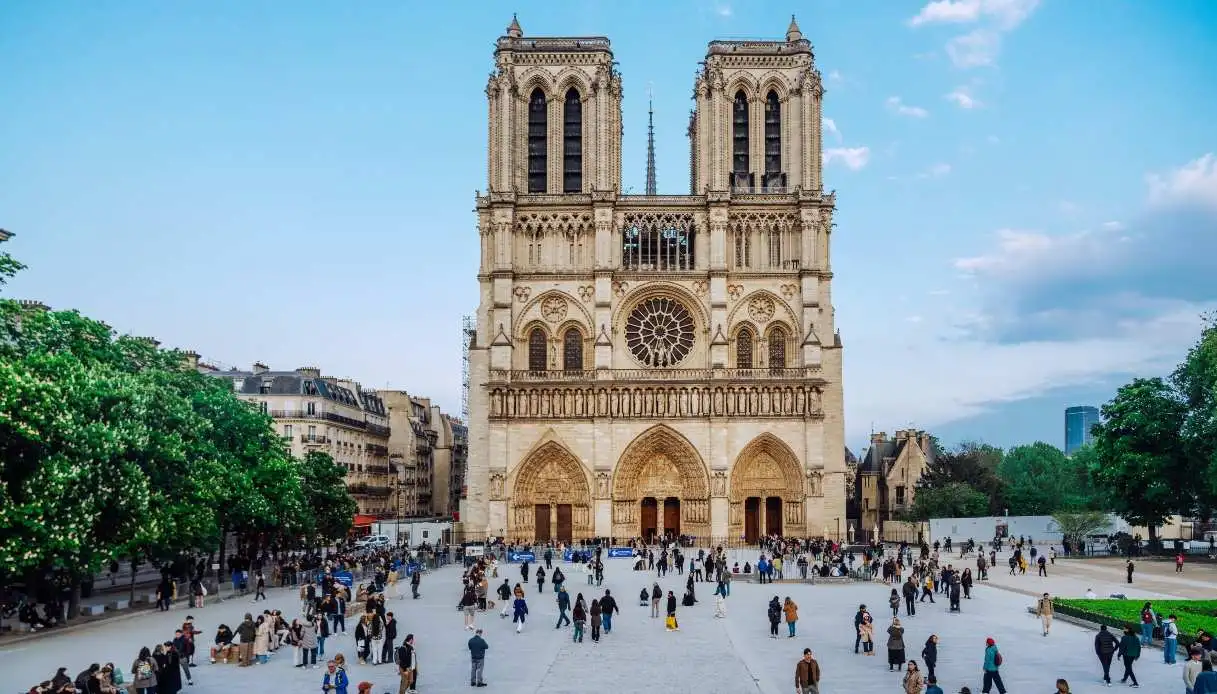
Paris never ceases to astonish thanks to traces of its past. A stone’s throw from Notre-Dame, in the heart of the Île de la Cité, archaeologists have unearthed a structure that could rewrite what we know about the origins of the French capital.
During excavations in the Hôtel-Dieu area, AP-HP, an imposing stone-and-wood curtain wall was revealed, preserved for about 20 meters and characterized by a construction technique typical of the Gallic fortifications of the late Iron Age.
The discovery beneath Hôtel-Dieu
The archaeological research at the Hôtel-Dieu began in February 2026 and involves the City of Paris Archaeological Service and the Inrap (National Institute for Preventive Archaeological Research), as part of the hospital renovation works. It is here that the structure, formed by blocks of stone and wooden elements, was identified.
Behind the wall, an artificial platform made of sand and gravel was also found. Archaeologists also recovered a Gallic spearhead, partially carbonized remains, and the remnants of a burned wooden building. The wall itself shows clear traces of a very intense fire.
Initial results from carbon-14 analyses on the wooden elements place the structure in a window between 200 BC and 10 BC. The presence of fire and charred materials is compatible with a destruction episode, but scholars emphasize that it is not yet possible to determine that the fire was the one that broke out in 52 BC as Caesar’s Roman troops advanced.
The combination of these elements, however, has rekindled a question that has interested archaeologists for centuries: where exactly was Lutetia of the Parisii? Caesar describes an oppidum situated on an island in the Seine, connected by bridges, and the Île de la Cité has long been considered the most natural hypothesis. Yet archaeological evidence of a true Gallic settlement had remained limited. This had also led to the hypothesis of Nanterre.
The significance of the discovery
The value of the find lies chiefly in the possibility to connect more directly Paris with the Lutetia gallica cited in ancient sources. If the new analyses confirm the interpretation currently studied, the wall could be part of the rampart of the Parisii oppidum, the Gallic population that inhabited the territory of today’s Île-de-France.
The discovery was deemed of exceptional importance by the Regional Commission for Archaeological Research of Central-North, which in mid-September 2026 validated the discovery report. The excavations can thus continue to clarify the wall’s function, its dating, the manner of its destruction, and its relationship with the sand-and-gravel platform, as well as to verify traces of possibly even older occupations.
However, the remains are still very fragile: the fire has damaged the stones and charred much of the wood. To preserve their memory, there will be digital documentation, photogrammetry, and a 3D reconstruction. A mold of a section of the bastion is planned, followed by the reconstruction of part of the wall with some original stones, intended for a museum in Paris.
Thus, right beside one of the capital’s most famous monuments, the subsoil of Île de la Cité could add a new chapter to Parisian history: that of the Gallic city that preceded the Roman Lutetia.