
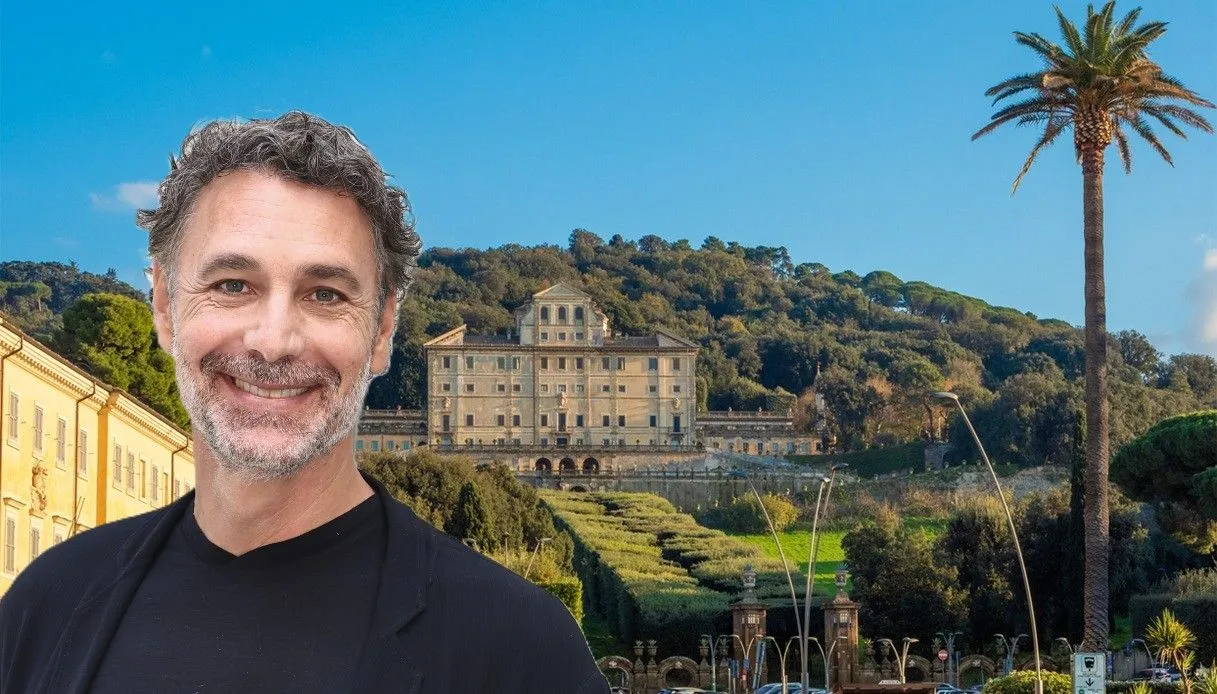
In the new Rai fiction Tutto l’amore che resta, with Raoul Bova, places are not mere locations; they accompany—at times almost push—the protagonists toward a deep path of personal growth and change. Not by chance, the main setting of this Italian-flavoured teen drama, which also features Giulia Bevilacqua, Francesco Leo and Gloria Harvey, is a school.
The shooting locations of the new TV series, airing from September 29, 2026 in prime time on Rai 1 and on Rai Play, reveal wonderful and unexpected glimpses of the Lazio.
What it’s about
Directed by Andrea Rebuzzi, the new Rai series centers entirely around the Helen Keller High School: a school on the outskirts of Rome where inclusion, more than remaining an abstract value, is practiced daily by students, teachers, and school staff. Leading the high school is Stefano Fogli, the character played by Raoul Bova: a man who truly understands, also through personal experiences, what it means to deal daily with illness.
When Vittoria, a girl from Rome’s upper class, arrives at Keller, forced by her parents to move to the province so that her autistic brother can attend the school, it will be Stefano who helps her to appreciate, after initial reluctance, the tight-knit group of teens navigating friendships, first crushes, and “grown-up” experiences that constitute Keller’s school community.
Where the series was shot
Tutto l’amore che resta is set and entirely filmed in Lazio, specifically the Castelli Romani, to be precise, also to stay faithful to the provincial setting of the French format – Lycée Toulouse-Lautrec, which in turn was inspired by a true story – of which the new Rai fiction is an adaptation.
Frascati
The Helen Keller High School is located in Frascati, and it is here that the series production (Rai Fiction and Fabula Pictures) set up the crew’s base at the Cocciano rugby field, transforming key spots of town life, such as the panoramic Piazza Marconi, into outdoor sets. On screen, it’s easy to recognize the 16th-century historic center, the Cathedral of Saint Peter with its imposing facade, and the maze of streets overlooking Renaissance palaces and aristocratic residences.
Marino Laziale
However, Keller is not actually a Frascati high school, and the production even had to move to nearby Marino Laziale to find spaces suitable for the crew’s needs and to portray on screen a school free of architectural barriers. Among the locations of Tutto l’amore che resta is the former Convent of the Augustinian Fathers: a late sixteenth-century building, today annexed to the Church of Santa Maria delle Grazie, undergoing redevelopment and often used precisely as a film set.
Fiano Romano
Also for another key location of the series—the Frascati police station—it was necessary to artfully transform a building normally dedicated to a very different use: the Orsini Ducal Castle in Fiano Romano. This imposing medieval stronghold houses inside, especially in the wing commissioned by Niccolò III, splendid fifteenth-century rooms typically occupied by public offices or left free for visits, perfect for conveying a sense of rigor and respect for institutions.
Ariccia
Among the places where filming took place is also Ariccia. Here, filming concentrated around Piazza di Corte: the main square, redesigned in the mid-Seicento in part by Gian Lorenzo Bernini.
Gian Lorenzo Bernini is also linked to the project of Palazzo Chigi, which faces the square and which is easily recognizable in many shots of the series with Raoul Bova: currently home to the Museo del Barocco Romano, it is famous for its nearly 30 hectares of park once used for hunting. On screen, the Collegiata di Santa Maria Assunta in Cielo also stands out: the iconic church with a circular plan and a dome of seventeen meters inspired by the dome of St. Peter’s in Rome.