
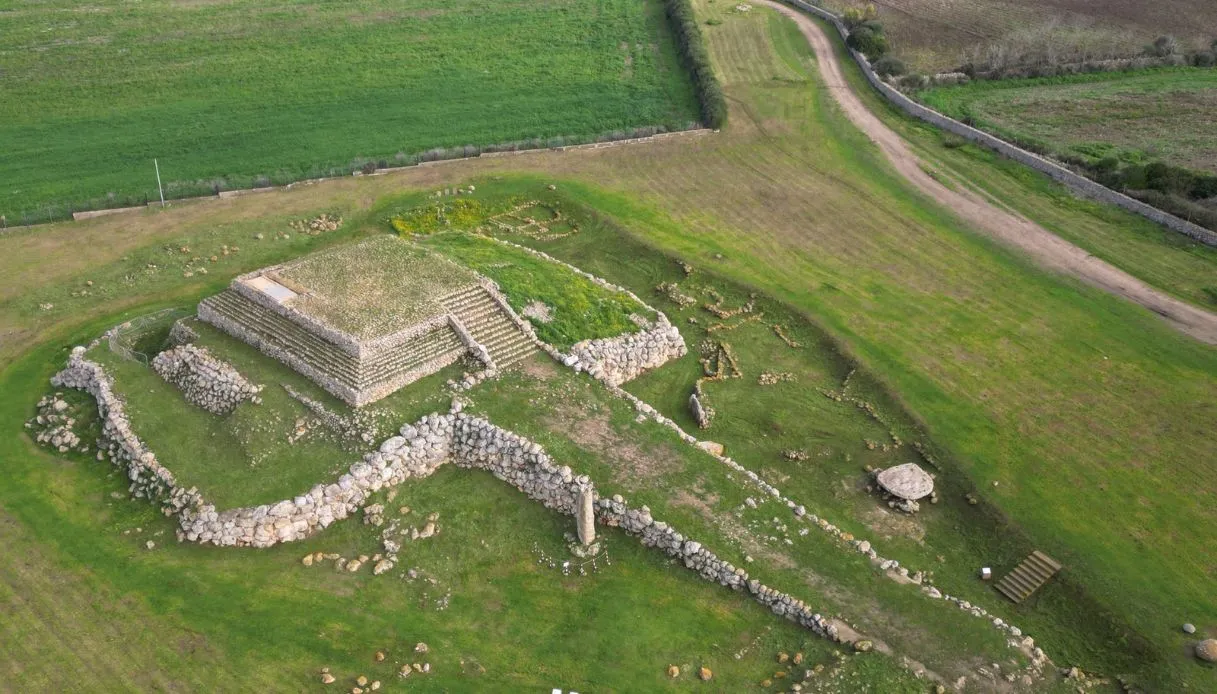
In the open landscape of the Nurra, to the northwest of Sardinia, a large stone structure rises from the plain with a markedly unusual appearance for the island. At first it seems like an artificial hill, carefully shaped to draw the gaze upward, but gradually one realizes that beneath the earth stones and large calcareous blocks preserve the history of a prenuragic sanctuary built around 5,000 years ago.
It is called Monte d’Accoddi and its main monument is a terraced altar with a truncated-pyramid shape, reached by a long straight ramp. The resemblance to the ziggurats of Mesopotamia has inspired fascinating comparisons, although archaeological sources emphasize the absence of a direct relationship between the two realities.
The archaeological area as a whole, however, tells a story broader than the great altar: around it a village developed, while about 500 meters away a necropolis comprises 8 multi-chamber hypogea carved into the calcareous wall. Menhirs, large slabs, spheroidal stones, and structures linked to the ritual sphere complete a landscape that for generations served a religious function.
Brief History of Monte d’Accoddi
The history of Monte d’Accoddi begins with a village of circular huts, perhaps inhabited as early as 3400 BCE, during the phases of the San Ciriaco culture. In the following centuries the settlement changed its appearance and, during the Ozieri culture, between 3200 and 2800 BCE, the first dwellings were replaced by square huts. Right at the center of this new settlement an area was organized for the sacred sphere, marking the transformation of the hill into an important place of worship.
It was then that the first altar appeared, a structure far smaller than the one visible today, atop which stood a rectangular shrine nearly 13 meters long and 7.20 meters wide, of which the floor and parts of the walls remain. The plaster coated with red ochre gave the building its famous nickname, the “Red Temple.”
The history of the first sanctuary, however, was abruptly interrupted around 2800 BCE by a fire, and instead of simply rebuilding the original edifice, the communities that frequented the site undertook a far more ambitious project. The first altar was absorbed into a new tronco-pyramidal platform, built with layers of earth and stones and externally clad with large calcareous blocks. To reach the terrace a new trapezoidal ramp was created, about 42 meters long. It is this second, more imposing construction, still recognizable today, that gave this corner of Sardinia its distinctive appearance.
Roughly around 2600 BCE, during the Abealzu culture, the area around the altar was again occupied by a village, this time formed by huts with straight walls, hearths, and coverings supported by posts. Notable among these is the so-called “witch’s hut,” a building organized into five irregular spaces. The name comes from certain peculiar finds inside, including a bovine horn tip and a pair of bivalve shells stored in a jar.
Even the spaces around the altar preserved elements tied to the ritual dimension: a 4.44-meter-tall menhir marked the sacred area, while nearby two large spheroidal calcareous stones were found, which some scholars attribute with astral symbolism (though their meaning remains a matter of interpretation).
Over the centuries, however, Monte d’Accoddi lost its original religious function. The sanctuary was gradually abandoned as a cult center, and the site continued to be frequented in various forms during the Nuragic era, the Phoenician-Punic period, the Roman age, and the Middle Ages.
For centuries the hill remained hidden beneath earth and vegetation, until its unusual shape captured the attention of archaeologists. The turning point arrived in 1952, when Ercole Contu began digging on land that had belonged to Antonio Segni. Initially it was thought the relief might conceal the remains of a nuraghe. The excavations, however, brought to light the monumental altar, the village, the menhir, and numerous elements related to the ritual sphere, revealing the true nature of the site.
The Visit Among Altar, Village, and Necropolis
A visit to Monte d’Accoddi begins at the base of the monument, in front of the large ramp that climbs toward the terrace. Seen from below, it almost appears as a monumental road built specifically to guide visitors toward a space reserved for the sacred realm.
The ascent leads to the upper terrace, but the true interest of the monument also lies in what remains hidden inside it. The first sanctuary, the so-called “Red Temple,” is currently not accessible to visitors for protection, conservation, and safety reasons. Yet traces of its presence remain, and reconstructing its various phases allows the monument to be read almost as a cross-section of Sardinian Prehistory.
Around the altar opens the area occupied by the village. The huts belong to different phases of the site’s occupation and reveal an organization very different from the monumentality of the sanctuary. The walls consisted of a base made of small stones, upon which were built structures with sun-dried bricks or with cane and daub plastered. Posts inserted into floor pits supported vegetative coverings, while inside the homes there were rectangular hearths with raised clay rims.
In addition to the “witch’s hut,” the ritual dimension becomes evident mainly from the lithic elements distributed around the sanctuary. Beside the right-hand side of the ramp there is a large offering table in trachyte, while on the southern side lies the menhir.
Even more enigmatic is the large trapezoidal limestone slab resting on three stone bases and bearing seven holes along its edges. Beneath the slab lies a natural sinkhole, whose function has perhaps been interpreted in relation to bloody sacrifices. Not far away are two large spheroidal calcareous stones, regarded as elements with possible sacred significance.
Three limestone stelae complete the ensemble. One bears a lozenge and spirals, another displays a stylized female figure, while the third is characterized by 13 parallel grooves crossed by at least two perpendicular incisions. About 500 meters from the altar lies the hypogeal necropolis, carved into the calcareous wall facing the Ottava river.
It comprises 8 multi-chamber tombs, some decorated with bovine protomes and other architectural features. The presence of the burials completes the picture of the ancient landscape, linking the inhabited space, the area set aside for rituals, and the zone reserved for the dead.
Where it is and how to reach
The Sanctuary of Monte d’Accoddi is located in Nurra, in the Sassari area, about 13 kilometers from the city center. To reach the site from Sassari, follow the former Strada Statale 131 toward Porto Torres up to kilometer 222.200. From there take the exit indicated for Bancali and other directions, returning toward Sassari until you reach the Strada Vicinale Monte d’Accoddi. The presence of tourist signage makes it easy to identify the access to the archaeological area.
Those arriving from Porto Torres follow the same route toward Sassari. After about 8 kilometers, the Strada Vicinale Monte d’Accoddi lies immediately on the right of the former SS 131.