
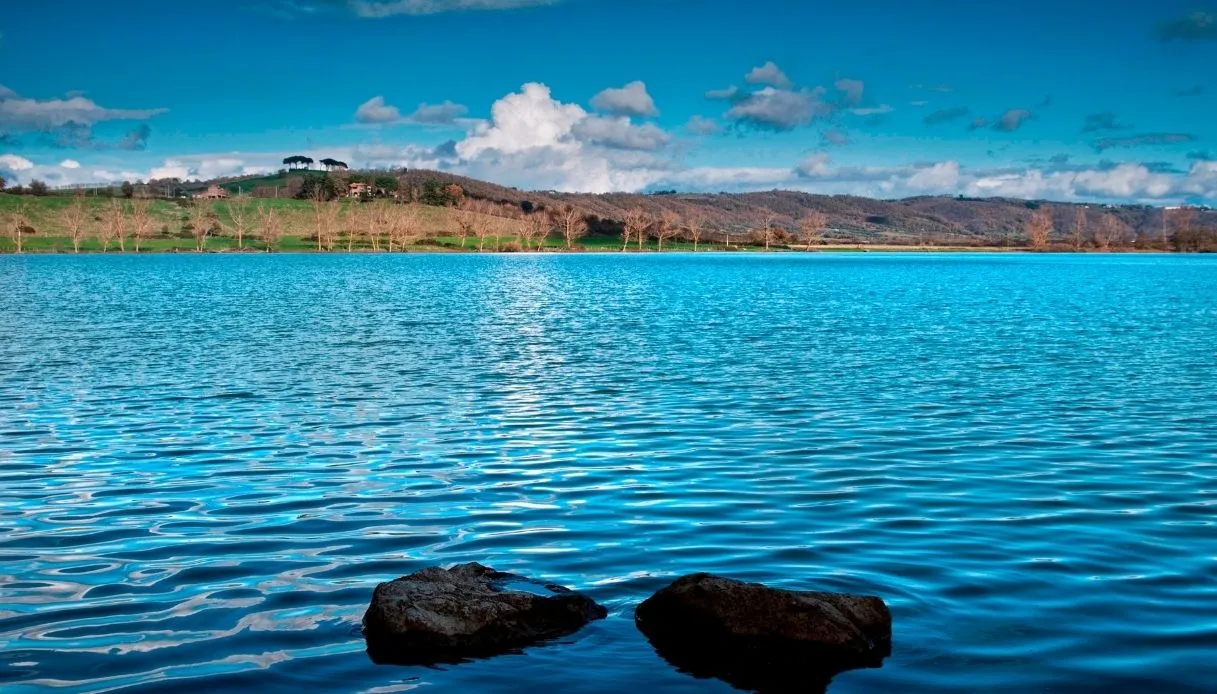
The Lago di Mezzano has just yielded another piece of its past, and not just any piece. On the seabed of the small volcanic basin of Tuscia, a Bronze Age sword was identified, perfectly preserved, alongside intact vases and other bronze objects. A discovery that pushes the history of this corner of Lazio even further back in time, where underwater lie traces of an ancient palafitte settlement. We are talking about the XIII–XII centuries BC: several centuries before the traditional founding date of Rome.
The Discovery of a Third Sword in Lake Mezzano
The centerpiece of the new research campaign is a sword with a tang that surfaced in the lake’s southern sector, in a zone still relatively unexplored. It is the third one found here since archaeological investigations began in the 1970s. And it was not alone. In the same area, an axe, a bronze razor, and several vessels arrived at our shores in nearly intact state also appeared.
In recent years the lake bed has been yielding a remarkable quantity of objects. Just in the 2025 campaign, more than 25 bronze artifacts had emerged: axes, spear points, fibulae, rings, a pin, a small sickle, and even fragments of ingots, the so-called “panelle.” What most intrigues archaeologists, however, is the position of the discoveries.
Several metallic finds seem to lie at similar depths on the seabed. This is not a detail known only to specialists: understanding where and how they were deposited can completely change the interpretation of the site. Were these objects lost during daily village life? Deliberate deposits? Water-related offerings? Or perhaps the lake’s landscape, altered over the centuries, has shifted and submerged areas that once lay very close to the shore?
Why This Discovery Changes Our Understanding of the Site
The temptation is to focus on the most spectacular object: a sword more than three thousand years old, indeed, makes its mark. But the value of the discovery lies mainly in the context. It seems that right in the Lago di Mezzano in the province of Viterbo there lies one of the most important Bronze Age palafitte settlements in Italy: research is allowing us to reconstruct how lake communities lived by examining the wooden structures, the tools and ceramics, as well as the various Bronze Age finds themselves.
Between the XIII and XII centuries BC, bronze was a precious material, the product of supply networks and complex technical skills. At Mezzano, the presence of finished weapons together with ingot fragments tells of a world already far more interconnected than one might imagine.
But what also piques curiosity is the relationship with water. In several European Bronze Age sites, lakes, rivers, and swamps have yielded weapons and metal objects. In some cases ritual depositions are hypothesized; in others interpretations remain open. At Mezzano, the presence of three swords and still intact vases makes the picture even more intriguing. And as archaeologists work underwater, often with limited visibility and challenging conditions, the lake continues to change its face. From a secluded corner of Tuscia to a kind of submerged archive of Italian protohistory.