
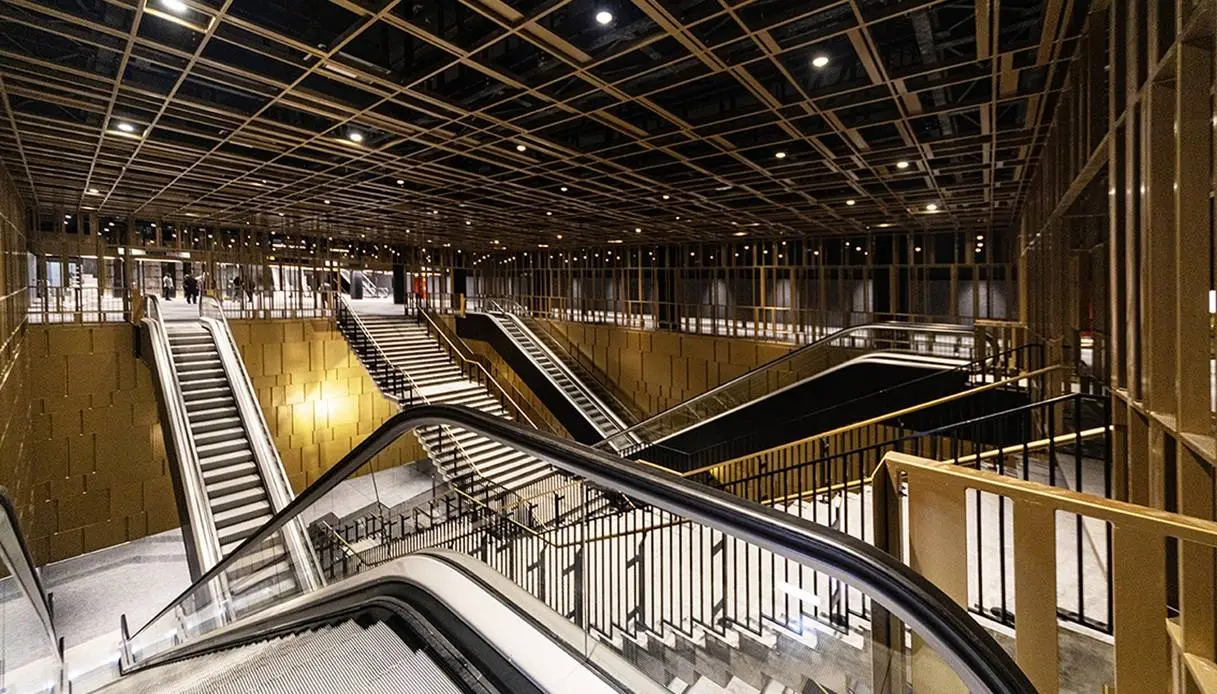
Among the world’s most beautiful new stations, two Italian gems were crowned. The Prix Versailles 2026, on September 28, 2026, unveiled the list of seven projects selected as the most stunning, each combining nods to local heritage with creativity and innovation to become new iconic urban spaces.
These are places that best illustrate how design excellence has become a driver of progress, as noted by Jérôme Gouadain, Secretary-General of Prix Versailles: they enhance travelers’ experiences, breathe new life into neighborhoods, and modernize spaces while respecting existing architecture. Three of the awarded stations will also receive an additional world title (Prix Versailles, Interior or Exterior) during the ceremony scheduled for December 10 at UNESCO’s headquarters.
Colosseum – Imperial Forums Station, Rome (Italy)
In Rome, every excavation can unearth a fragment of history: just as happened with the Colosseo–Fori Imperiali station, which links lines B and C of the metro and has become a genuine museum route through the artifacts revealed during construction.
The Italian station, honored by Prix Versailles 2026, unfolds across four levels, plunging to depths of more than 30 meters: as you descend toward the platforms, light and shadow reveal the layers of the city, with ancient wells acting as a connecting thread. A ride through the station becomes an archaeological experience that lingers in memory.
The museum section, designed by the Colosseum Archaeological Park in collaboration with Sapienza University, guides travelers through this immersion into ancient Rome. Then, between trains, a circular opening hides a surprise: a breathtaking view of the Colosseum.
Monte Sant’Angelo Station, Naples (Italy)
The second Italian station to receive the Prix Versailles nod is Monte Sant’Angelo in Naples. The station’s entrance seems to fling open the “gates of hell”: two monumental openings in corten steel and aluminum invite you to descend into a world evocative of Vesuvius, a cave, and the legend of the Sibyl of Cumae. Conceived by artist Anish Kapoor with Future Systems and AL_A, the station takes travelers down to 48 meters below the surface, with walls and ceilings left deliberately rugged.
The project, begun over twenty years ago, gave life to the first active station on Line 7: its 6,500 square meters serve the Monte Sant’Angelo campus of the Federico II University and the western districts of the city. Here you do not pass through a station that hosts a work of art: you enter the work itself, right into the bowels of Naples.
Town Hall Station, Melbourne (Australia)
In the heart of Melbourne’s historic center, beneath Swanston Street, lies Town Hall Station: designed by Hassell, RSHP and WW+P, this space impresses travelers with its vast subterranean expanses. In the atrium, eight monumental tree-like columns rise, and their branches support the roof, giving the place the look of a cathedral.
The copper-toned vaults reach up to 10 meters above the platforms, intensifying the sense of openness and space. What makes it even more distinctive are the artworks installed along the route, broadening the civic and commemorative dimension of the two stations by conveying stories through imagery.
Lyon Part-Dieu Station, Lyon (France)
In Lyon, moving through a building to switch from one street to another has long been second nature. The Lyon Part-Dieu station exemplified this, becoming a shortcut between districts. Its transformation drew on this everyday use: after nearly a decade of work, the AREP and L’AUC studios doubled its spaces, adding new entrances and routes for travelers boarding a train or simply crossing from one side to the other.
Today the station stands as a major hub for regional, national, and international connections, while also opening up to the city: outside, Place Charles Béraudier hosts on two levels France’s largest bicycle parking; nearby, a 210-meter-long, 15-meter-high gallery faces the new public spaces. The reference nod is to the traboules, Lyon’s hidden passages, reinterpreted here in a contemporary light.
National Museum Station, Riyadh (Saudi Arabia)
In Riyadh, the National Museum Station welcomes those heading toward the National Museum and the historic center with a façade that seems carved into rock. Designed by the Arup studio, it echoes the shapes of Mount Tuwaiq: through its triangular openings, inspired by Najd architecture, one glimpses the bright blue of the interior spaces.
A short distance away, the bus station evokes a Bedouin tent, adding another cue to the landscape and Saudi traditions. But the surprise comes once you pass the threshold: the blue walls shine like a hidden sky inside a mountain of stone. From a large atrium lit naturally, one then descends toward the platforms, reaching 33 meters in depth. As a interchange between the Blue and Green metro lines, the station gives travelers the impression of entering into a precious geode.
Western Station, Riyadh (Saudi Arabia)
Where once there was an open-air market, in Riyadh, the Western Station was born. Omrania Studio transformed the area into a small city neighborhood: around the tracks there are shops, a mosque, squares and pedestrian routes designed for strolling and meeting. The eye is drawn to the two long, undulating roofs, inspired by desert dunes: their curves create shaded areas while allowing light and air to pass through.
The station serves as a node on the Orange Line, but the trains glide on an elevated track: from the plazas and gardens you can see daily life passing overhead, while on the ground people continue to walk and meet.
LAX/Metro Transit Center, Los Angeles (United States)
In Los Angeles, a city where the car has long dominated, the LAX/Metro Transit Center offers a different way to reach the airport area. Designed by Grimshaw Architects in collaboration with Gruen Associates, it brings together the C and K subway lines, 16 bus routes, and a Bicycle Mobility Center; future plans also include connections to autonomous transport systems.
Above travelers unfold expansive canopies with sculptural forms and glass roofs, lending a light feel to the station. The climate also plays a role in the design: shade and natural ventilation reduce air-conditioning use, while solar panels cover about half of the internal energy needs. Surrounded by Los Angeles’ major highways, this hub gives travelers a bright, airy space to switch modes and continue their journey toward the famous city spread between the ocean and the hills of Hollywood.