
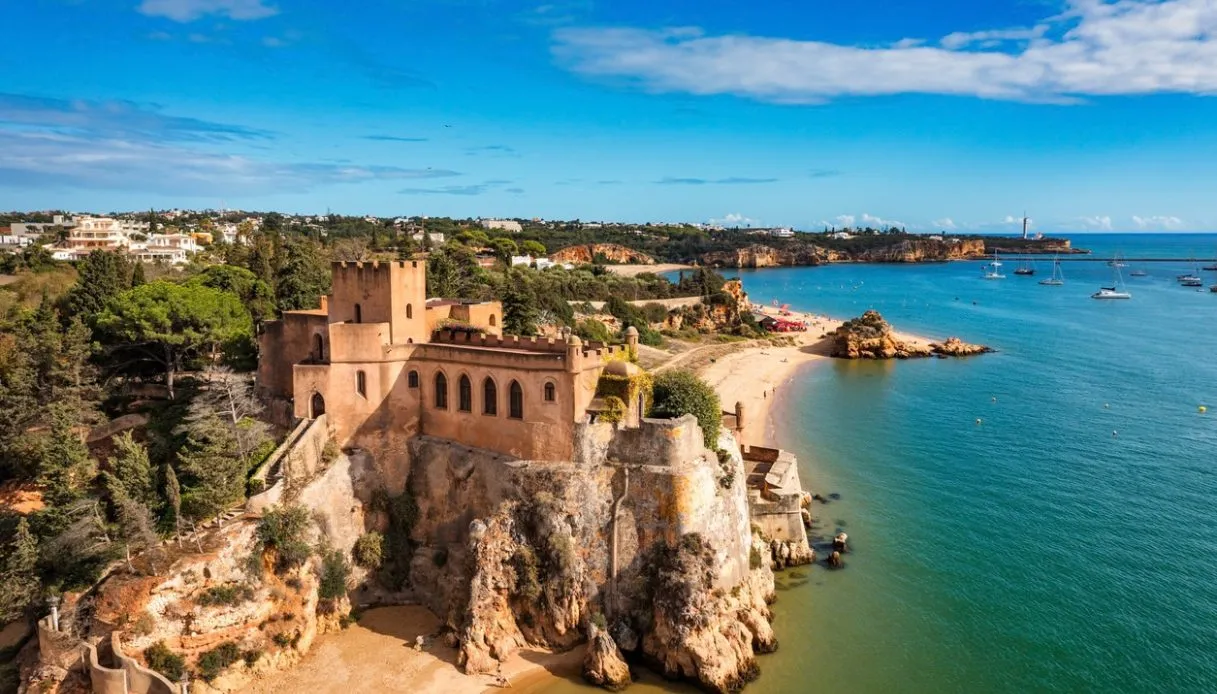
Along the southern coast of Portugal, in the Algarve, the landscape alternates between golden beaches, cliffs, and small fishing towns facing the Atlantic. Among them lies Ferragudo, which still preserves houses clustered around the historic core and boats along the Arade River. Right at the river’s mouth, on a rocky promontory between two beaches, rises a building that seems to belong to another era: the Castle of São João do Arade, also known as Castelo de Ferragudo, Forte de São João Baptista, and more simply, Castle of Arade.
Crenellated walls, structures arranged at varying heights, a tower and small garîtes (the projecting structures used for surveillance) compose a romantic-looking ensemble. At first glance it might resemble a medieval noble residence, but its origins are primarily tied to coastal defense and to the control of ships passing along the river.
However, the castle has also a peculiarity that distinguishes it from many other Portuguese fortifications: today it is private property, well preserved and converted into a residence, so interiors are not accessible to the public. Its presence nevertheless continues to shape Ferragudo’s landscape, especially when viewed from the surrounding beaches.
A Brief History of the Castle of Arade
The story of this Portuguese castle begins even before the construction of the current fortress. The area had already been frequented in Roman times, as evidenced by remains of fish-salting vats found nearby. The first defensive structure dates from the 15th century, when a watchtower was built on the promontory.
Work on the Castle of São João do Arade, however, took place between 1643 and 1644, right on the site of the previous watchtower. The project envisaged a roughly trapezoidal structure, designed to control a wide area and to organize the fire of the artillery.
On 2 May 1646, King John IV appointed Francisco da Costa Barros as captain of the castle, confirming the fortress’s role in protecting the western Algarve coast, the Bar lavento. The garrison also carried out functions of river traffic control, with checks on vessels bound for Silves.
Its military importance, however, diminished over the decades: by 1669 the building was already in ruins, though further interventions were carried out later. In the 19th century some artillery batteries were still operational, but the decline of the defensive function continued until its military decommissioning.
1892 marked a turning point, when the complex was leased by the writer and diplomat Joaquim José Coelho de Carvalho, whose family bought it in 1896. The renovations in the early 1900s transformed it into a private residence with a romantic character, integrating living spaces into the preexisting military structures.
The changes altered the building’s character without erasing its defensive layout entirely. The walls, garitas and the different heights of the bastions continue to tell of the complex’s original function. Since 1974 it has been classified as Imóvel de Interesse Público, i.e., a Property of Public Interest, a Portuguese heritage protection category. The property has remained private, and the fortress has also been used for stays and exclusive occasions.
Visiting the Castle of São João do Arade and Appreciating Its Details
The first piece of information to keep in mind concerns accessibility. As noted, the is privately owned, and interior spaces, the garden and residential areas are not open to ordinary tourist visits. The mere presence of a heritage classification does not automatically grant public access.
Nevertheless, the fortress can be admired from the outside, especially from the beaches that edge the promontory. To appreciate its structure, it is worth observing it from several angles, since the profile changes with the vantage point along the coast. Praia da Angrinha, on the side closest to Ferragudo’s historic core, allows one to grasp the relationship between the fortress and the small settlement.
The beach faces the estuary, with the waters of the Arade reflecting light and boats heading toward Portimão. From this perspective, the fortress appears tied to the river’s life, precisely the geographic element that determined its original function. On the other side lies Praia Grande, a wide sandy stretch facing the mouth of the river.
The view highlights the rocky outcrop on which the building rises and the sequence of masonry structures, to the point that the fortress seems to grow vertically, following the terrain rather than occupying a flat, regular area. Looking at the walls, one can distinguish some of the characteristic elements of military architecture: the main tall tower, often described as the torre de menagem, i.e., the principal tower of Portuguese castles, rises above the other structures. The crenellations define the upper profile, while the projecting garites recall the surveillance posts.
The arrangement across different levels is another interesting feature. Several annexes adjoin the main structure, forming an articulated complex, far from the conventional image of a symmetrical medieval castle. The openings and windows visible on some façades reveal a residential transformation. In particular, a portion facing the ocean features windows with a broken profile and a garita, elements that contribute to the singular blend of military architecture and private dwelling.
Another detail worth admiring is the continuity of the wall system between Praia da Angrinha and Praia Grande: the wall runs along the edge of the promontory and helps define the place’s dramatic character. Finally, the inner garden, also belonging to the private property, completes the ensemble, though it remains outside the ordinary tourist path.
Where the Castle of Arade Is Located and How to Get There
The is located in Ferragudo, in the municipality of Lagoa, Faro district, in the Portuguese region of the Algarve. It sits on the left bank of the Arade River, very close to its mouth, in the stretch of coast that separates Praia da Angrinha from Praia Grande.
To reach Ferragudo by car, you can use the Algarve road network, referencing the municipality of Lagoa and the town center. Once you reach the coastal area, it is advisable to head toward Praia da Angrinha or Praia Grande, the two beaches from which the fortress is most visible.
Those staying in Portimão can reach the site by crossing the river and continuing toward Ferragudo. The actual distance and travel times depend on the starting point and chosen route.