
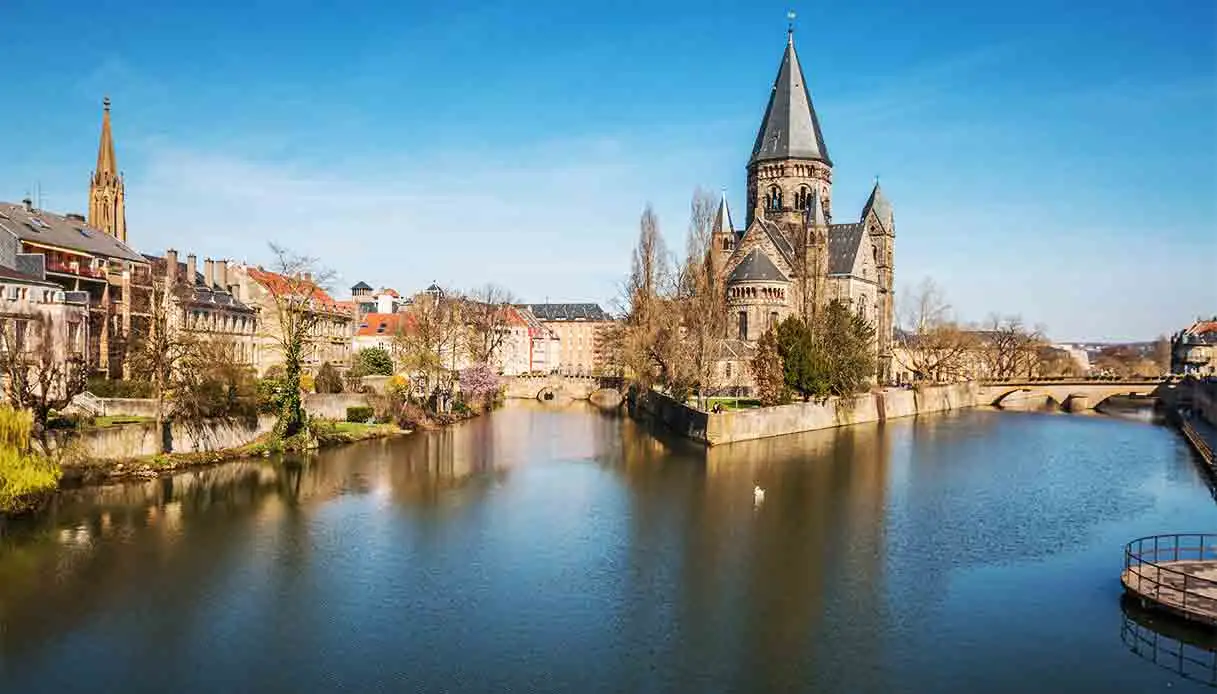
Metz, the capital of Lorraine in the Grand Est region, is a splendid city of art in the heart of a territory whose position, at the crossroads between French-speaking and Germanic realms, has been the subject of endless territorial disputes over the centuries and today offers the opportunity to admire the wonderful outcomes of the blending of diverse cultures.
The History of Metz
The city’s origins go back long before the Gallo-Roman era. On Sainte-Croix Hill, toward the end of the 3rd century BC, the Celtic tribe of the Mediomatriches settled there. The Romans expanded and transformed the settlement, which they called Divodurum Mediomatricorum. The name Metz derives precisely from this tribe. The Romans built an amphitheater, aqueducts, baths, temples, and a wall that protected them from the Huns and Vandals. However, the city was probably destroyed by Attila’s Huns in 451.
The city, like the entire region of Lorraine, initially lay at the heart of the Carolingian kingdoms and became an ecclesiastical center, so that the bishop exercised spiritual and temporal power until the 13th century, before becoming part of the complex state system of the German Empire and, around the 13th century, transforming into a free commune. Subsequently it was annexed to France, where it remained until 1871, when the Germans occupied it because of its industrial importance, especially coal and metal, losing it after the end of World War I and regaining it during World War II. In 1945, Metz definitively returned to France. The city was spared from extensive conflicts, preserving much of its heritage: from Roman times to the present, about a hundred historic monuments bear witness to its rich past.
In the past, the city was a military and industrial center of great strategic importance and thus highly sought after by the tactical interests of neighboring powers, while today, although it remains an important industrial hub, it is above all an art city of extraordinary beauty. Here are the most interesting attractions to see in Metz.
What to See in Metz
The most evocative way to visit the historic center of Metz is to cross the spectacular Porte des Allemands, the Gate of the Germans, a formidable example of medieval military architecture and a testimony to the old and mighty wall that once surrounded the urban area. The gate’s name derives from the fact that, in the Middle Ages, the Teutonic Knights had built a large hospital nearby, and the knights’ origin became the nickname for the main access road into Metz for travelers coming from the East. Today, the gate stands as a mighty fortress composed of bridges and large arches and, although isolated, it allows one to imagine how imposing the entire city must have appeared, wrapped in its high crenellated walls.
The heart of the urban center is Place d’Armes, the Army Square, created at the end of the 18th century by demolishing an entire block of the old city to make room for barracks and facilities guarding the border. Today, the square is Metz’s vibrant core, facing some of the city’s most famous and important buildings, such as the Cathedral of Saint-Étienne and the Town Hall.
The Cathedral of Saint-Étienne is one of the grandest examples of French Gothic architecture, constructed between the late 14th and the first half of the 15th century, and it holds the record for the largest area of stained glass windows in Europe, reaching an impressive 6,500 m². This extraordinary decoration has earned the cathedral the nickname Lanterne du Bon Dieu — “Lantern of the Good God” — due to the stunning display when sunlight shines through the colorful panes. In addition to the stained glass, the cathedral is a marvel in every detail, with exquisite Gothic statues that lend grace to the stone structure and towering ogival arches rising over 40 meters in the central nave.
Just a short distance beyond the cathedral lies Hotel de Ville, Metz’s City Hall. While not architecturally monumental, it is a remarkable building because it bears witness to how deeply the capital of Lorraine’s history has been shaped by the military dimension, being located in a border region of a Europe that has often stood on the brink of war. Inside the building, in addition to hosting the municipal offices, is the city’s tourist office, always ready to offer support to visitors who come to admire its masterpieces.
Staying in the Place d’Armes area, you can stroll among the stalls of the famous covered market, a market of local products that offers a superb opportunity to sample the best of the northern French gastronomic production, and to shop choosing from a vast selection of cheeses, pastries, wines, and traditional products.
Another square worth a visit is the elegant Place Saint-Louis, where one finds one of Metz’s most characteristic viewpoints, with a series of evocative ancient palaces forming a real stage of arcades and refined decorations behind the square’s cobblestones.
To admire one of the city’s most romantic panoramas, one must reach the islet of Petit Saulcy, connected to the city center by a succession of spectacular stone bridges, from which Metz unfolds along the bends of the Moselle River and, in the evening, the spectacle of lights reflected on its waters.
On the island you can visit the beautiful Protestant church, built in a Neo-Romanesque style during the period of German domination in Lorraine, the Opera Theatre, and the splendid Place de la Comédie. Petit Saulcy is also the area of Metz that, in spring and summer, hosts the peak of the festival season, bringing together, along its narrow streets, a great cultural vitality that lasts until late at night.
Metz’s cultural life was revolutionized when, in 2010, the Centre Pompidou-Metz was opened, a true branch of the Paris-based renowned center for art and culture. Within the cultural center, exhibitions, conferences, and events of national and international significance are hosted. The main collection preserves nearly 65,000 works of contemporary art, making it the most important collection in Lorraine and the third most important cultural institution in France.
How to Arrive in Metz
Getting to Metz is very straightforward thanks to its strategic position near the borders with Luxembourg, Germany, and Belgium. The most convenient way from Italy is to depart from Paris aboard a high-speed train that leaves from the Gare de l’Est. The TGV journey lasts about one and a half hours. If desired, it is also possible to reach Metz by train directly from Milan, crossing Switzerland (Basel or Zurich), and then continuing toward Strasbourg and finally Metz. Nearby Metz are also the airports of Luxembourg (about 60 km via direct buses and regional trains) and Strasbourg (SXB) (about 160 km by regional TER or TGV trains). For those who prefer to travel by car, Metz is about 650 km from Milan. You would cross Switzerland via Chiasso/San Gottardo (a Swiss highway vignette is required) toward Basel, continue into France toward Strasbourg via the A35 and then take the A4 toward Metz.