
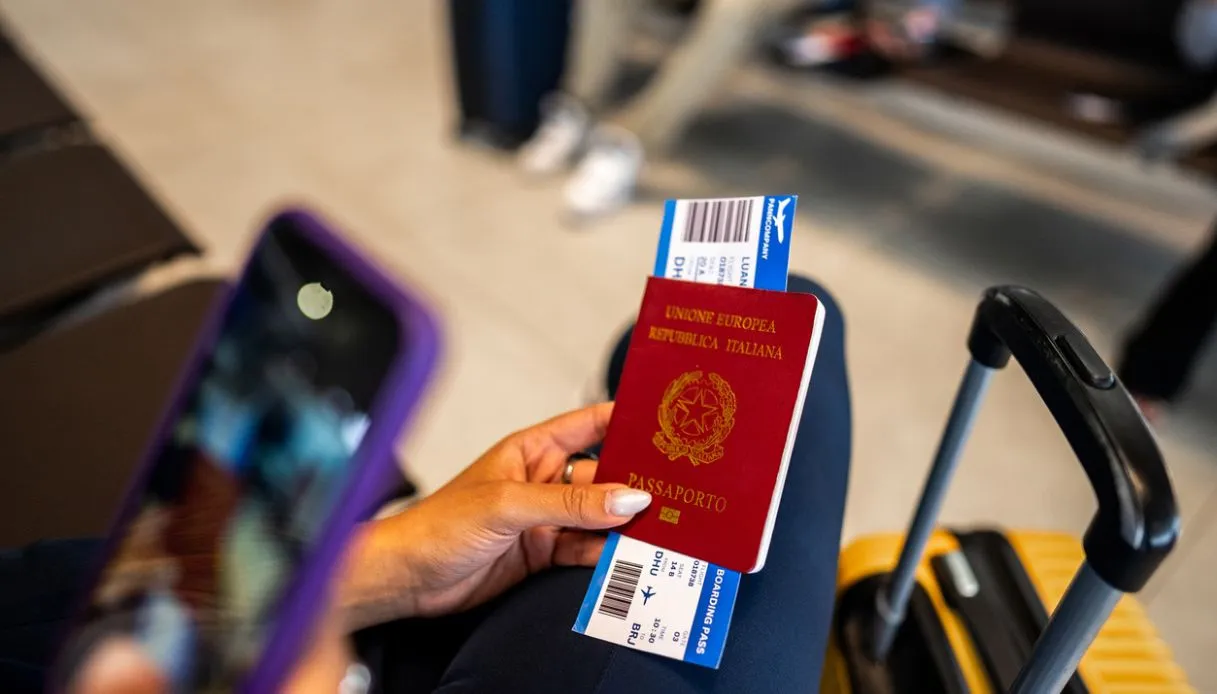
An unusual scene has begun to appear in European airports: at the document check, some passengers pull their passport from their bag, carefully wrapped in aluminum foil. They unwrap it in front of the official, hand over the document, and once the check is finished, they protect it again with the foil.
The gesture may seem quirky, but behind this new habit there is a very real fear: the possibility that the chip housed in modern biometric passports could be read remotely and that the personal data contained inside could be intercepted. The concern has found space mainly on social platforms and travel forums, turning a technological precaution into a curious airport trend.
The biometric passport and that contactless chip
To understand where the fear comes from, one must start with how biometric passports work, now used for years in Europe: inside the document there is a RFID chip, short for Radio Frequency Identification, equipped with a small antenna that allows it to communicate with the appropriate readers via radio waves.
The chip does not have its own battery; it is activated by the energy coming from the reader’s signal and can therefore exchange information without the passport being physically inserted into a device.
Inside are stored data associated with the holder: first name, last name, date and place of birth, a digital photograph and, in the newer documents, also the fingerprints required by the regulations. In German passports, for example, the chip also contains other personal information used for identification.
It is precisely the possibility of wireless communication that has fed the doubt: if the document can dialogue with a reader without being physically connected, could it also do so with an unauthorized device?
Why aluminum foil should shield the passport
The principle behind the trick is simple: aluminum can act as shielding against electromagnetic waves and, wrapping the passport completely, can prevent the chip from receiving a signal sufficient to communicate.
From a physical standpoint, therefore, the idea is not without foundation: aluminum foil can indeed hinder the chip’s radio communication. The question is whether this protection is truly necessary with modern passports.
The answer, according to the information provided by authorities and experts cited in the material, is far more nuanced than the fear circulating online. The systems used in contemporary documents are, in fact, designed precisely to prevent anyone from approaching the holder and reading the information stored in the chip.
From early fears about interceptions to RFID-protective cases
The fear of distant reading did not originate with TikTok: already in the early 2000s, when electronic documents began to spread, cybersecurity experts like Bruce Schneier drew attention to the risks associated with contactless technology. In those years the topic also sparked public demonstrations and discussions about the possibility of querying the chips with specific equipment.
Thus there appeared anti-RFID passport holders and wallets, made with materials capable of blocking radio communications. The same principle is used for other objects equipped with contactless technology, such as some bank cards and badges.
Compared to foil, these cases have a practical advantage: there is no need to open and close an improvised wrapper each time before presenting the document at the checkpoint.
Meanwhile, however, the technology of passports has also evolved. Reading the chip no longer occurs by bringing a device close to the document and downloading its contents freely.
To establish secure communication, the reader must first obtain information from the part of the passport intended for optical reading, the area containing the lines of letters, numbers and symbols present on the page with the photograph.
In newer documents the PACE system, or Password Authenticated Connection Establishment, is also used: the mechanism allows to protect the communication between the document and the reader and makes unauthorized access to the data much more difficult.
Is the risk of abusive reading real?
Information provided by the German authorities indicates that, in normal travel scenarios, unauthorized access to the chip is considered extremely unlikely. The reach of the communication is very limited, and any reader would need to be at a very close distance to the document.
Even for this reason, the idea of protecting the passport with aluminum foil seems more like an additional precaution than a necessity for most travelers.
That does not mean shielding is harmful: those who hold an older document or prefer to block any radio communication when the passport is tucked away in a backpack can use an RFID case. It is a preventive measure that does not compromise the document’s operation when used at the checkpoint.