
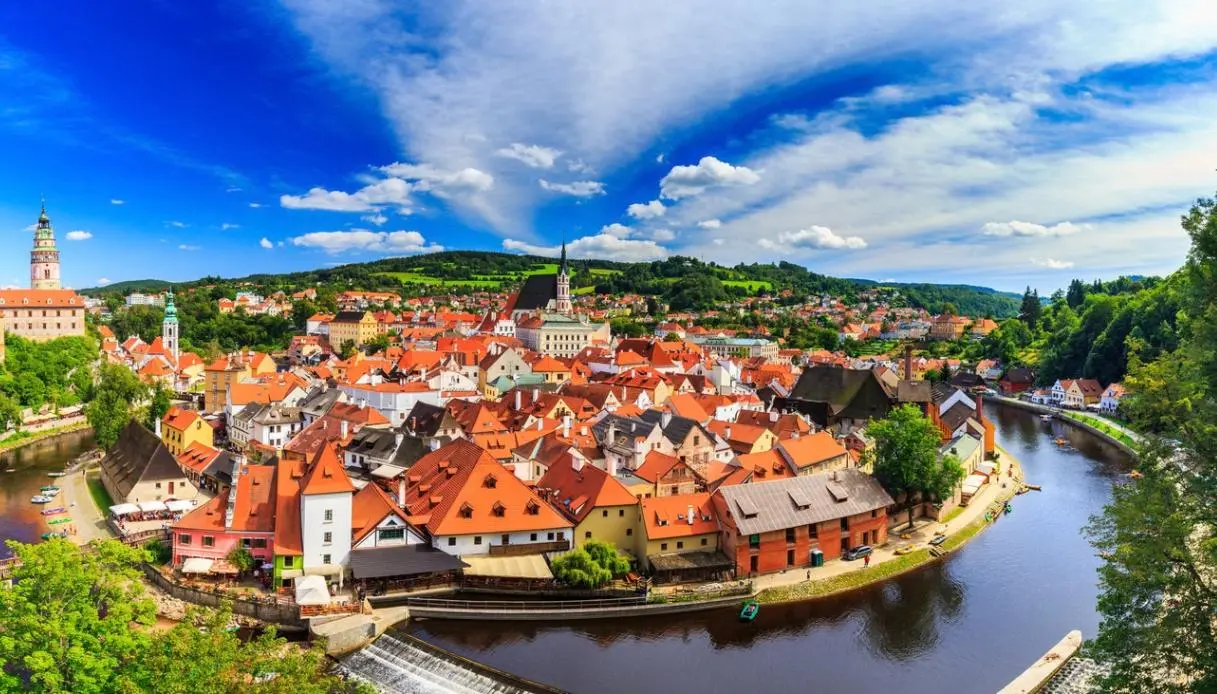
In southern Bohemia, the Moldau River traces a series of curves around the historic center of Český Krumlov, as if to shelter it. Water wraps around the houses, flows beneath the bridges, and reappears among the ancient buildings, becoming an integral part of the urban landscape.
The historic core preserves a labyrinthine network of narrow lanes, squares, and houses from different eras, from Gothic to Renaissance to Baroque. Surrounding it is a vast castle complex, second in size in the Czech Republic only to Prague Castle.
The result is a historic center that remains extraordinarily intact, so much so that it earned a place on the UNESCO World Heritage List. To truly grasp its character, one should leave behind the most obvious routes and follow the curves of the streets, noticing the façades’ details, arches, signs, and sudden viewpoints onto the Moldau.
What to see in Český Krumlov
This town in the Czech Republic safeguards a surprising amount of testimony tucked into a compact space.
Český Krumlov Castle
The castle’s immense silhouette dominates Český Krumlov from above and tells of centuries of architectural transformations. The original construction dates back to the 13th century, when the Vítkovec family built the first fortress. The Rožmberks expanded the complex and, in the 16th century, profoundly altered its appearance, turning it into a refined Renaissance residence.
< /ask-ai-widget>
Among the attractions, the Baroque Theatre stands out, regarded as one of the oldest theatres preserved inside a castle in Central Europe. Scenography, theatrical machinery, props, and the so‑called mystical gulf—the space reserved for the orchestra—recreate the organization of a Baroque-era performance.
The cylindrical tower, meanwhile, represents one of the most distinctive viewpoints: from above, the gaze reaches the city’s rooftops, the bends of the Moldau, and the Bohemian Forest landscape.
Concordia Square and the Inner Town
Náměstí Svornosti, Concordia Square, is one of the most recognizable spaces in the center. Its square shape is framed by Gothic, Renaissance, and Baroque buildings, with painted façades that seem to belong to a fairy-tale stage set.
Among the most interesting elements are the Renaissance Town Hall and the hexagonal stone fountain erected in the 19th century around the Marian plague column.
From this square, streets branch out in various directions, allowing you to discover the Inner Town, enclosed by the Moldau. Three bridges connect it to the other parts of the settlement, creating a very distinctive urban geography.
Latrán and the Barber’s Bridge
On the northern side of the historic center lies Latrán, an ancient neighborhood at the foot of the castle. The connection to the Inner Town passes via the Barber’s Bridge, the Lazebnický most, a wooden structure crossing the river.
The houses crowd along the streets, while the mass of the castle rises behind the buildings: yes, it is one of Český Krumlov’s most characteristic viewpoints.
Seidel Museum and Photo Studio
One of the town’s most original experiences leads inside an old photographic studio. Josef Seidel and his son František documented for decades the people, landscapes, and daily life of the region from the late 19th to the early 20th century.
The exhibition houses glass negatives, cameras, equipment, original furniture, client ledgers, notes, and personal diaries. Behind the vintage photographs appear faces, clothes, streets, and landscapes of a world now distant, fixed on plates that have endured for more than a century.
Egon Schiele Art Centrum
Český Krumlov also played an important role in the life of Egon Schiele, Austrian painter and draughtsman born in 1890 and died in 1918. The artist’s mother came from the town and Schiele stayed here, creating works inspired by the town and its landscapes.
The Egon Schiele Art Centrum occupied the spaces of the town’s former 16th‑century brewery and covers about 3,000 m². The center documents the life and work of the artist, pairing Schiele’s works with temporary exhibitions dedicated to classical and international 20th‑century art.
What to do in Český Krumlov
After tracing the footsteps of noble families and artists, the town invites you to change tempo. Its compact size allows alternating cultural visits, river viewpoints, and moments devoted to local traditions.
- Climb the castle tower: to observe from above Český Krumlov’s distinctive urban form and to pick out the Moldau’s bends around the historic center.
- Follow the Moldau’s course: offers a different perspective on the city, built right along one of Bohemia’s main waterways.
- Try navigating the river: allows you to admire Český Krumlov from the water, with tourist excursions even on wooden rafts lit by torches at dusk.
- Discover the local beer tradition: leads to the Eggenberg brewery, active in the city since 1560 and tied to the Eggenberg lineage, which acquired Český Krumlov in 1662.
- Visit the town during the Five-Petaled Rose Festival: means witnessing a Renaissance reenactment with knights, costumed processions, music, markets, living chess, and fireworks.
- Explore the surroundings: the Hluboká nad Vltavou Castle, the village of Holašovice, the Vyšší Brod and Zlatá Koruna monasteries—important testimonies of southern Bohemia.
Where it is located and how to get there
Český Krumlov is located in southern Bohemia, along the Moldau river. The town lies about 170 km from Prague and makes for an easily incorporable stop on a regional itinerary.
By car from the capital, it takes roughly 2 hours. Direct buses take nearly 3 hours, while the train journey requires a similar amount of time and involves a change at České Budějovice. To truly grasp its atmosphere, however, a longer stay allows you to see the center at a different pace, especially during the hours when the streets grow quieter.
Then the city changes its face: light glides over the painted façades, the Moldau continues its loop around the houses, and the castle tower rises above the rooftops. Český Krumlov thus reveals its most difficult quality to put into words: a town that is both intimate and monumental, built over centuries around a river that still dictates its pace.