
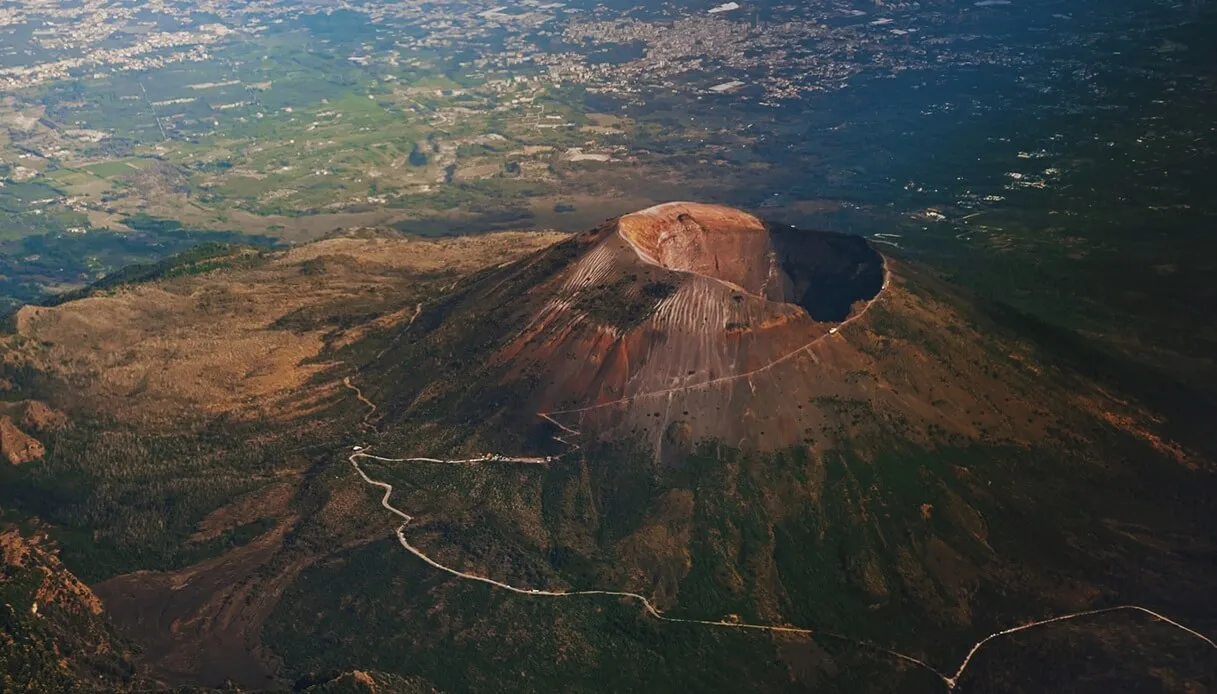
There are few countries in Europe with a greater number of active volcanoes than Italy, which boasts a high concentration, especially in the southern regions. A geological privilege, this translates into the possibility for travelers to undertake some of the most unique and surprising trekking experiences that the continent has to offer.
Hiking is one of the main tourist activities on the slopes of Etna, the great volcano that dominates eastern Sicily with its silhouette, while less famous yet equally scenic are the trails that climb along the perfect cones of Vulcano and Stromboli, the two Aeolian Islands hosting active volcanoes, or the gentle slopes of Vesuvius, with views that stretch over the Gulf of Naples.
Hiking on Etna
Etna is the highest active volcano in Europe and one of the most studied in the world. Its imposing cone, often topped by a plume of light smoke, is visible from practically every corner of the eastern Sicilian Ionian coast, as it towers clearly beyond three thousand meters in altitude. While at times it can become unsettling and threatening, the Sicilian volcano offers a wide range of trekking experiences suitable for all levels, united by the surprising discovery of a unique natural environment.
Those seeking an easy excursion can stop at the Silvestri Craters, just below 2,000 meters, reachable even without a guide and still extremely fascinating for their shape, for the black soil that characterizes them, and for the contrast with vegetation that, resilient, has managed to take root even in this environment. Another option is to ride the cable car from Rifugio Sapienza up to about 2,500 meters, from where panoramic trails with a low to moderate elevation gain start, within reach of most visitors.
Those who want to venture toward the summit craters, located between 2,900 and 3,300 meters, must necessarily rely on an authorized volcano guide. Greater effort yields greater reward: around the summit the landscape becomes truly lunar, you encounter active fumaroles, fields of recent lava, and a panorama that, on clear days, encompasses all of eastern Sicily up to the Strait of Messina.
The northern flank of Etna, the Piano Provenzana area, offers a wilder and less crowded alternative: here the trails wind among recent lava flows, such as the 2002 one, and some beech forests, in a constant contrast between the lush life of the forest and the black rock.
Hiking on Vesuvius
A true symbol of Campania and Naples, Vesuvius is the volcano that has most shaped human history in Italy: its eruption of 79 AD buried Pompeii and Herculaneum under a veil of ash and lapilli, returning to us today two of the world’s most extraordinary archaeological testimonies.
Today it is a quiescent volcano: it is active, but its last eruption dates back to 1944, and its unpredictable future is a constant object of study by volcanologists.
Its great charm can also be discovered by venturing on its slopes on foot. The most famous hike in the Vesuvius National Park, created in 1995 to valorize and protect the volcano’s ecosystem, is the one that leads to the Gran Cono, the trail that from the Ercolano overlook climbs to the crater rim, at 1,281 meters above sea level.
It is a route that is neither short nor particularly demanding, yet capable of delivering a spectacular view over the Gulf of Naples, with the possibility of seeing the silhouettes of Capri, Ischia and Procida emerging on the sea level. Once at the top, you peer into a crater roughly 700 meters in diameter and more than 300 meters deep, where you may observe active fumaroles, and certainly you will be able to spot colorful minerals and vegetation that has adapted with surprising tenacity to such a hostile terrain.
Vulcano, Trekking in the Aeolian Islands
Among the seven islands that make up the Aeolian archipelago, Vulcano is the closest to the Sicilian coast and, as the name suggests, owes its fame to the Great Crater of the Caldera (Gran Cratere della Fossa), which at about 390 meters in height dominates the entire island.
According to Roman mythology, it was right here that the furnaces of the god of fire and metallurgy stood, the one called by the Latins Vulcano (Hephaestus in the Greek pantheon). A fantasy that still awakens today when the fumaroles hint at the volcano’s quiescent state, never completely extinguished even if there has been no eruption since 1890.
The path leading to the crater starts near the port and climbs to the summit in about 3 hours of walking. It is an intense experience: the elevation gain is fairly concentrated and even if the route is suitable for anyone with a minimum level of training, it is not without effort; you walk among small rocks and volcanic sand, in a barren landscape but with vivid colors; you can perceive the volcanic activity also from the sulfur smell that penetrates from time to time; finally, you are treated to an exceptional panorama, with views spanning the entire Aeolian archipelago.
An alternative excursion is the one that crosses the Valle Roja, a gorge carved into volcanic rock where the wild environment opens to the contrast between lava walls characterized by bold colors and the surrounding vegetation trying to take root all around. Very beautiful, short, and within everyone’s reach is also the Vulcanello excursion, as it is called the small peninsula connected to the rest of the island only by a thin sandy isthmus, formed thanks to some relatively recent eruptions, which allows for a scenographic and different viewpoint on Vulcano, the Grand Crater, and the nearby Lipari.
Hiking on Stromboli
Stromboli rises in the middle of the Tyrrhenian Sea, an island-volcano with a stereotypical appearance, standing 924 meters above the waters. It is one of the most active volcanoes in the world, with short and frequent eruptions. On one hand this leads to a near-continuous natural pyrotechnic display, on the other it obviously poses a threat to human presence on the island, which is divided between the towns of Stromboli and Ginostra.
Regarding tourism, and in particular hiking, climbing the Stromboli volcano cannot be done autonomously beyond 400 meters: once past this threshold, the route toward the summit craters is open exclusively to groups accompanied by authorized volcanological guides, and only when allowed by the volcano’s activity.
In any case, once you reach the 400-meter viewpoint, the spectacle that unfolds before your eyes is already among the most evocative that volcanic Italy can offer, especially at dusk: the sky turns red at sunset, the great black tongue of the Sciara del Fuoco plunges toward the sea and, as night falls, the regular flashes of explosions illuminate the darkness. The return then takes place with headlamps, along the old mule path, in an almost spiritual atmosphere.