
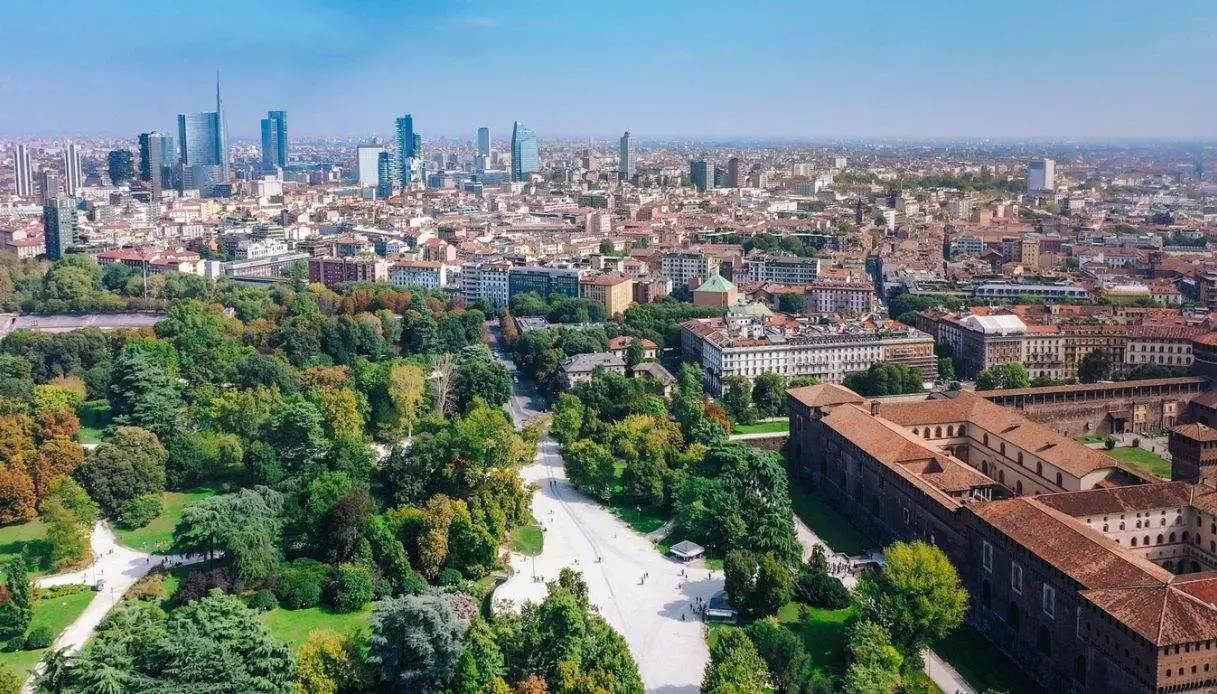
On September 23, the results of the Global Destination Sustainability Index 2026 (GDS-Index) were unveiled, the international program that measures a destination’s commitment to a model that respects the environment, residents, and travelers.
Among the 40 cities recognized as sustainability leaders, Milan also features, ranking 26th: eight places higher than last year. The Lombard capital owes this result to a strategy that aims to balance its role as a global hub of investment and innovation with attention to the environment and social inclusion. And the recognition arrives precisely in the year of the Milano Cortina 2026 Winter Olympics and Paralympics.
Milan Among the World’s Most Sustainable Cities
Milan joined the GDS-Index in 2022, the first Italian destination to do so. The jump came quickly: in 2023 it entered the global top 40, at the 40th position. In 2025 it had already risen to 34th place, with a score of 74.31%, and this year it climbs another eight positions to reach 26th.
The pillars of its strategy are clear: Milan aims to be a young, inclusive city with a sustainability-oriented mindset, capable of offering the energy of a global metropolis without losing its human scale. On the environmental front stands ForestaMi, the project that plans to plant three million trees in the metropolitan area by 2030. Today 43% of the city’s electricity comes from renewable sources.
Great attention is also given to mobility, inspired by the model of the “15-minute city.” The objective is to electrify 100% of public transport by 2030. In the meantime, two new driverless metro lines have been completed, including the M4, which connects Linate airport to the city center in 15 minutes. On the surface, around 200 electric buses operate. For those who prefer cycling, there are 290 bike-sharing stations, with 3,650 conventional bicycles and 1,150 e-bikes, plus 218 km of bike lanes.
There is also a focus on conference tourism. Since 2020, YesMilano Convention Bureau has helped organize fairs, congresses, and corporate events with low environmental impact, and 46% of event venues hold sustainability certifications. Socially, the city pursues the regeneration of peripheral neighborhoods and seven strategic railway stations that connect the center to the outer districts, one of which hosts the Olympic Village. The picture is completed by policies against food waste, support for short supply chains, and a commitment to LGBTQ+ rights, expressed in neighborhoods such as NoLo and Porta Venezia.
GDS-Index: The Top 10
Regarding the overall ranking, for the third consecutive year the first place goes to Helsinki. The Finnish capital scores 92.94%, followed by Göteborg (91.29%), which had dominated the ranking for seven editions between 2016 and 2023. The podium is completed by Copenhagen, with 90.35%.
The Nordic region remains the model to follow. The first five positions are all Scandinavian, with the Danes Aarhus (90.12%) and Aalborg (88.24%) just behind the podium, and Reykjavik and Tampere among the top eleven. The United Kingdom places Glasgow in sixth and Belfast in eighth.
To compile the ranking, the GDS-Index evaluates four areas: the organization that manages tourism, the local supply chain (hotels, airports, restaurants and event venues), social progress, and environmental performance. The 40 cities with the highest scores are recognized as leaders in the journey toward regenerative tourism.
Here is the top 10:
- Helsinki, Finland;
- Göteborg, Sweden;
- Copenhagen, Denmark;
- Aarhus, Denmark;
- Aalborg, Denmark;
- Glasgow, United Kingdom;
- Sydney, Australia;
- Belfast, United Kingdom;
- Montreal, Canada;
- Reykjavik, Iceland.
