
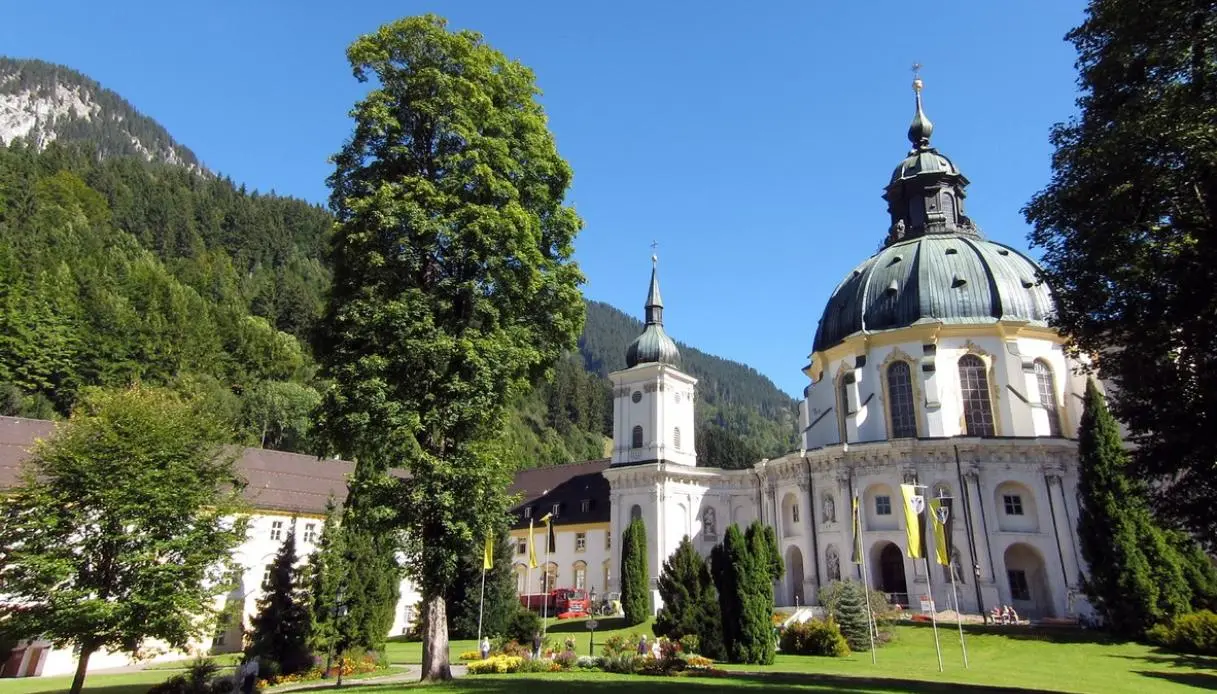
In the landscape of the Bavarian Alps, among the Ammergau mountains, the Ettal Abbey rises into the sky with its massive towers and a large dome that dominates the small town of the same name. Even from the road, precisely the B23, one can catch a first view of the imposing monastic architecture, and it is only upon entering the abbey precinct that the emotion becomes tangible.
A slightly sloped garden leads toward the buildings, while the basilica occupies the center of the scene with a monumental façade and two bell towers of different shapes. Ettal still belongs to the Benedictine community and alongside religious life hosts activities related to the production of beer and liqueurs, a secondary school, a monastic shop and other realities born around it.
A Brief History and Legends of Ettal Abbey
The history of this abbey in Germany begins in April 1330 with Louis IV of Bavaria, also known as Louis the Bavarian. The ruler founded the monastery after returning from a military campaign in Italy and tied the foundation to a vow. The underlying idea also had practical aims, connected with the development of the territory, the safety of travel routes, and the creation of a foundation intended for knights and their wives.
A legend closely tied to the statue of the Madonna arose around the foundation: according to the傳 tradition, an angel would point out a sacred image to Louis and entrust him with the task of founding a monastery. The tradition also says that the figurine arrived from Italy and that Louis received it from the city of Pisa.
The white marble sculpture depicts Mary with the Baby Jesus in her arms. At first it bore painted decorations, and during the Baroque period it was clothed in precious garments. The veneration began soon after the foundation and transformed Ettal into a pilgrimage site.
The first church was completed in 1370, after about forty years of work. In 1710 the abbey also housed a knightly academy, regarded as one of the most important higher education institutions of the period. The most dramatic moment came in 1744, when a fire destroyed the religious building and much of the monastery.
The rebuilding profoundly changed the appearance of the complex, with Enrico Zucalli and Joseph Schmuzer among the principal architects of the new design, together with the artists active in decorating the interiors. A crucial part of this artistic season bears the signatures of Johann Baptist Zimmermann, Johann Georg Üblherr and Johann Jakob Zeiller, who created one of the most spectacular expressions of Bavarian Baroque, featuring an extraordinary concentration of stuccoes, paintings and sculptures.
The religious history was then abruptly interrupted by secularization, which led to the suppression of the abbey. The Benedictines returned at the beginning of the 20th century, reviving the monastic community.
A Visit to the Basilica, the Cloister, and the Abbey’s Historic Activities
The basilica deserves time especially for the abundance of details packed into its central structure. Eleven windows contribute to the interior’s brightness, while the gaze is drawn upward to the grand dome frescoed by Johann Jakob Zeiller. The scene depicts a multitude of saints gathered beneath the Trinity, creating the impression of an open sky above the nave.
At the center of the presbytery stands the monumental high altar, completed in 1790 after the reconstruction following the fire. The Madonna of Ettal occupies the altar’s most precious spot, inside a rich baldachin adorned with gilded carvings, columns and precious stones. The small sculpture thus appears set in a frame vastly larger than its size, almost as if a jewel safeguarded inside the basilica.
The altarpiece of the high altar depicts the Assumption of Mary and is the work of Martin Knoller. The scene completes the presbytery’s composition together with the revered statue and the surrounding decorations. Along the sides of the nave follow six side altars created in the mid‑18th century. The sculptural works belong to Johann Baptist Straub, and among the subjects depicted are the Holy Family and the Risen Christ with the Apostles.
Also noteworthy is the pulpit of 1759–1760, enhanced by the gilded relief of the Nativity of Jesus, also linked to Straub’s production. Not far away lies the bust of Father Rudolph Mayer, placed in memory of his forced exile during the Nazi regime. The Baroque organ dates to around 1763 and was built by Johann Georg Hörterich of Dirlewang, near Mindelheim.
Then there is the sacristy which represents another jewel of the complex: here the Rococo environment preserves high-quality decorations and furnishings and is considered one of the most beautiful Rococo sacristies in southern Germany. From the main body of the basilica one also reaches the Kreuzgang, the abbey’s cloister, with the monks’ graves laid to rest over the centuries.
The visit can then continue through the monastery’s productive activities. An example is the abbey brewery dating back to 1609, which maintains a Bavarian beer‑making tradition. Adjacent to the brewery is the distillery, linked to recipes handed down for about 400 years. The experience can also continue with a visit to a local dairy, where regional cheeses and dairy products are produced, or to a woodcarving workshop.
Finally, outside, near the western entrance, lies the Schwedensäule, the Swedish Column, a monument tied to the Thirty Years’ War.
Location and How to Reach
The abbey comes to life in the small town of Ettal, in the Ammergau Alpine region, along the B23. The location places the monastery between Garmisch-Partenkirchen and Oberammergau, in a setting dominated by the Ammergebirge mountains. Garmisch-Partenkirchen is about 12 km to the south, while Oberammergau lies about 5 km to the north.
For those arriving from Italy, the Brenner Pass is roughly 115 km away via Garmisch-Partenkirchen and Innsbruck. The basilica provides routes and ramps accessible to people with reduced mobility.
Ettal makes it clear that this is a place capable of bringing together very different eras without turning into a mere monument. The Madonna arrived from Italy in 1330 continues to occupy the center of devotion, the eighteenth-century dome tells of Baroque magnificence, the bells still mark religious life, and the brewery continues a tradition begun over 400 years ago.
