
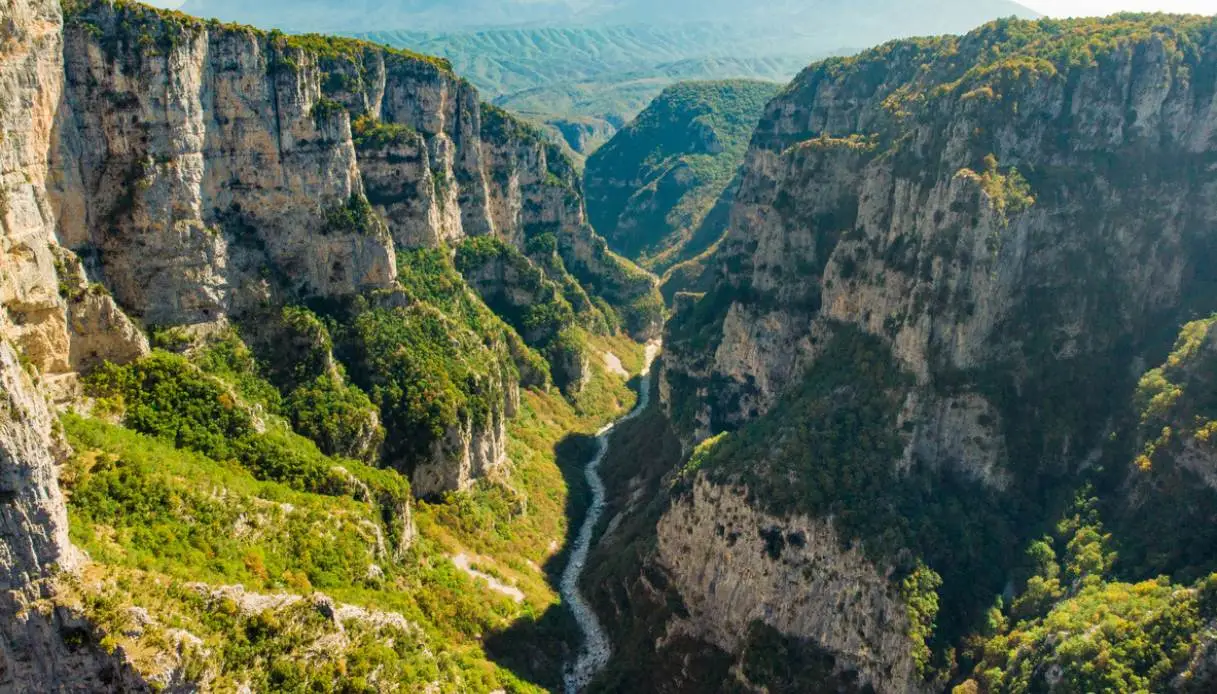
Breathing with lungs only partly filled by air, the crisp dawn air of the mountain ascends as a few steps beyond the forest edge reveal an imposing vertical opening carved into the earth. A colossal fissure, nestled between the Pindus mountains, known as the Vikos Gorge, unquestionably stands as one of the most spectacular landscapes of mainland Greece.
Around it lies Zagori, a mountainous region famed for its 46 traditional villages, built mainly from local stone, which since 2023 has been listed on the UNESCO World Heritage site for its cultural landscape and architectural tradition. The canyon itself represents the wildest portion: it runs along the southern flank of Mount Tymfi, inside the Vikos–Aoos National Park, in a landscape that alternates between vertiginous limestone cliffs, forests, side gorges, springs, and the course of the Voidomatis, regarded as one of Europe’s clearest rivers.
The international fame of Vikos, however, stems primarily from a remarkable feature: the Guinness World Records names it the world’s deepest gorge relative to its width. After all, the walls reach depths of over 900 meters in some areas, while the distance between the two sides varies considerably along the route.
Origin and formation of the Vikos Gorge
The current shape of the gorge is the result of an extremely long process of erosion. The limestone of the Tymfi mountains has been carved by water over millions of years, while the Vikos stream and the Voidomatis have progressively deepened and sculpted the system of gorges, ravines, and valleys.
The landscape’s configuration changes considerably along the route: in some stretches the rock faces plunge almost vertically, while elsewhere the gorge widens, allowing denser vegetation to flourish. Megas Lakkos stands out as one of the narrowest and most dramatic sectors of the system.
However, water remains one of the protagonist elements. The Voidomatis originates from springs located within the gorge’s inner zone and continues downstream with exceptionally clear waters. The Klima springs constitute one of the most well-known stops along the route, also thanks to its intersection with other trails.
In the area, around 1,700 plant species and subspecies have been catalogued, including many rare plants: wild lilies, orchids, Narcissus poeticus and gentians appear among the most characteristic blooms, while aromatic and medicinal herbs have played a significant role in local culture for centuries.
These very plants are tied to the history of the so-called “doktoros of Vikos,” traditional healers from Epirus renowned for preparing herbal remedies. Their fame spread far beyond the mountains of the region and remains one of the most curious aspects of Zagori culture.
Then there is the fauna, with deer, roe deer, wild boar and wild goats sharing the habitat with numerous raptors, among them the golden eagle, peregrine falcon, lesser eagle and the Egyptian vulture.
Visiting the gorge, trails, springs and viewpoints
Completing the crossing of the Vikos Gorge requires preparation, suitable footwear, and a careful assessment of trail conditions. The best-known route starts from Monodendri and reaches the village of Vikos, traversing the canyon floor and following the Voidomatis trail system.
The terrain continually changes: shaded forested sections give way to rocky stretches, passages beside the limestone walls, and more open segments. In summer the contrast between the heat of exposed areas and the coolness of the valley floor is particularly pronounced.
The Klima springs offer a natural pause. Here, cold mountain water gushes out, and the point marks the junction between the main gorge, Megas Lakkos, and the Voidomatis springs area. It is one of those places where the sound of water takes the place of voices, and the landscape invites you to slow down.
For those who prefer to observe the canyon from above, two viewpoints deserve special attention: Oxia, near Monodendri, which lets you peer into the deep incisions of the mountain and the limestone walls; Beloi, accessible from the Vradeto area, which offers a broad perspective on the fissure and the surrounding peaks.
From up there the scale of the landscape becomes even more striking. The path traced along the bottom seems minute, and the walls appear to extend endlessly toward the Tymfi summits. The network of trails also offers various combinations: from Megalo Papingo there are routes toward Monodendri and Kapesovo, while from the Vikos area one can reach Kapesovo and Kipi.
The route can thus be organized according to distance, elevation gain, and ground conditions, ideally with an experienced local guide. Summer and early autumn are particularly busy for trekking, but a preliminary check of trail conditions is essential, especially after heavy rains or weather changes in the mountains.
Where it is and how to reach Vikos Gorge
Vikos Gorge lies in the Zagori region of Epirus, in the northwest of Greece, between Ioannina and Konitsa. The area belongs to the Pindus Mountains and is situated within the Vikos–Aoos National Park. Monodendri stands as one of the main access points to the gorge and is also the ideal starting point for reaching the Oxia viewpoint.
The village is reachable by road from Ioannina via Zagori’s road network. From Vradeto you can reach the Beloi viewpoint, another privileged spot to observe the canyon from above. For a traverse along the valley floor you must carefully organize transport between origin and destination, preferably choosing linear itineraries. Distances between Zagori villages can prove more demanding than their map-distance would suggest, due to mountainous terrain and winding roads.
The visit can therefore begin from the heights, facing the vastness of the canyon, or from the bottom, among trees, rocks and water. The first perspective conveys the power of geology, while the second returns the physical dimension of the gorge, composed of shade, silence, sheer walls and springs.
Vikos leaves a lasting impression precisely because of this contrast: on one side lie Zagori’s stone villages, churches and ancient bridges; on the other, a colossal fracture in the mountain, shaped by water and teeming with life in surprising abundance.