
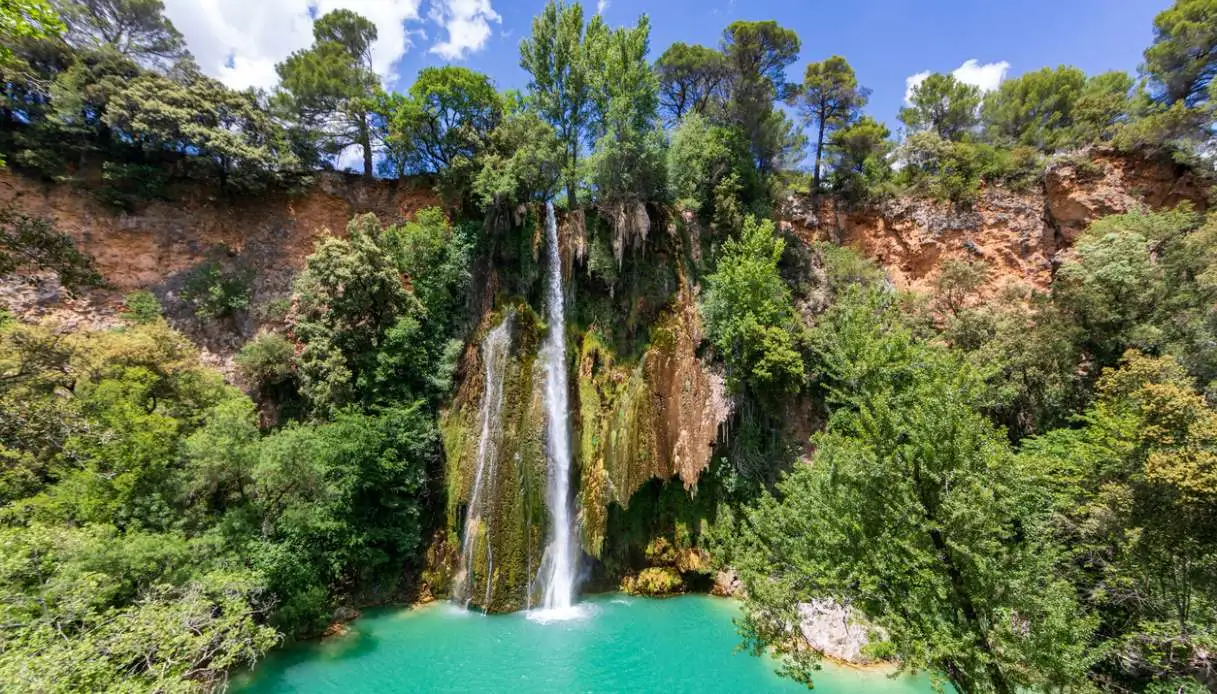
Sillans-la-Cascade is a small village in the southern Var, at the edge of the Verdon territory, a spot that owes its fame mostly to its nature. Just beyond the houses, the Bresque river plunges 44 meters from a travertine cliff and gathers in a turquoise-hued basin, one of those colors that in photography looks retouched and in reality gains even more intensity.
The visual impact comes after a short walk in the coolness of the woods. The sound of the water gradually rises, while between the trunks rosy walls lined with moss, vegetation and roots come into view. Then the waterfall suddenly appears, framed by the forest. The Bresque falls with a white and impetuous leap toward the basin below, creating a contrast that almost seems fake between the warm Provençal rock and the blue-green water.
The village of Sillans-la-Cascade thus brings together two very different attractions: on one side the village, with its fortifications, narrow streets and historic buildings; on the other a fragile natural environment, protected for the value of its geological formations.
Origin and formation of the Sillans Waterfall
The waterfall forms along the Bresque, a river in the Var that runs through a territory characterized by limestone rocks. Its most spectacular element is the travertine wall, a particular sedimentary rock that forms thanks to the action of water rich in calcium carbonate.
The process is slow, but leaves very recognizable traces. Water runs over the calcareous surfaces, progressively deposits minerals and builds incrustations that, over time, become real rock walls. The travertine at the jump displays rosy tones and irregular surfaces, shaped by erosion and the constant presence of water. At the same time, mosses, ferns, small shrubs and roots cling to the walls, accentuating the wild look of the leap.
The undersea pool appears so intense precisely thanks to the combination of depth, reflections and transparency. The color can vary depending on light, season and the flow of the Bresque, but the blue-green tones are the most recognizable feature of the landscape. The comparison with the Verdon arises spontaneously, also due to the geographic proximity to the famous canyon region and Sainte-Croix Lake.
The site is classified as Espace Naturel Sensible and also belongs to the Natura 2000 network, instruments dedicated to the conservation of natural environments of particular value. The travertine walls are fragile and crumbly, with a risk of rockfall. For this reason access to the main basin is prohibited, as is swimming. The prohibition protects both visitors and a delicate ecosystem that faces strong pressure during the summer season.
Visiting the Sillans Waterfall
After several months of work, the belvedere overlooking the waterfall and the left-bank path of this Provençal marvel were reopened on May 8, 2026. The visit follows a forest route, with on-site signage and a tramline of about 800 meters to the viewpoint. The actual time may vary depending on pace and trail conditions, but it is a short hike suitable for a family excursion.
The temperature changes compared to the village, the rustle of leaves accompanies the path and the sound of the Bresque becomes progressively closer. At the end, the belvedere offers a wide view of the waterfall and the turquoise pool, with the travertine wall in the foreground and vegetation climbing the edges of the gorge.
However, the route presents some difficulties to consider: access is not barrier-free and unsuitable for people with reduced mobility or strollers. Sneakers or shoes with good grip are recommended. In summer it is useful to bring water, especially for the return, when the heat can be felt even after a short walk. Dogs are allowed, provided they are kept on a leash, and you must stay on the marked trails.
The most pleasant season to observe the waterfall is spring, when vegetation becomes lush again and the moss on the walls appears especially green and thick. The late spring is also recommended for photography, thanks to the light and the richness of the landscape. In summer, on the other hand, it is essential to check the access conditions related to fire risk.
The visit deserves to continue in the inhabited center of Sillans-la-Cascade, a fortified village with a medieval imprint, with walls, defensive towers and viewpoints that preserve the character of the small Provençal villages. A walk around the ramparts allows you to recognize defensive structures dating back to the 11th century, among stone, battlements and towers that recount a period in which protecting the settlement played a central role.
Where it is located and how to get there
Sillans-la-Cascade is located in the Var department, in the region of Provence-Alpes-Côte d’Azur, about 9 kilometers from Aups and on the edge of the Verdon Regional Nature Park. The village is also about a 20-minute drive from Sainte-Croix Lake, one of the most famous landscapes in the Verdon area.
To reach the waterfall you first arrive at the village, then follow signs for the natural site and for the parking area. The pedestrian route leads from the starting point to the belvedere through the forest. Access is free, but parking is paid in certain periods of the year: the first thirty minutes are free, followed by a tariff of 1 euro every 15 minutes.
Before departure it is advisable to consult the Var fire risk map, especially in the warmer months. Access conditions may vary depending on the danger level and municipal provisions. Also the rules relating to trails and swimming must be followed with care, because the waterfall lies in a protected, fragile and heavily frequented environment.
The village tells Provence through its walls and architecture, while the Bresque reminds us how nature can build spectacular scenery without artifices.