
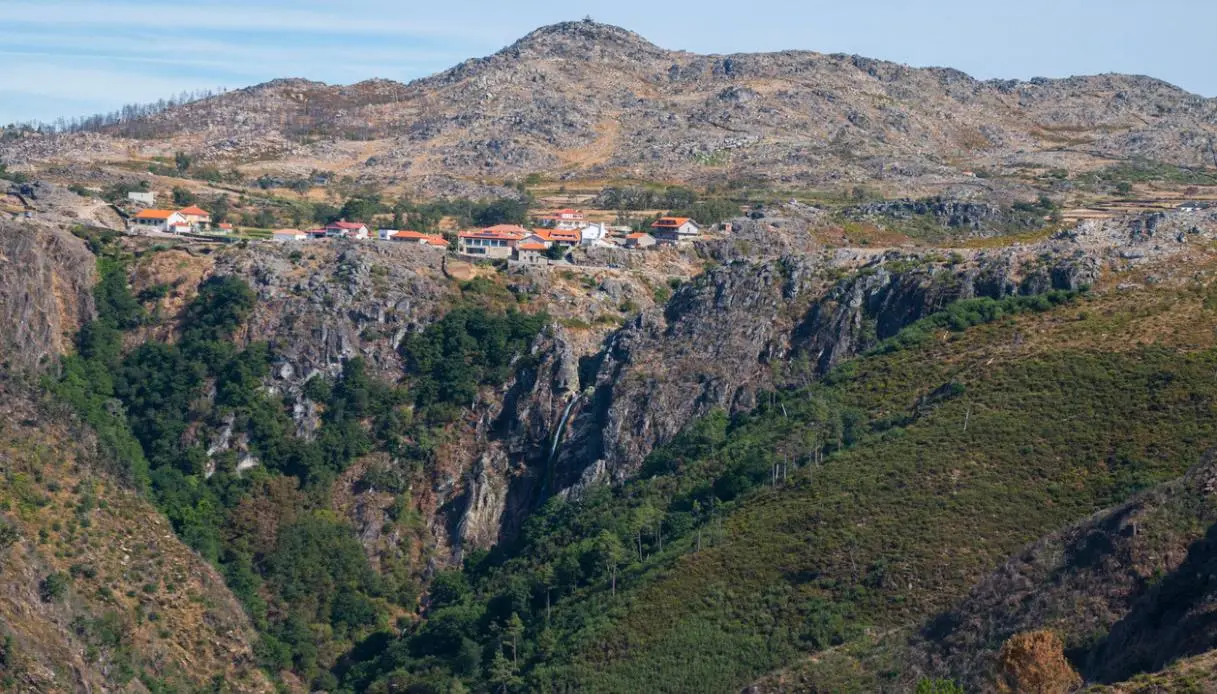
The Serra da Freita, in Portugal, is one of those places with a singular aura: fog appears suddenly, the mountains become indistinct, and the sound of cattle bells seems to come from very far away. Then the gaze settles on the rocks and something immediately unusual reveals itself. Large blocks of granite are scattered on the ground, dotted with small dark forms that seem embedded in the stone.
They are the Pedras Parideiras, literally the “stones that birth,” a name that describes with striking precision the impression the phenomenon leaves. The largest rock is regarded as a kind of mother, while the small dark nodules that detach from its surface assume the role of “children.”
The explanation, of course, belongs to geology, while the suggestion belongs entirely to this remote corner of the country, in the village of Castanheira, within the UNESCO Global Geopark of Arouca.
Origin, Formation and Legends of the Pedras Parideiras
To understand how the phenomenon manifests itself one must observe the stone up close. The surface of the granite shows numerous dark nodules, with sizes ranging from about 1 to 12 cm. On the outside they are made of biotite, a dark mineral belonging to the mica family, while inside they feature a core composed of quartz and feldspar.
The nodules are strongly flattened and align in well-defined orientations within the granite body. Their arrangement preserves a sort of memory of the tectonic forces that acted on the Earth’s crust during the rock’s formation. More than 300 million years ago, the region underwent a highly dynamic geological phase.
The tectonic forces shaped the area, while magma and rock materials contributed to the mountains’ formation. The chemical conditions of the magma, together with movements of the crust, would have favored the formation of the particular nodules embedded in the granite.
The clear explanation of the process remains a subject of study, but one theory considers the possibility that the magma incorporated small mineral aggregates before cooling and solidification. Another hypothesis assigns a significant role to internal pressure, compared by geologists to the effect produced by shaking a closed bottle.
Then time enters the scene: biotite and granite respond differently to atmospheric agents. Rain, wind, temperature fluctuations, freeze-thaw cycles gradually wear down the surrounding rock. The nodules, more resistant, remain embedded for a while longer, until they detach. On the ground appear the small “daughter stones,” often oval and slightly flattened.
According to a legend common in the area, sleeping with a small Pedra Parideira under the pillow would aid conception. The tradition has drawn people from far away, attracted by the hope of finding a particular fertility stone.
During the 20th century this belief had notable consequences, as many visitors carried away the small nodules and, in the 1990s, the accessible surfaces of the rocks were greatly depleted. The folk story, however, remains part of the site’s identity, to the point that the Geopark even developed an experimental program through which some stones may be borrowed for a set period, with the aim of protecting the geological heritage and reducing clandestine collection.
Visiting the Stones that “Give Birth”
The main reference point is the Casa das Pedras Parideiras – Interpretation Center, opened on November 3, 2012. The building was constructed right around the granite outcrop and serves scientific, educational, and tourist purposes. Before observing the rocks outdoors, it is worth going inside.
The explanations help read details that at first glance might seem like simple dark spots on the granite’s surface. Once the nodules are recognized, the stone changes its whole appearance. The path allows visitors to learn the area’s geological history through informational materials and audiovisual content, including a 3D video. The building also houses an auditorium with 30 seats and hosts guided activities periodically.
Outside the center, a wooden boardwalk lets visitors view the outcrop without harming it. The landscape unfolds on an impressive scale: the area touched by the large mother rocks extends to roughly the size of about 10 soccer fields, and among the granite masses the small dark nodules still gleam.
The most curious sensation arrives precisely here. A stone that seemed compact and uniform reveals itself to be full of tiny forms embedded, as if mineralized seeds destined to release themselves very slowly. The visit can also become an opportunity to discover Castanheira and the Serra da Freita landscape.
From the village you can admire Frecha da Mizarela, a spectacular waterfall linked to the Caima River course, while those who wish to delve deeper into the territory can take the PR15 geotouristic route, a 17-km circular itinerary across the Serra da Freita plateau.
The landscape belongs to the so-called Montanhas Mágicas, the Magic Mountains of Portugal. Between pastures, rock outcrops, and high plains, one may encounter the cattle of the Arouquesa breed and the dogs that accompany the herds.
A fundamental recommendation: the small Pedras Parideiras belong to the area’s protected geological heritage. Taking one away as a souvenir means depriving a rare phenomenon of a fragment of a site studied by the scientific community. Photography remains therefore the most respectful memory.
Where They Are Located and How to Reach the Pedras Parideiras
The Pedras Parideiras are located in the village of Castanheira, on the Serra da Freita, within the municipality of Arouca, in northern Portugal. The site is part of the Arouca UNESCO Global Geopark, a vast territory recognized for its geological heritage.
From Lisbon by car, the trip takes about 3 hours, depending on the route and traffic conditions. The locality is just a short distance from Arouca, the main hub of the area and a convenient starting point to organize a visit to the Serra da Freita. The road gradually leaves the towns and moves toward a more open landscape, made of plateaus, pastures, and mountains.
Once in the village, the Casa das Pedras Parideiras becomes the main reference for the visit. From there the boardwalk allows direct observation of the granite outcrop.
If science explains their origin through minerals, pressure, magma, and erosion, the ancient name continues to suggest a much simpler and more powerful image: a mountain that, with a measured pace spanning millions of years, still seems to birth stones.