
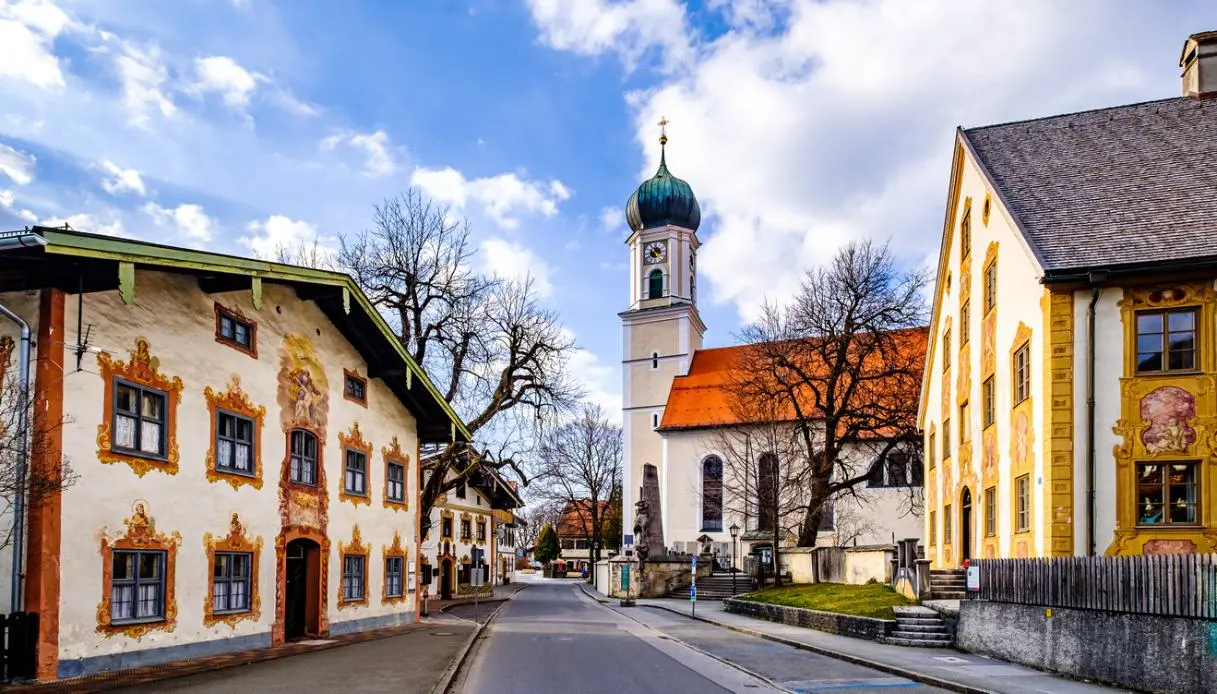
Rising at an altitude of around 840 meters, amid the forests and peaks of the Ammergau Alps, Oberammergau presents the orderly silhouette typical of Bavarian villages. Yet it reserves a singular feature capable of transforming how you experience a visit: the façades of the houses narrate stories through painted figures, illusionistic frames, and religious scenes, while from the workshops emerge crucifixes, nativity scenes, and sculptures crafted according to an ancient artisanal tradition.
The town sits in Upper Bavaria along the Deutsche Alpenstraße, the German Alpine Road, a scenic route that traverses the southern Alpine region up to the Austrian border. Its international fame, however, stems from a vow. In 1633, during the Thirty Years’ War, the inhabitants pledged to perform the Passion of Christ if they were spared from the plague. The first performance took place in 1634, and since then the tradition has become a core part of the community’s identity.
Apart from the grand religious event, Oberammergau preserves a more everyday aspect: painted houses, woodcarving workshops, small squares, and paths that wind toward the alpine landscape.
What to See in Oberammergau
In this German town, even a side façade, a storefront sign, or a tiny sculpture can tell the story of the link between faith, craftsmanship, and local life.
The Church of St. Peter and Paul
The Pfarrkirche St. Peter und Paul, dedicated to the apostles Peter and Paul, is one of the most evocative religious buildings in Upper Bavaria. The current edifice dates from the eighteenth century and was designed by the master Johann Schmutzer, a native of Wessobrunn, a center renowned for its stuccoists.
The exterior, characterized by pale tones and a bell tower crowned with the traditional onion-shaped roof, gives way to a far richer interior, where the main altarpiece stands as one of the building’s most precious works. Equally noteworthy is Matthäus Günther’s altarpiece depicting the rosary in prayer before the Virgin Mary, flanked by statues of the saints.
The Painted Houses and Lüftlmalerei
The most recognizable feature of Oberammergau is the Lüftlmalerei—a German term that translates roughly as “air painting.” This Bavarian decorative technique is applied directly to building façades, featuring religious scenes, biblical episodes, fairy-tale figures, ornamental motifs, and depictions of traditional life.
The result is a painted architecture, where windows, columns, and decorations can appear three-dimensional. The walls seem to unfold a narrative larger than the house itself, turning the town center into an open-air gallery.
Among the best-known examples is the Pilatushaus, built in 1774–1775 and regarded as one of the masterpieces of Ammergau mural painting.
The Woodcarvers’ Workshops
The wood art that defines the locality is another signature. The residents were already celebrated in the sixteenth century for the quality of their works, and with the decline of trade that once spurred the town’s growth, many returned to carving.
The Herrgottsschnitzer, a German term meaning “carvers of God,” are chiefly linked to the production of crucifixes, sacred statues, and devotional objects. Wandering through the town’s streets, shop windows display saints, nativity scenes, animals, and decorative pieces of various sizes.
Oberammergau Museum
The Oberammergau Museum gathers testimonies of the local history and the artisanal tradition. Its collections include wooden sculptures, religious objects, nativity scenes, decorative glass, and artifacts from different eras.
One of the most intriguing aspects is the link to wood art, documented through works spanning from the Gothic period to contemporary times. The museum also houses an early nativity scene composed of numerous sculptures, once admired by Bavarian king Ludwig II.
The Passion Theater
The Passion Theater is the venue for the major, decennial performance. The present building dates to 1930 and can accommodate thousands of spectators.
Designed to host a show of considerable scale, it retraces the last days of Jesus’ life, from His entry into Jerusalem to the crucifixion and the resurrection.
The Crucifixion Monument
On a small rise at the edge of the center stands the Kreuzigungsgruppe, the Crucifixion Monument. The piece was donated to the community by King Ludwig II of Bavaria after witnessing a Passion performance in September 1871.
The sovereign personally chose the site, the materials, and the artisans commissioned for its execution. The monument, blessed on October 15, 1875, reaches about 12 meters in height and portrays Christ on the cross, flanked by the Virgin Mary and the Apostle John.
The Marian Grotto
Among the lesser-known attractions worth mentioning is the Marian Grotto, a grotto dedicated to the Virgin Mary located near the cemetery on the slopes of Kofel. Built in the early twentieth century, it was realized by the husband-and-wife pair Dominikus and Anna Schilcher.
According to tradition, Anna suffered from a serious illness for nine years and vowed that, if she recovered, she would build a Marian grotto inspired by Lourdes. After her condition improved, the couple kept their vow.
What to Do in Oberammergau
Beyond visiting the sights, Oberammergau invites you to spend time with its traditions and its landscape.
- Buy a wooden sculpture: to take home an object connected to a centuries-old craft tradition.
- Visit Käthe Wohlfahrt’s shops: a particularly pleasant stop during the Christmas season. The Dorfstraße locations offer decorations, toys, nativity scenes, and ornaments inspired by German tradition.
- Explore the town during Advent: a chance to encounter craft stalls, decorations, and seasonal specialties at the Christmas markets.
- Reach the surrounding alpine areas: a way to mix cultural sightseeing with hikes through forests and trails.
- Join König Ludwig Feuer: if your visit coincides with August 24, you can witness the traditional celebration dedicated to Ludwig II.
Where It Is and How to Get There
Oberammergau lies in Upper Bavaria, within the district of Garmisch-Partenkirchen, at an altitude of roughly 840 meters. The village sits about 4 kilometers from the Ettal Abbey, 6 from Linderhof Castle, and under 10 kilometers from Garmisch-Partenkirchen.
From Munich, driving typically takes around 1 hour and 15 minutes, depending on traffic. The main route follows the A95 south, continuing toward Oberau and then along the B23 into the town. By train, Oberammergau is served by the local Ammergaubahn line, with connections from Murnau am Staffelsee.
Oberammergau thus remains a destination capable of combining art, faith, craftsmanship, and Alpine scenery.
