
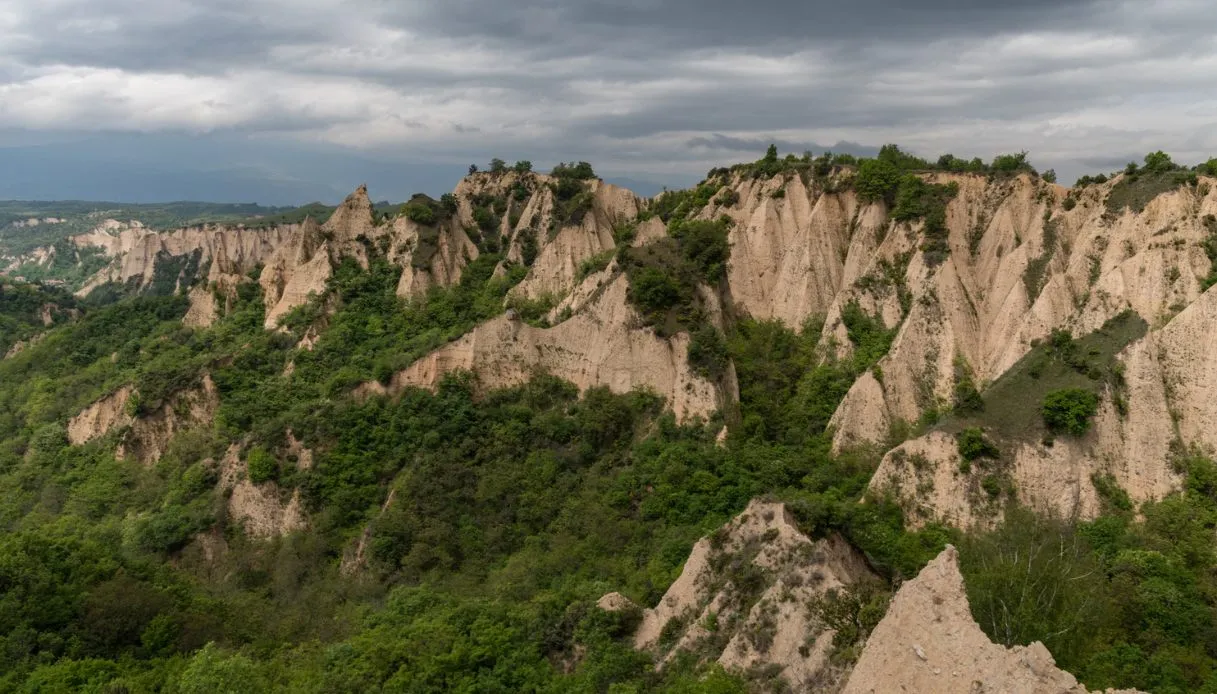
As you pass through vineyards, small villages and ever more rugged slopes of Bulgaria, the Pirin Mountains rise in the distance, while the pale forms of the rocks begin to emerge from the vegetation. At a certain point, a vast expanse of sand-colored pinnacles, tall and slender, with walls carved by deep grooves, opens before the eyes. They are the Melnik Pyramids, a large geological formation that covers about 50 square kilometers and comprises three main groups: those of Melnik, Karlanovo and Rozhen.
Here the rocks take profiles that recall Egyptian pyramids, obelisks, minarets, alpine crests, stone mushrooms and even Gothic spires. Some seem like architectures left unfinished by a colossal mason, while others have a softer form, with tufts of grass on their summits and trees gathered at their bases.
Melnik, the smallest urban center in the country, adds a second level to this experience: the town appears squeezed in the valley, surrounded by the rock formations and the slopes of the Pirin.
Origin, formation and legends of the Rozhen Pyramids
The story of the pyramids begins long before human arrival on this fascinating planet. The formations are mainly composed of sedimentary materials, ranging from sandstone to clays, shaped over a very long time by atmospheric agents. Rain, wind and variations in environmental conditions progressively wear away the slopes, removing the most fragile material and leaving the more resistant parts exposed.
The result is a morphology in continuous transformation. An even slope can be eroded until it becomes a jagged wall; a crest can take on the appearance of a blade; a rock column can remain isolated while the surrounding ground is slowly worn away. The same erosion that builds the spectacular image of the landscape thus also determines its fragility.
< /ask-ai-widget>
In 1960 the entire Melnik Pyramid complex was declared a natural monument. The Rozhen formations constitute one of the most evocative parts of this ensemble, especially for the variety of shapes and for the direct relationship with the surrounding rural landscape.
Particularly striking are also the pyramids near Karlanovo, with obelisks that reach about 100 meters in height and very steep walls. To the south of the village of Rozhen, large and small elevations appear that often take the form of gigantic stone mushrooms.
A place like this (not to say the least) almost seems to invite a fantastical explanation. It should come as no surprise that legends surrounding Bulgaria’s treasure have sprung up about its origin: various stories attribute these shapes to giants turned to stone after a divine punishment. There are also tales evoking an ancient flood, capable of leaving behind walls and pinnacles after the waters receded.
Looking at the spires from the valley floor, the sense of facing something almost unreal comes naturally.
The visit among spires, trails and panoramas
The visit acquires value especially when you leave the valley floor for a few hours and reach the viewpoints on the slopes. The trails cross terrain shaped by erosion, with steep stretches and surfaces that can become slippery. Good shoes are essential, but so is a careful pace (especially after rain).
The ascent gradually offers a different perspective. From below the pyramids appear as a compact cluster of spires; from above you can pick out crests, gorges, natural terraces and isolated columns. And then there is the light, which changes the scene considerably: at midday the pale tones of the sandstone prevail, while toward evening the walls take on golden, orange and reddish hues.
The shapes even vary from one vantage point to the next, while the vegetation introduces green patches among the bare rock surfaces. In places the silhouettes evoke medieval towers; a little further on they resemble blades, hats or gigantic mushrooms.
The Melnik nature trail forms a 6-8 km route, with generally moderate climbs and several viewpoints. A broader itinerary also reaches the Rozhen Monastery, creating a particularly interesting link between nature and historical heritage.
The visit can therefore start from Melnik, proceed among the pyramids and reach the village of Rozhen. Along the way there are also historical signs scattered in the valley, among churches, monasteries and the remains of the Slavova fortress, originally built during the Byzantine era.
To Rozhen, a detour to the Rozhen Monastery is well worth it, one of the most important historical sites in the area. The complex sits on a high vantage point and adds an architectural element to a landscape already dominated by stone.
Melnik also deserves time: the town achieved notable commercial importance between the 18th and 19th centuries, when wine, timber and crafts were sent to European and Ottoman markets. The traditional houses still bear the imprint of that prosperity.
Where they are located and how to get there
The Rozhen Pyramids are located in southwestern Bulgaria, near the eponymous village, not far from Melnik, in the Blagoevgrad region. The area forms part of the Pirin landscape, one of the country’s main mountain ranges. From Sofia you follow the international route toward Kulata, then take the turn indicated for Melnik.
The last stretch crosses about 13 km of rural scenery dotted with villages, farms and vineyards. Just before Melnik, near Lozenitsa, the first large light-colored surfaces of the pyramids become visible. Melnik represents the most practical base for exploring the area, because the town has connections with Sofia and with larger regional centers, including Blagoevgrad, Sandanski and Petrich.
For those arriving by car, the road allows you to reach directly the village area and to organize the visit by combining the pyramids, the monastery and the historic center of Melnik. After sunset the movement slows, the valley becomes quiet and the mountains change color.
It is precisely then that the Rozhen Pyramids reveal their most distinctive character: by day they seem an extraordinary geological anomaly; by night they become almost a natural stage, with spires and crests standing out against the Pirin sky.