
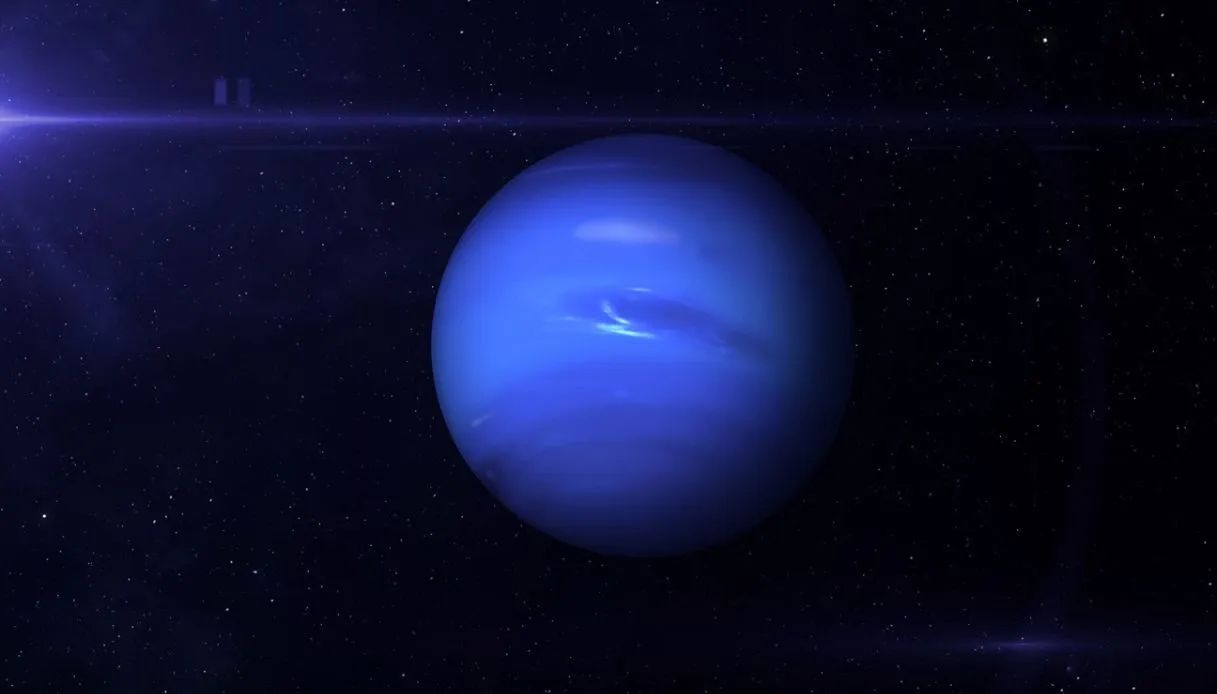
September brings one of the most anticipated moments for astronomy enthusiasts: the best chance of the year to observe Neptune. The outermost planet of the Solar System, a frozen giant with the typical deep blue hue, will indeed reach its opposition on September 26, 2026, the moment when it appears highest, brightest and most visible for the longest time in the night sky.
You don’t need a professional observatory to feel the thrill of spotting it: a mid‑power binocular, sufficiently dark skies, and a bit of patience are enough.
September 26, the perfect alignment with Neptune
On September 26, 2026, the Sun, the Earth and Neptune will lie on the same line, with the Earth in the middle: a 180° alignment that astronomers call an opposition. In this phase the planet rises at sunset, remains visible all night and culminates, i.e., reaches its highest point above the horizon, in the heart of the night, i.e., ideal conditions for any observation.
For Neptune, the opposition also coincides with the moment of minimum distance from Earth, about 4.3 billion kilometers: a figure that seems enormous, but that represents the closest possible approach between the two planets. Despite this, spotting it with the naked eye remains impossible, because its brightness is just beyond the limit perceptible by the human eye. With a binocular, however, the planet reveals itself as a small point with the characteristic blue-azure color, clearly distinguishable from the background stars.
A handy trick to orient yourself is to look for Saturn first, visible even without instruments as a clear and steady disk, free from the twinkling typical of stars. Neptune lies a few degrees away, in the region of sky shared by the constellations Pisces and Cetus (the Whale). Smartphone sky-mapping apps, once calibrated, help narrow down the field and confirm the exact spot to frame.
Where to admire the phenomenon in Italy
The success of the observation depends mainly on one factor: light pollution. Getting away from cities and reaching areas certified for the quality of the night sky makes a huge difference in the sharpness of the view.
Among the most suitable destinations is Isnello, in the Madonie Park, in Sicily: its Gal Hassin Astronomical Park has earned the certification “Starlight Stellar Park” from the Fundación Starlight and is already a regular destination for stargazers thanks to some of the darkest skies in the Mediterranean. In Puglia, Alta Murgia offers wide plateaus free of nearby inhabited centers, perfect for setting up a portable telescope and observing the southern horizon without obstacles.
In Abruzzo, the plateaus of the Gran Sasso National Park and Monti della Laga, particularly the Campo Imperatore area, have for years been a benchmark for those seeking clear high-altitude skies.
Those who prefer to rely on professional instruments and an expert guide can head to the Piombino Astronomical Observatory, in Tuscany, where on September 26 the Piombino Amateur Astronomers Association organizes “La Festa della Luna,” an evening of public observing with telescopes open to all, dedicated to the protagonists of the autumn sky.