
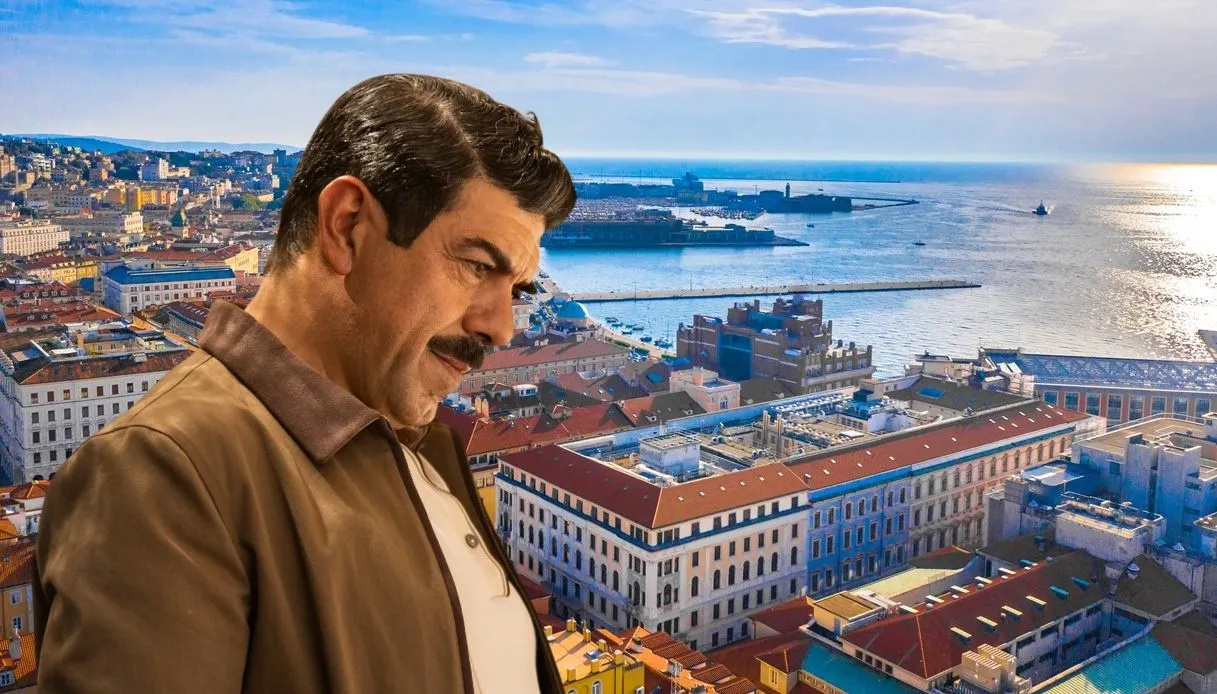
The Napoli – New York locations add realism to a story that is already conceived as a disenchanted snapshot of Italy in the 1940s: the film by Gabriele Salvatores, featuring Pierfrancesco Favino, slated to air exclusively on Rai 1 on Thursday, September 17, 2026 at 21:30, was shot indeed between Naples and Trieste, in places so symbolic for Italians who in the postwar years decided to leave for America and chase their fortune.
What is it about
It is 1949. Carmine and Celestina manage, thanks to a sequence of fortunate events, to clandestinely embark on an ocean liner bound from Naples to the United States. Their hope is to escape the misery that the war has left the city in, but also to find Celestina’s sister who had already departed for America to keep faith with a promise made to an American boy.
During the voyage they will experience moments of joy and others of hardship, and, above all, they will meet people destined to change their lives. The film, released in theaters in 2024, is based on a story by Federico Fellini and Tullio Pinelli.
Where the film was shot
In keeping with the story of Carmine and Celestina, so similar to that of many Italians of the era, the film is set between Naples and New York: the destruction left by the war in Southern Italy contrasts onscreen with an American dream of tall, modern buildings, shops open at any hour of the day or night, and abundant prosperity.
Naples
The Neapolitan scenes that populate mainly the first part of the film were shot in the historic center of Naples: among alleys, districts, courtyards where time seems to have stood still and the city continues to present itself authentically, even in its wounds.
In the port district, scenes were filmed where the two youngsters try to sell contraband cigarettes alongside their companions, ask for a pizza on credit, and beg money from tourists for an improvised dance.
Other scenes were shot in the Sanità district, one of the city’s most authentic neighborhoods, often chosen in recent years to depict on screen a Naples of yesteryear but never truly past. Here stands, for example, Palazzo Sanfelice: a 18th-century palace with twin portals in piperno and marble, very similar in architecture to the nearby and more famous Palazzo dello Spagnolo, once home to the family of architect Ferdinando Sanfelice, where, in addition to some scenes from Salvatores’ film, old and modern classics of Neapolitan cinema were shot.
In many frames the Spanish Quarters (Quartieri Spagnoli) are recognizable with their labyrinth of narrow streets, crowded with tourists, locals, simple trattorias, low rooms, and artisan shops.
Along the equally iconic Via dei Tribunali, some scenes were filmed at Piazza Cardinale Sisto Riario Sforza: a square that once led to a side entrance of the Cathedral, today recognizable for the tall obelisk dedicated to San Gennaro.
The dock from which the transatlantic liner carrying Carmine and Celestina departs is, in the end, Molo San Vincenzo: one of the historic docks of the Port of Naples, which over the centuries has undergone various redevelopment and refurbishing projects.
Trieste
The true surprises among the Napoli – New York locations come, however, from Trieste: the film’s production design team and crew artfully transformed the capital of Friuli-Venezia Giulia into 1940s New York for almost all the scenes, and they are numerous in the second part, set in the United States. This, undoubtedly, is connected to Trieste’s Mitteleuropean vocation, which has always made it one of the most international of Italian cities, as many online commentators have noted.
Among the places where Salvatores’ film with Pierfrancesco Favino was shot in Trieste is the Porto Vecchio: the main gate, the passenger terminal, and the piers’ quaysides are clearly recognizable on screen.
Another instantly recognizable Trieste location is the Savoia Excelsior Palace: the hotel’s imposing façades facing the sea evoke the grand buildings on the other side of the ocean.
In downtown Trieste, the film’s production transformed several historic businesses—such as Drogheria Toso, Pasticceria La Bomboniera, and Antico Caffè San Marco—into American shops: the surroundings of Piazza San Giovanni, long the city’s commercial heart, hosted mainly this type of shooting.
In some shots appear buildings that symbolize the city’s past, especially its economic and industrial heritage, such as Palazzo Berlam (known locally as “the red palace”), the former Stock plant (home of the eponymous liqueur brand), Palazzo Vivante and Palazzo Carciotti (both once belonging to prominent local aristocratic families).
The Church of Sant’Antonio Taumaturgo, one of the most recognizable landmarks in Trieste’s historic center thanks to its Ionic-columned façade, was transformed by the production into the American courthouse where one of the film’s protagonists’ trial takes place.
The most cinematic of Trieste’s Napoli – New York locations is undoubtedly the Salone degli Incanti: Trieste’s former central fish market, built in the early 20th century with an eclectic style and a shape reminiscent of a Roman basilica, today mainly used as an exhibition space but over the years has been a set for important film productions such as The Godfather Part II.
Cinecittà
The film by Gabriele Salvatores with Pierfrancesco Favino also features studio scenes and sequences shot in studios: at the Cinecittà studios in Rome, to be precise.
Rijeka
There is, finally, Rijeka in Croatia among the locations where Napoli – New York was filmed. In the former city of Fiume, where the influence of Italian culture remains strong, scenes of the Little Italy party that Celestina and Carmine attend soon after disembarking in America were shot.
In the Croatian port city, in particular, the ship Galeb stayed docked for the entire duration of filming, and in the film it is the vessel on which the two protagonists embark in search of fortune and affection across the ocean. It is a historic vessel, once beloved as a maritime refuge by General Tito and later restored and incorporated into the Croatian fleet.